

A chemical anchor – also called a bonded or injection anchor – fixes a threaded rod or a reinforcing bar into a drilled hole with an injectable structural resin. Instead of expansion pressure, the load is carried by the bond between the resin, the steel and the surrounding concrete or masonry, which makes chemical anchors the first choice for close spacings, small edge distances, cracked concrete, seismic loads and post-installed rebar connections.
What is a chemical anchor?
In a bonded anchor the drilled hole is cleaned, filled with a two-component resin and the steel element is inserted while the resin is still fluid. As it cures the resin keys into the roughness of the hole wall and grips the steel, transferring load along the whole embedment depth rather than at a single expansion point. Because there is no expansion force, chemical anchors can be placed closer together and nearer to an edge than mechanical anchors, and they perform well in cracked concrete when the resin carries a European Technical Assessment (ETA) for that use. For the full background, see our guide on what a chemical anchor is and the types available.
ADIT supplies a complete range of injectable resins under ETA – from pure-epoxy systems for the most demanding cracked-concrete, seismic and rebar applications, through fast-curing hybrids, to economical polyester adhesives for uncracked concrete and masonry. The families are compared below, and a quick selection table appears at the end of the page.
Choosing the right adhesive
Four questions decide the adhesive: the base material (cracked or uncracked concrete, solid or hollow masonry); the load (static, seismic C1–C2, or fatigue); whether you are fixing a threaded rod or a post-installed reinforcing bar; and the site conditions – hole temperature, in-service temperature and whether the hole is dry, damp, water-filled or underwater. Temperature is the factor most often overlooked: it changes both the working (gel) time and the full curing time, sometimes by hours – see our chemical-anchor curing and gel-time tables by temperature. For a step-by-step walk-through, read how to choose the right chemical anchor.
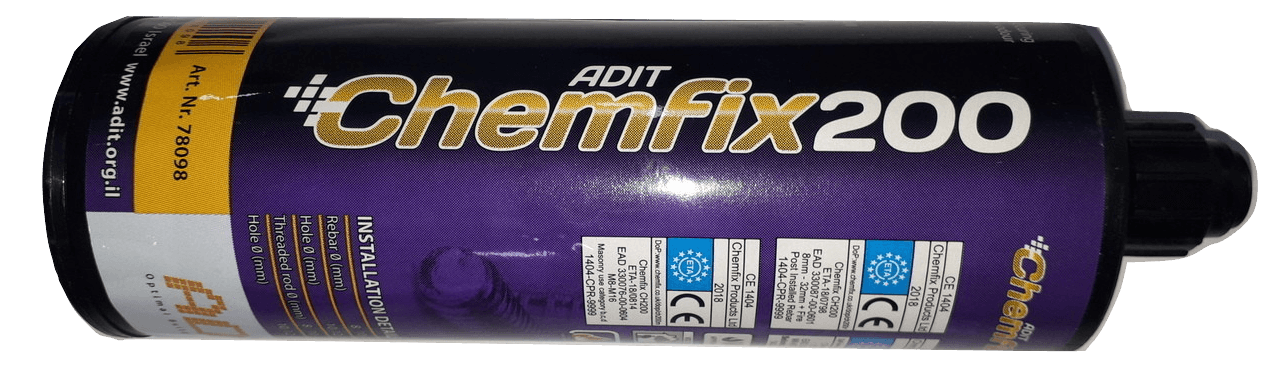
Cracked concrete needs an Option 1 assessment. Most concrete in tension is cracked at the anchor location. Only a resin whose ETA covers cracked concrete (Option 1) – such as AC500 V4, Chemfix100 or Chemfix200 – may be relied on there; polyester adhesives assessed for uncracked concrete only (Option 7) must not be used for structural fixings in the tension zone.
Chemical Adhesives
Injectable resins for threaded rods and rebar – pure epoxy, hybrid and polyester, with European Technical Assessments.



Hollow Blocks

Accessories

Selection Guide
| Your condition | Recommended adhesive |
|---|---|
| Cracked concrete | AC500 V4 · Chemfix100 · Chemfix200 |
| Seismic loads (C1 / C2) | AC500 V4 · Chemfix100 · Chemfix200 |
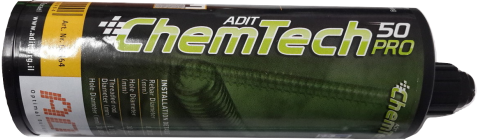
| Uncracked concrete & masonry | CT50Pro · PESF |
| Hollow blocks | Chemical Anchor for hollow blocks |
| Standard silicone gun on site | PESF |
| Rebar (post-installed reinforcement) | AC500 V4 · Chemfix100 |
Chemical anchors – frequently asked questions
How long does a chemical anchor take to cure?
It depends almost entirely on temperature. The resin first reaches its working (gel) time – after which the rod must not be moved – and then a longer full curing time before it may be loaded. Both shorten in heat and lengthen in cold; full tables are in how long a chemical anchor takes to cure.
Epoxy, vinylester or polyester – what is the difference?
Pure epoxy gives the highest bond strength and the best performance in cracked concrete, seismic loads and rebar, with a long working time; hybrids and vinylester cure faster and still cover cracked concrete; polyester is economical for uncracked concrete and masonry. The families are explained in the chemical-adhesive families guide.
Can I use a chemical anchor for post-installed rebar?
Yes – a bonded reinforcing bar is designed differently from a bonded rod. The three accepted calculation approaches are set out in 3 methods for calculating post-installed rebar with chemical adhesive.
Can chemical anchors be installed in wet or underwater holes?
Some resins are assessed for damp, water-filled or even underwater holes, with stricter hole preparation. See underwater chemical anchoring.
Why can’t I anchor into fresh concrete?
Young concrete has not developed its strength or its final crack pattern, so anchor performance is not yet valid – the reasoning is in why you must not install a chemical anchor in young concrete.