

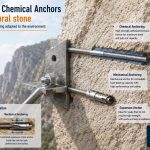
How to design an anchor connection in a natural stone wall
12 בJuly 2026
Wedge anchor or concrete screw: which should you use, and when?
12 בJuly 2026How to design an anchor connection in a natural stone wall
12 בJuly 2026Wedge anchor or concrete screw: which should you use, and when?
12 בJuly 2026What Is a Chemical Anchor, and What Types Are There?
To make a connection in construction you have two options: a mechanical one or a chemical one. As the technology advances, the chemical connection becomes steadily more attractive — here is what it is, how it is installed, and which adhesive family to use.
Why chemical anchoring matters in construction today
To make a connection in construction there are two options: a mechanical connection or a chemical one. As the technology has advanced, the chemical connection has become steadily more attractive.
What is a chemical anchor?
A chemical anchor is a threaded rod, or a reinforcing bar (a “dowel”), bonded with a chemical adhesive — still commonly called “epoxy”, a legacy of the days when these adhesives were all epoxy-based — into a base material such as concrete, hollow block, solid block or asphalt. The adhesive normally has two components that must be mixed to activate the bond. Unlike a mechanical anchor, which relies on friction or expansion, a chemical anchor relies on adhesion between the base material and the rod.
The three installation technologies
- Hand-mixed — two separate components are mixed by hand out of two tubs, in the ratio the manufacturer specifies, the adhesive is poured into the drilled hole, the rod is pushed into the filled hole, and you wait for it to cure. An outdated method, prone to human error in the mixing ratio.
- Glass capsules — a capsule is placed in the hole. With hammer-in capsules the rod is driven in with a hammer; with rotary capsules the rod is fitted to a drill and screwed in.
- Injection — the adhesive is supplied in a rigid plastic cartridge — some suppliers offer a flexible foil tube — together with a dispensing gun and a static mixing nozzle. This is the most common, safest and most accurate technology in use today.
The adhesive families compared
Matching the adhesive to the application is critical to the success of the anchoring.
| Adhesive type | Characteristics and curing | Durability / extreme cases | Rating |
|---|---|---|---|
| Polyester | Cheapest; tends to shrink slightly | Not for heavy loads or long-term wet | Light applications only |
| Epoxy-acrylate | Properties and price identical to polyester; fast curing | Basic durability; less pungent smell | Basic applications |
| Vinylester (hybrid) | Fast cure (about half an hour to an hour), no shrinkage | Suits seismic, higher temperatures, diamond drilling, wet holes | Excellent all-rounder |
| Epoxy (pure) | Slow cure — long working time | Best bond, especially at large diameters and depths | Best for heavy loads |
1. Polyester (e.g. Adit CT50Pro)
The cheapest material, and suitable for most applications — but it shrinks slightly during curing, so it is not recommended for underwater installations or for critical loads. Polyester adhesives are sold both with and without European approvals (some are carcinogenic, others benign). It is the cheapest category, and also the most unruly.
2. Epoxy-acrylate
Frequently confused with epoxy, and unjustly regarded as better: in practice its properties and its price are identical to polyester. The one real difference is that it usually gives off fewer pungent fumes during injection (styrene-free) — from an engineering standpoint the advantages are negligible.
3. Vinylester, or “hybrid” (e.g. Adit Chemfix200)
A more sophisticated adhesive that also suits extreme cases — seismic action, higher temperatures, diamond drilling and more. Vinylester-based adhesives have excellent chemical resistance, cure quickly, and do not shrink in the borehole, which allows a full bond that seals the hole even in wet conditions. Adhesives in this family generally carry advanced approvals and properties, but the characteristics stated for each individual product should still be checked.
4. Epoxy, pure (e.g. Adit Chemfix100)
The best choice for heavy loads and for installing rebar dowels at large embedment depths. In its properties it is fairly similar to vinylester, apart from its slower curing — a very useful characteristic on large anchors, because it gives the engineer and installer a longer working (gel) time before the adhesive sets. The best advanced epoxies offer slightly higher bond properties than vinylester, particularly at large diameters.
Caution — approvals and certificates (ETA)
The chemical anchor market is full of products of widely varying quality. There are many kinds of injectable epoxy adhesive, and there are also far poorer adhesives with no approvals at all.
The absence of an approval — a European ETA, or a seismic certificate — can lead to catastrophic failure under significant load. Always confirm that the adhesive you hold is backed by technical documentation from a recognised assessment body, and that the approval actually covers the case you are designing: the substrate, the diameter, cracked or uncracked concrete, and the drilling method.
Common questions
How do you install a chemical anchor in a hollow block, such as Ytong or pumice?
Inject straight into a hollow block and the adhesive simply runs away into the internal cavities without gripping the rod at all. In that situation a mesh sleeve, plastic or metal, is mandatory. You place the sleeve in the hole, inject the adhesive into it, and as the rod goes in the adhesive is pushed out through the small openings in the mesh, forming a wide key that locks against the sound webs of the block.
How do temperature and working time interact?
The two main factors that decide how fast the adhesive cures are the type of adhesive and the ambient or concrete temperature. As explained above, pure epoxy adhesives cure slowly. The higher the temperature — an Israeli summer, for instance — the faster the reaction and the shorter the working time. In cold conditions curing is slow, sometimes needing many hours before the anchor can be loaded.
Does the borehole have to be cleaned before injecting?
Always, without exception. Uncleaned boreholes are one of the most common causes of anchoring failure. Use a steel brush and an air pump (blower) to clear the drilling dust from the walls at least twice; dust left in the hole stops the adhesive bonding to the concrete and can cut the load capacity by tens of percent.