

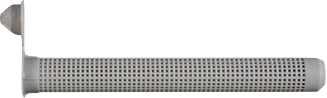
Chemical Anchor for Hollow Blocks
Sleeves, mesh sleeves and female anchors for chemical anchoring into hollow block – in any base material.
Why Does a Hollow Block Need a Sleeve?
In a hollow block the chemical resin has nothing to grip: it simply runs into the internal void and disperses. The result is wasted resin and virtually no holding power.
The solution: a sleeve or mesh inserted into the hole before injection. The resin is injected into the sleeve, forces its way out through the perforations, and spreads behind the wall of the block – forming a “chemical rivet” that locks the anchorage.
The Three Solutions
Plastic sleeve (male)
For anchoring a threaded rod or bolt. Available in M12x50, M16x85, M16x130, M20x85.
Mesh sleeve (male)
A long mesh sleeve, cut to length as needed. Available in M12x1000, M16x1000, M22x1000.
Female anchor for block
An internal thread inside the block – the element is screwed in after the anchorage. Available in M6/12×50, M8/16×85, M10/20×85, M12/20×85.
Which Resin Should You Use?
The adhesives in the Adit catalogue holding an ETA approval for masonry:
| Adhesive | Type | Suits |
|---|---|---|
| CT50Pro | Polyester | Uncracked concrete and blocks – the common, economical choice |
| PESF TOP | Polyester | The same adhesive, for a standard silicone gun |
| Chemfix200 | Hybrid | Blocks and also cracked concrete and seismic loads |
Files to Download
- Guide to chemical anchoring in a hollow block
- Chemical anchoring in blocks – technical data (1)
- Chemical anchoring in blocks – technical data (2)
Videos
Frequently Asked Questions
Can resin be injected straight into a block without a sleeve?
No. The resin will run into the internal void of the block, disperse, and form no grip. The sleeve or mesh is what holds the resin in place and lets it spread behind the wall.
What is the difference between a plastic sleeve and a mesh sleeve?
The plastic sleeve comes in fixed sizes. The mesh comes in a one-metre length and can be cut to the wall thickness – more flexible, and suited to blocks of non-standard thickness.
When should I choose a female anchor for block?
When the suspended element must be installed after the anchorage, or when it needs to be replaceable later without touching the anchor – for example when suspending pipework or cabinets.