

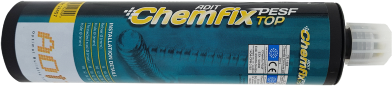
PESF TOP Chemical Anchor
Injectable polyester chemical anchor with European ETA7 approval — for concrete and hollow blocks, in a cartridge that fits a standard silicone (caulking) gun.
The Adit chemical anchor family
Choose the right adhesive for your load, substrate and approval requirements.
Technical specification
| Property | PESF TOP — polyester chemical anchor, European approval |
|---|---|
| Adhesive type | Polyester |
| Technology | Injectable chemical anchoring |
| European approval | Yes — ETA7 for concrete (15-0008) · ETA for masonry (19-0496) |
| Separate ETA approvals | 2 — concrete and hollow block |
| Tested rebar | Up to Ø25 mm rebar |
| Wet hole | Yes |
| Fire rating | Yes |
| Green certification | Yes — LEED |
| Gun | Standard silicone (caulking) gun — no dedicated injection gun required |
| Applications | Anchoring in concrete and hollow block |
Downloads
Installation & field pull-out test videos
Polyester chemical anchor: the complete guide
Everything you need to know about the polyester chemical anchor — from the working principle, through installation in concrete and hollow blocks, to the projects it serves. This guide was written by the experts at Adit Ltd., the largest chemical-anchor company in Israel.
What is a polyester chemical anchor and how does it work?
A polyester-based chemical anchor is a two-component system made of a polyester resin and an accelerator (hardener). When the two components are mixed inside the static mixing nozzle, a chemical reaction immediately begins, producing a rigid polymer that bonds powerfully to the base material — concrete, blocks, stone and rock.
During installation the anchor is injected into the drilled hole, and then the threaded rod (ATR) or reinforcing bar is inserted. After curing, a solid, reliable connection is formed that withstands heavy loads and applies no expansion pressure to the walls of the hole.
The best-selling chemical anchor in Israel
PESF TOP is a premium polyester chemical anchor with European ETA7 approval — for both concrete and hollow blocks. In terms of formulation and approvals it is the exact same adhesive as CT50Pro, but packaged in a compact 300 ml tube that fits a standard silicone (caulking) gun. Its field advantage is clear:
- European ETA approval — meets the stringent European standard for concrete and for masonry.
- Competitive price — the most cost-effective solution in the premium chemical anchoring category.
- Maximum versatility — suitable for concrete, stone and solid blocks, and ideal as a chemical anchor for hollow blocks.
- Fast curing — loads can be applied within about 8–12 hours at 20°C, and even faster in the Israeli summer.
- Standard silicone gun — no need to carry a dedicated, heavy injection gun.
- Proven experience — used in thousands of public and private projects in Israel and worldwide.
Chemical anchor for hollow blocks — the solution that works
One of the most notable advantages of PESF TOP as a chemical anchor is its proven ability to work efficiently and safely in walls made of hollow blocks (such as Ytong, pumice or “black” block).
Unlike mechanical anchors that cannot fix themselves inside the block’s internal cavity and tend to break its delicate webs, the chemical anchor flows into the cavity — with the help of a dedicated plastic mesh sleeve — expands beyond the mesh and grips the block walls from every direction. The result is a strong, wide and durable “chemical plug” that cannot be pulled out.
PESF TOP — the same technology, in a silicone-gun tube
PESF TOP is essentially the same premium polyester adhesive as CT50Pro, in a compact 300 ml tube. The small format is especially suited to:
- Spot jobs and hard-to-reach locations.
- Contractors, awning installers and plumbers performing individual anchorings.
- Saving material and preventing waste on small projects.
- Convenient field work with a standard silicone gun — no dedicated injection gun required.
PESF TOP retains all the performance characteristics, ETA approvals and recognized quality of CT50Pro — just in a more accessible, cost-effective format for the end user.
Comparison: PESF TOP vs. other anchor types
| Product | Chemical type | Notable approvals | Suitable for |
|---|---|---|---|
| PESF TOP / CT50Pro | Pure polyester adhesive | Full ETA approval, dedicated approval for blocks | Standard applications, chemical anchor for hollow blocks, concrete, bricks |
| Chemfix200 | Advanced hybrid vinylester | ETA for all, including seismic C1/C2 | Dowels, structural anchoring, seismic requirements, fast work |
| Chemfix100 | Advanced epoxy | ETA for all, including seismic C1/C2 | Dowels under extreme loads, deep structural anchoring, seismic environments |
| AC500 V4 | Advanced epoxy | ETA for all, including seismic C1/C2 | Massive dowel anchoring, infrastructure, stringent seismic requirements |
Thousands of projects in Israel — PESF TOP in the field
The PESF / CT50Pro polyester chemical anchor has proven itself over many years in some of the largest and most complex projects in Israel:
- Highway 20 (Ayalon Highways): anchoring of signage, electrical and structural infrastructure along the main interchange axis in Tel Aviv.
- Dozens of infrastructure tunnels: withstanding harsh humidity conditions and heavy-duty work across the country.
- Hundreds of towers and high-rise buildings: reinforcement projects, balcony extensions, anchoring of structural elements and dowel anchoring to floors.
- National infrastructure projects: new road paving, bridges, public parking garages, factories and large logistics warehouses.
- Anchoring in blocks: the everyday solution for anchoring in hollow blocks across tens of thousands of housing units nationwide.
Why choose Adit Ltd. for your chemical anchor?
Adit Ltd. is the largest, most experienced and leading company in the field of anchors and chemical anchor systems in Israel. Choosing Adit gives you much more than a quality raw material:
- In-depth engineering consultation: a certified engineering team advises on selecting the right chemical anchor and performs complex load calculations.
- Field training: company representatives come directly to construction sites to train installation crews on compliant, safe application.
- International standards: all products undergo rigorous quality control and hold official approvals (CE and ETA).
- Wide, available inventory: fast, direct supply to any location and project in Israel.
- Continuous technical service: full support before, during and after project completion.
Frequently asked questions
What is the difference between PESF TOP and CT50Pro?
Is a chemical anchor really effective in hollow blocks (Ytong / pumice)?
How do you install a chemical anchor in a hollow block?
What is the difference between a chemical anchor and a steel wedge (Jumbo) anchor?
How long does the chemical anchor take to cure?
Can polyester adhesive be used in a wet hole?
When is it better to choose polyester over pure epoxy?
How should you store a chemical anchor after partial use?
What does the ETA approval on the chemical anchor mean?
Is it suitable for hollow blocks with a dedicated approval?
Not sure whether you need polyester or epoxy? Tell us about the base material and the load — our engineers will recommend the right adhesive at the right price.