

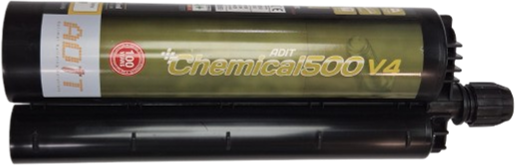
AC500 V4 Epoxy Adhesive
Injectable epoxy chemical anchor with European ETA1 approval — for cracked concrete, seismic loads, diamond drilling and underwater installation.
The Adit chemical anchor family
Choose the right adhesive for your load, substrate and approval requirements.
Technical specification
| Property | AC500 V4 — pure epoxy, European approval |
|---|---|
| Adhesive type | Advanced epoxy |
| Technology | Injectable chemical anchoring |
| Cracked concrete | Yes — tension zone approved |
| Seismic | Yes — C1 and C2 for threaded rods · C1 for rebar |
| Underwater application | Yes — including wet holes and subsea installation |
| Diamond drilling | Yes |
| Fire rating | Yes — classification R120 |
| Wind & dynamic loads | Yes |
| Working life | 100 years |
| Cartridge size | 585 ml |
| Approvals | European ETA 23-0553 · CE |
Downloads
Instructional & field-test videos
Epoxy chemical anchors for fastening: the complete guide
Everything you need to know about using a chemical anchor or professional epoxy adhesive for anchoring rebar and bolts — from the engineering principle, through the field installation steps, all the way to the largest infrastructure projects in Israel. This guide was written by the experts at Adit Ltd., the leading and largest chemical-anchor company in Israel.
What is an epoxy chemical anchor and how does it work?
A chemical anchor based on pure epoxy is a two-component engineering adhesive — an epoxy resin and a dedicated hardener — designed to anchor rebar dowels, threaded rods, dowels and studs under exceptionally high loads in concrete, natural stone, brick and solid building materials.
When the components are mixed in the mixer nozzle, an advanced chemical reaction (polymerization) begins, producing an exceptionally rigid three-dimensional polymer structure. Unlike simple mechanical anchors that apply point pressure on the concrete walls, an epoxy chemical anchor such as ADIT AC500 V4 forms a perfect, integral chemical bond with the pores of the drilled hole — delivering unprecedented resistance to shear, tension, pull-out and constant vibration.
The bonding principle:
The molecules of the epoxy chemical anchor penetrate into the micro-cracks and natural pores of the concrete. After curing and hardening, they form a single homogeneous unit with the structure, without creating internal expansion stresses.
Installation stages for chemical anchoring of rebar dowels and bolts
- Drilling — drill a hole to the required diameter and depth per the structural engineer’s instructions and the manufacturer’s tables, matched to the diameter of the threaded rod or rebar. AC500 V4 is also approved for use with diamond core drilling.
- Cleaning the hole (mandatory step!) — thoroughly clean the hole with a dedicated wire brush and blow the dust out with compressed air. Poor cleaning is the number-one cause of chemical-anchor failure in the field, because the adhesive would bond to the dust instead of the concrete.
- Injecting the chemical — inject the adhesive from the back of the hole upward (filling about 2/3 of the hole volume) to prevent air pockets.
- Inserting the rod / rebar — insert the rod or rebar with a slow, gentle rotating motion that ensures full chemical coverage around all the steel ribs.
- Curing time — wait fully for the material to harden according to the substrate temperature (8-12 hours to full cure at room temperature per the manufacturer’s data). Do not apply any load or torque at this stage.
Advantages of a pure epoxy chemical anchor (ADIT AC500 V4)
For demanding engineering projects, a pure epoxy chemical anchor such as ADIT AC500 V4 (supplied in 585 ml cartridges) offers superior advantages over simple polyester adhesives and even hybrid vinylester systems:
- Maximum structural strength and service life: among the highest load-bearing values in the anchoring world, approved for a 100-year working life.
- Advanced seismic resistance: AC500 V4 holds C1 and C2 approval for threaded rods and C1 approval for rebar dowels. No C2 approval for rebar dowels yet exists anywhere in the world, so C1 is the highest level currently achievable in the reinforcement field.
- Full resistance to chemicals and moisture: approved for wet holes and even underwater applications.
- No creep: the polymer stays stable and does not deform under constant, sustained loads — critical for structural connections.
- Suitable for cracked concrete: distributes stresses widely and evenly (tension zone approved) without creating splitting pressure, allowing safe work close to edge distances.
- Fire resistance: high fire resistance with classification R120.
- International standards and approvals: carries rigorous CE and ETA approvals (ETA 23-0553) and is approved by leading design offices and engineers in Israel.
Proven performance in Israel’s largest projects
The ADIT AC500 V4 chemical anchor has proven its reliability across thousands of construction sites and complex projects in Israel and worldwide. Its high grip level — enabling anchoring of rods and rebar up to 32 mm diameter and above — durability in harsh environmental conditions, approval for wind loads and standards compliance have made it the preferred choice for tunnels, high-rise buildings, logistics centres, underground car parks and bridges.
Durability in port and underwater environments
Installing bolts and rods in marine and subsea structures requires an anchoring solution that can cope with high water pressure, extreme salinity and constant vibration. AC500 V4, which holds a dedicated underwater approval, has demonstrated perfect durability in port projects in Israel, confirming it is a leading critical product for edge loads.
Why choose Adit Ltd. for your chemical anchor?
In the anchoring and construction field, choosing a professional supplier is just as important as choosing the material itself. Adit Ltd. — the leading and largest company in Israel for anchors and chemical-anchor solutions — provides full engineering support: professional consulting for load calculations, direct on-site guidance, fast supply from stock (including dedicated 585 ml injection guns) and competitive prices for projects of any scale.
Frequently asked questions
What is the difference between AC500 and Chemfix100?
What is the difference between an epoxy chemical anchor and a polyester chemical anchor?
Why use a chemical anchor for rebar dowels in concrete?
How long does the epoxy chemical anchor take to cure before it can be loaded?
Can it be injected into a wet hole or underwater?
Is the epoxy chemical anchor earthquake-resistant?
What is diamond drilling and why does it matter?
Is it suitable for cracked concrete?
Why are brushing and cleaning the hole so critical?
Anchoring in tough conditions? Tell us the drilling type, hole condition and load — our engineers will recommend the right adhesive and send you the ETA data.