

ADIT NA-G vs Fischer FNA II H — Nail Anchor Comparison
12 בJuly 2026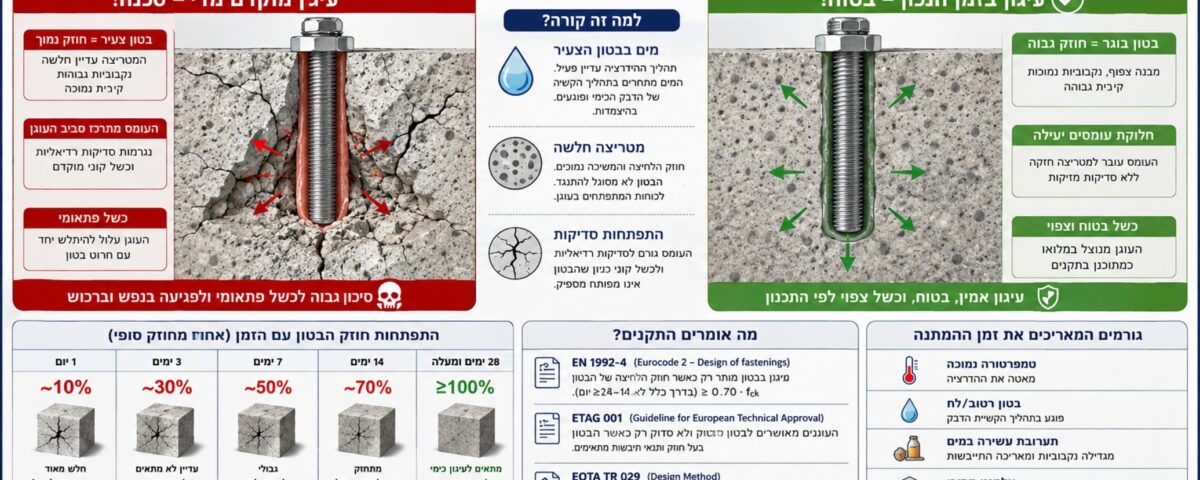
Why You Must Not Install a Chemical Anchor in Young Concrete — the Physics Behind the Rules
A detailed look at how concrete gains strength, what a hammer drill does to a not-yet-cured slab, why free water sabotages the resin, and why the ETA fixes the drilling diameter — the reasons behind the 21-day rule.
In short
Installing a chemical anchor in concrete that has not reached its design strength is one of the most common causes of anchor failure on new projects. The anchor and the resin are perfectly fine — the failure comes from the concrete substrate itself, which does not meet the design assumptions behind the anchor and its ETA approval. This is why the ETA requires a minimum of 21 days (or a measured concrete strength) before a chemical anchor is installed. Below we explain what happens — physically and chemically — and why no drilling technique can make up for concrete that is simply too young.
Why this is what makes an anchor fail
Unlike a material defect or a manufacturing fault, a young-concrete failure leaves the anchor and the adhesive completely intact. The weakness is in the concrete around them. This article covers three linked topics:
- The concrete strength-development curve, and how the microstructure changes over time.
- What happens when you drill young concrete with a hammer drill — the breaking of the interfacial transition zone (ITZ), the growth of the damage zone, and the loss of the resin’s ability to be drawn into the micro-cracks.
- Why the drilling diameter is fixed by the ETA specification and is not the installer’s decision — neither smaller nor larger.
1. How concrete gains strength over time
The characteristic concrete strength (fck) is defined at 28 days according to EN 206. Up to that age the concrete is still hydrating: the cement reacts with water to build the C-S-H (Calcium-Silicate-Hydrate) crystals that give concrete its strength. Two points matter for anchoring:
- Strength alone is not the whole story. At 7 days the mix may have only 50–55% of its final strength, even if it “feels” set.
- The interfacial transition zone (ITZ) — the thin shell around every piece of coarse aggregate — is the weakest region in concrete. In young concrete the ITZ still holds loose portlandite (Ca(OH)₂) and ettringite crystals rather than a dense, interlocked C-S-H matrix.
- Free water is still present. Young concrete still contains unreacted water from hydration, and this directly affects how a chemical resin bonds.
Bottom line: do not treat a strength reading as the only indicator that concrete is ready for a chemical anchor. Strength, the ITZ structure, and the internal moisture level all lag behind the point where the concrete first appears “hard.”
What the numbers do not tell you — the microstructure
Sixty-five per cent of compressive strength at seven days sounds good enough. But that figure reflects only one thing: the matrix’s resistance to uniaxial compression of a test cylinder. It says nothing about the three parameters that actually govern a chemical anchor’s hold.
- The concrete’s tensile strength (fctm) — this is what governs cone failure at the anchor. Tensile strength develops more slowly than compressive strength. At seven days it may be only 50–55% of its final value, even when compressive strength has already reached 65%.
- The integrity of the interfacial transition zone (ITZ) — a thin shell around every coarse aggregate particle, and the weakest region in concrete. In young concrete the ITZ still contains elongated ettringite crystals and large portlandite Ca(OH)2 crystals instead of dense C-S-H.
- Free water in the capillary pores — at an early age there is still free water in the capillary porosity that has not reacted with the cement. It bears directly on the polymerisation of the chemical resin.
Compressive strength must not be accepted as the sole indication that a chemical anchor may be installed. Tensile strength, ITZ structure and capillary moisture all lag behind it.
2. What a hammer drill does to young concrete
A hammer drill works in two simultaneous motions — rotation of the bit, and mechanical impact at 3,000–5,000 blows per minute. In mature concrete the intended mechanism is the fracture of C-S-H crystals into dust as the bit edges cut the hardened matrix; the damage zone around the hole is narrow (about 0.5–1.5 mm) and the bore leaves a rough but mechanically stable surface. In young concrete the physics change:
The precise mechanism in young concrete
a. Breaking the interfacial transition zone (ITZ)
In young concrete the ITZ around each coarse aggregate is full of elongated ettringite and crystalline portlandite instead of a dense C-S-H matrix, and these crystals are especially brittle under dynamic load. Each hammer blow sends a radial shock wave outward: in mature concrete the wave is absorbed by the C-S-H matrix, but in young concrete it splits the ITZ and widens micro-cracks around every stone.
b. Aggregate pull-out instead of cutting
In mature concrete the aggregate is held in the matrix more strongly than the drill can cut, so the stone is cut cleanly. In young concrete the grip is weaker than the cutting force, so the bit tears the aggregate out and leaves an asymmetric void with irregular walls. Such a hole is larger than the design diameter (an “oversized hole”), sometimes by 1–3 mm in places; it puts the resin in momentary contact with material that has not reached strength; and it cannot be reliably assessed for bond strength under EN 1992-4, §7.2.1.
c. Formation of a drilling slurry layer
In mature concrete, drilling dust is dry and separates easily under compressed air and a brush. In young concrete the dust contains incompletely hydrated C-S-H particles and free water, and together they form a sticky paste on the wall of the hole that standard cleaning does not remove. That layer, 0.1–0.3 mm thick, acts as a separation layer between the resin and sound concrete — and reduces the resin’s bond stress by 30–50%.
d. The effect on effective embedment depth (hef)
The ETA of any chemical anchor refers to a measured effective embedment. In young concrete, even when the hole reaches the correct geometric depth, the outer layer of the hole wall — the first 5–10 mm — is damaged to the point where it cannot be counted as load-bearing. The practical effective hef is therefore smaller than the designed one.
The engineering consequence: hammer drilling in concrete less than 21 days old creates a phantom anchor — the geometry looks correct, but the substrate in direct contact with the resin is not structural concrete. Pull-out tests in young concrete show a 40–70% reduction in failure load compared with the same anchor at 28 days.
3. Diamond (wet) drilling — the worst case
In diamond coring, pressurised water flows continuously through and around the barrel. A standard Ø14 mm hole at 90 mm depth pushes roughly 4–8 litres of water into the hole and its surroundings within 60–90 seconds. In mature concrete that water leaves with the cuttings; in young concrete it is the opposite:
- Over-saturation of the capillary pores. Young concrete already holds free hydration water; the added drilling water pushes the liquid content at the resin-contact zone to about 15% by volume — three to four times the maximum allowed for chemical resin by the manufacturer’s instructions.
- No way to dry it out. Compressed-air cleaning removes water from the hole face but not from the concrete mass. The absorbed water keeps migrating back out for hours-to-days after drilling — exactly while the resin is meant to polymerise.
- A shifted hydration zone. The effective water/cement (W/C) ratio at the hole face moves toward “more water,” so the concrete that hardens there ends up with a lower final local strength.
The fundamental difference between hammer and diamond
A hammer drill works by mechanical fracture — radial blows that crush the matrix. A diamond core works by abrasion with water cooling: segments impregnated with diamond powder grind the concrete away while 2–5 litres of water per minute flow continuously to cool the bit and clear the debris. In mature, dry concrete a diamond core produces a clean, cylindrical cut surface. But those two properties — clean and cylindrical — are precisely the opposite of what a chemical anchor needs.
One point to establish first: most ETAs for resin anchors are explicitly limited to hammer drilling only.
a. Water multiplication — the most serious problem
In diamond drilling, pressurised water flows continuously through the barrel and around it. A standard Ø14 mm hole 90 mm deep takes 4–8 litres of water into the hole and its surroundings within 60–90 seconds. In mature concrete that water leaves with the drilling debris: the capillary pore system is relatively closed, and the water stays mainly at the face of the hole.
In young concrete the situation is completely reversed. The capillary system is still open and active, and the water is absorbed into the concrete over a zone of 10–20 mm around the hole. Three consequences follow directly.
- Over-saturation of the capillary pores. Young concrete already contains free water from hydration. Adding drilling water raises the liquid content in the resin contact zone to roughly 15% by volume — three to four times what the manufacturer permits for installing a chemical resin.
- There is no way to dry it. Standard compressed-air cleaning removes water from the surface of the hole, but not from the mass of the concrete. The absorbed water continues to migrate out for hours and days after drilling — precisely while the resin is supposed to be polymerising.
- The concrete’s own hydration zone changes. The effective water/cement ratio at the hole wall shifts towards more water, so the concrete that hardens there reaches a lower final strength than the parent concrete.
b. Calcium leaching
Young concrete holds a large excess of free portlandite, Ca(OH)2, in its pores — a by-product of hydration. The water flowing during diamond drilling comes into direct contact with high concentrations of it and dissolves it.
- Between 0.05 and 0.2 g of lime is leached per litre of drilling water.
- A lime-depleted concrete layer 0.1–0.5 mm thick forms at the face of the hole.
- That layer loses up to 40% of its matrix strength — it stays porous and friable.
- The chemical resin bonds to this damaged layer, not to sound concrete.
The effect is visible to the naked eye: the concrete at the face of the hole is lighter than the concrete deeper in, and is sometimes covered by a whitish layer of recrystallised portlandite that migrates to the surface as the water evaporates.
c. Slurry that becomes part of the structure
In mature concrete, drilling slurry — water plus ground concrete particles — either washes out or stays loose, and can be cleaned away. In young concrete something considerably more destructive happens.
- The slurry contains C-S-H particles and cement that has not fully hydrated.
- These particles are pressed into the porous structure of the young concrete during drilling.
- As the young concrete continues to hydrate in the days after drilling, that slurry becomes chemically bonded to the hole wall and an inseparable part of it.
- The result is a skin of damaged concrete 0.2–0.5 mm thick that cannot be removed — it has become the structure itself.
This is unlike hammer-drill dust, which stays loose and can be cleaned. Diamond slurry in young concrete becomes part of the permanent concrete, and the resin bonds to that layer — which is not structural concrete.
d. A smooth surface doubles the problem
Hammer drilling produces a surface roughness of 100–300 microns, like coarse sandpaper. Diamond drilling produces a roughness of only 5–15 microns, like a polished floor. Resin anchors were designed for a hammer-drilled surface. On a diamond-drilled one:
- the resin has no surface asperities to key into — there is no mechanical interlock;
- the bond relies on pure chemical adhesion alone;
- chemical adhesion on its own contributes only 30–40% of the total bond strength of a sound resin anchor.
Combine a smooth surface — a loss of some 60% of the grip — with a lime-depleted layer some 40% weaker locally, and failure becomes statistically assured.
e. What the ETA says about diamond drilling in young concrete
Approvals treat the combination of diamond drilling and young concrete as two separate departures at once.
- A double exclusion. Most approvals limit drilling to hammer only and require a minimum concrete age. Breaching both in a single installation puts the work entirely outside the approval. Contractually and professionally the anchor is not installed — the project engineer may not rely on any ETA-based design calculation for it.
- No laboratory testing covers the case. Anchor manufacturers run their baseline tests in the laboratory. The combination of diamond drilling with concrete at 7–14 days has never been tested commercially, because no manufacturer wants to publish the results.
The diamond paradox. Engineers on site sometimes choose diamond drilling because the concrete is young — less noise, less vibration, more elegant beside a fresh pour. It is exactly the wrong choice. Young concrete needs waiting, not an alternative drilling technique. No drilling method compensates for insufficient concrete age.
4. The effect on the resin’s bond strength
A chemical anchor relies on two parallel grip mechanisms: chemical adhesion of the resin to the hole walls, and mechanical interlock of the cured resin in the roughened bore texture. In young concrete both are undermined, each from an independent cause.
a. Free water interferes with polymerisation
The resins used in chemical anchors are mostly vinyl-ester, acrylic-epoxy, or pure epoxy. All cure by polymerisation, in which initiators open double bonds to form a three-dimensional polymer network. Free water at the hole face dilutes the local initiator, so the polymer in this critical interface layer never reaches full density. Unsaturated polyester suffers most, vinyl-ester is more resistant, and epoxy is the most resistant — but no resin is fully immune before it has set into a dense solid. During curing the network is still open, and the young free water is the medium through which hydroxyl ions migrate into the resin. The result is an interface layer that stays soft and gel-like and is not mechanically linked — right where the grip is most critical.
b. Alkaline attack on the resin
In young concrete the concentration of hydroxyl ions (OH−) in the pore water is unusually free, and the pH in direct contact with the cement’s aqueous phases reaches as high as 13.5. That environment attacks certain resins through saponification — hydrolytic cleavage of the ester bonds in the polymer. Unsaturated polyester suffers most; vinyl ester is more resistant; epoxy is the most resistant of the three. But no resin is entirely immune before it has become a dense solid:
- while curing, the polymer structure is still open and exposed to attack;
- the free water in young concrete is the medium through which hydroxyl ions migrate into the resin;
- the end result is an interface layer that stays soft and gel-like, with no mechanical coupling — in exactly the zone that matters for the hold.
c. Loss of mechanical interlock
As noted in Section 2, the bore face in young concrete is coated with a “drilling slurry.” Even full cleaning to the manufacturer’s instructions (brush + compressed air, three times) does not completely remove this layer in young concrete. The curing resin then bonds to the soft slurry instead of to sound concrete, so failure occurs inside the slurry layer, not in the structural concrete. In pull-out tests you can literally see a black-grey layer stuck to the extracted resin — the signature of a young-concrete failure.
Cumulative effect
In young concrete the resin bond strength (τRk) falls from a typical 15–25 N/mm² to just 5–12 N/mm² — a drop of 40–70%. That loss is not covered by the material safety factor (γM = 1.5), so it translates directly into a real risk of failure at ordinary service load.
Why the “pilot hole, enlarge later” trick does not work
Pre-drilling a small pilot hole in young concrete and enlarging it after the concrete matures does not recover the situation — it hides the damage:
- The slurry becomes part of the concrete. Partially-hydrated C-S-H particles and unreacted cement left on the first bore face are pressed into the pores of the young concrete and keep hydrating, bonding chemically. Later enlargement exposes a locally weak concrete layer that would not have existed without the pilot hole.
- Pulled aggregates do not go back. The hammer partly tears aggregates from the matrix; after curing they stay without a full bond, the gaps filled with air or dried slurry. Enlargement exposes them at the new bore face — and they tear out under load.
- You cannot inspect below the surface. After enlargement the hole looks clean and sound. No non-destructive method (Schmidt hammer, ultrasound) reveals the hidden damage zone. The failure arrives without warning at normal service load.
- Completely outside the ETA scope. Every ETA approval for a chemical anchor is based on a single drilling in concrete that has reached its design strength — a “pilot-and-enlarge” sequence is simply not the tested condition.
5. Why the hole diameter is fixed — neither smaller nor larger
A question installers ask constantly: “the correct-size bit is jamming, can I use one slightly larger?” — or the reverse, “I only have a bit 1 mm smaller, it will hold even better, won’t it?” The answer to both is an unqualified no. The ETA of every chemical anchor defines the hole diameter (d0) as an exact value; it is an inseparable part of the controlled system that was tested in the laboratory.
The physics of the annular gap
In an installed chemical anchor there is an annular gap between the threaded rod and the wall of the hole. That gap, typically 1–3 mm per side, fills with resin. The thickness of that resin is not arbitrary — it is engineered to transfer shear uniformly from the rod into the concrete.
Why a hole smaller than specified fails
- No intermediate resin. The rod bears against the wall of the hole and shear is transferred by friction rather than chemical adhesion. Friction is neither documented nor included in the calculation.
- The resin is squeezed out during insertion. Instead of surrounding the rod it escapes upward and out of the hole, leaving voids at depth and no load transfer in the inner regions.
- The rod cannot reach nominal depth. It jams before the designed hef, and the effective embedment ends up smaller than the design value.
- Damage to the rod’s thread as it is forced into an undersized hole.
Why a hole larger than specified fails
- Bulk shear in the resin. As thickness grows the resin behaves as a volume of material rather than an adhesive layer, and cracks in bulk shear before the load reaches the concrete. The failure strength within the resin is lower than either the resin-to-concrete or the resin-to-steel bond.
- Loss of confinement pressure. In a correct annular gap, shrinkage of the resin against the concrete wall creates a positive pressure that raises shear strength. In an oversized gap the resin shrinks inward and that pressure is lost.
- Greater heat build-up. Polymerisation is exothermic. An over-thick resin layer generates more heat and a higher peak temperature inside the system, which produces shrinkage cracks as it sets.
- It breaks the EN 1992-4 calculation. The bond resistance NRk,p is based on the perimeter π · d · hef, where d is the nominal diameter. A change of diameter is not recognised by the equation, and stepping outside its scope voids the validity of the design.
The underlying rule. The hole diameter is set in the anchor manufacturer’s laboratory as part of a functioning system proven over hundreds of pull-out tests. Departing from that value — smaller or larger — takes the installation outside the limits of the ETA, and with it the legal and professional basis of the design.
Doing it correctly — the rules
- Wait for strength. Install only after the concrete reaches the minimum criterion: 21 days, or a measured fck,cube ≥ 25 N/mm².
- Exact drilling diameter. Use the drill diameter d₀ stated in the ETA for the specific anchor (for Chemfix200, per the table in the technical datasheet). Do not deviate — not even by 0.5 mm, neither larger nor smaller.
- Full hole cleaning — “2-2-2”. Compressed air ×2, brush ×2, compressed air ×2. This is especially critical in young-but-permitted concrete (21–28 days), where a clinging dust layer may still be present.
- Concrete temperature. +5°C to +40°C in most ETA approvals. In young concrete a low temperature also slows the resin’s polymerisation.
- Dry / wet condition. The ETA states whether the anchor is approved for dry, wet, or flooded holes. Concrete younger than 21 days is “internally wet” by default — even if the surface looks dry.
Common questions
The concrete is 14 days old and my programme is tight. Is there really no way to install?
There is no compliant way to install a chemical anchor under its ETA approval before the concrete meets the minimum criterion (21 days, or a measured strength). Your options are to test the actual concrete — if it has reached fck,cube ≥ 25 N/mm² at 14 days (rare, but possible with certain cements and ideal curing) you may install — or to use a mechanical anchor instead (for example SLPT, TF, or TFE), whose approval covers the situation and which does not depend on resin polymerising against wet, immature concrete.
The concrete passed a strength test at 7 days and showed 25 N/mm². Is that enough?
No. A compressive strength of 25 N/mm² at 7 days shows the matrix is ahead of the curve, but it does not cancel the structural defects of young concrete: the ITZ is still not dense, there is still free water in the capillaries, and the tensile strength is still low. Some ETA approvals state both a minimum age (21 days) and a minimum strength — both criteria have to be met. A measured strength on its own is not enough.
The bit goes in and it feels as though the hole is swallowing it deeper than usual. What does that tell me?
Three possible signs of young or otherwise problematic concrete:
- An unusually fast rate of penetration — the concrete is too soft, the matrix has not fully hardened.
- Drilling dust that clings to the bore face instead of dispersing — a sign of internal moisture.
- Dust changing colour from grey to brown or black — a hidden void, or concrete with coarse stone that did not blend in.
In any of these cases: stop, order a strength test, and only then continue.
Why can a mechanical anchor work in younger concrete than a chemical one?
A mechanical anchor relies on mechanical pressure of the expansion against the wall of the hole, not on chemical adhesion. It is unaffected by free water, unaffected by high pH, and unaffected by a fine slurry layer — the expansion crushes through it. But a mechanical anchor will also fail in concrete that is too young, typically under 7 days or below 15 N/mm², because the tensile strength of the concrete itself is not enough to resist the expansion: the concrete simply cracks and gives way. Every mechanical anchor ETA states its own minimum concrete strength.
Can I use a chemical anchor in concrete that is 21 days old, if 15 of those days were unusually cold?
Not on calendar days alone. Concrete at a low temperature develops significantly more slowly. The concept that applies is degree-days, the maturity method: if the concrete spent 8 days at an average of 5°C, the system has developed as though only 2 days had passed at 20°C. The answer is a real strength test — Schmidt hammer, or a sample cylinder. A direct measurement always beats counting days.
What is the difference between hammer drilling and diamond coring for a chemical anchor?
Diamond coring leaves a bore face that is far too smooth — a roughness of 5–15 microns — so the resin loses the mechanical interlock it was designed around, which assumes a hammer-drilled face at 100–300 microns. Most ETA approvals for resin anchors are therefore limited to hammer drilling only. Special diamond-drilling approvals exist for certain anchors, but the approved τRk is then 30–50% lower. In short: unless the ETA explicitly permits diamond drilling, a hammer drill is mandatory. And in young concrete diamond coring adds a second, very serious problem — the water it flushes into concrete that is already saturated, plus calcium leaching and slurry that becomes part of the structure (see section 3). Diamond drilling in young concrete is not an alternative to hammer drilling; it is two ETA breaches at once.
I need to set the bolts today. Can I drill a small pilot hole now in the young concrete and open it to full diameter in two weeks?
No — and it is a common idea that sounds clever but fails physically. The problem is not the geometry of the hole; it is that the damage done to the concrete during the first drilling is permanent and cannot be removed by drilling again. Enlarging from Ø8 to Ø14 takes only 3 mm off each side, which is still inside the damage zone: the enlarged hole ends up surrounded by cracked, weakened concrete. The micro-cracks are also locked in as the concrete hardens — the radial crack network formed at 7 days does not close, because hydration continues around the cracks rather than across them, and drying shrinkage can even widen them. See the full explanation in the section on the pilot-hole trick above. A diamond pilot hole is worse still: it contaminates a zone 15–20 mm around the hole with water, leached calcium and slurry pressed inwards, and enlarging at 28 days does not remove that layer.
What to do instead — three compliant options:
- Wait — 21 days, or a measured strength of C20/25. Usually that is what is required.
- Use a mechanical anchor approved for a lower concrete class. Some SLPT ETA approvals cover concrete down to C12/15.
- Plan ahead — set cast-in bolts or an anchor plate during the pour itself. It takes coordination, but it is the only solution that gives a full structural connection in an area that has just been cast.
What about “extreme” anchors approved for wet or flooded concrete? Do they help in young concrete?
No. “Wet concrete” in ETA language means a hole that water enters from outside — in basement walls, for example — while the material around it is mature concrete. Those anchors use a resin with a hydrophobic formulation that is not repelled by water in the annular gap. But no resin solves the problem of a concrete matrix that has not fully hardened internally. The minimum-age requirement applies to every resin type without exception.
How do I know whether an anchor already installed in young concrete is dangerous?
Signs to check:
- Proof test. Test a sample anchor at 1.5 × the design load — if it moves more than 0.5 mm, or starts to pull through, it is dangerous.
- Visual check. Resin drawn out with the rod, or a grey slurry layer on resin that has been extracted.
- Documentation. With no written record of the concrete age and strength at the time of installation, the presumption is that the anchor is not approved.
In such cases the project engineer must be consulted, and will sometimes have to require removal and replacement.
Summary
A chemical anchor is an engineered system built on three assumptions: (1) the concrete has reached its design strength; (2) the hole is drilled at exactly the diameter that was tested; (3) the resin sits in a defined chemical environment. In young concrete all three are violated at once — which is why the anchor falls outside the limits of its ETA.
The three cumulative failures in young concrete:
- Structural: the weak ITZ cracks under the hammer, the damage zone widens by a factor of 3–5, and aggregates are torn out instead of being cut.
- Chemical: free water interferes with polymerisation, a high OH⁻ concentration attacks the resin while it cures, and a slurry layer separates the resin from sound concrete.
- Mechanical: the tensile strength of the concrete is still low — even a correctly set anchor will fail in cone at a load below the design value.
And on the drill diameter: it is engineered as part of the system. Any deviation, smaller or larger, takes the installation outside the approval. An annular gap of the right thickness is not a compromise — it is the engineering itself.
Sources and standards
- EN 1992-4:2018 — Eurocode 2: Design of concrete structures, Part 4: Design of fastenings for use in concrete.
- EAD 330499-01-0601 — Bonded fasteners for use in concrete.
- EN 206:2013+A2:2021 — Concrete: specification, performance, production and conformity.
- Eligehausen, R., Mallée, R., Silva, J. F. — Anchorage in Concrete Construction, Ernst & Sohn, 2006.
- fib Bulletin 58 — Design of anchorages in concrete, 2011.
- ETA for Chemfix200 — Adit technical datasheet.
- EOTA TR 048 — Bonded fasteners for use in concrete: assessment of relevant characteristics for use in cracked concrete.