

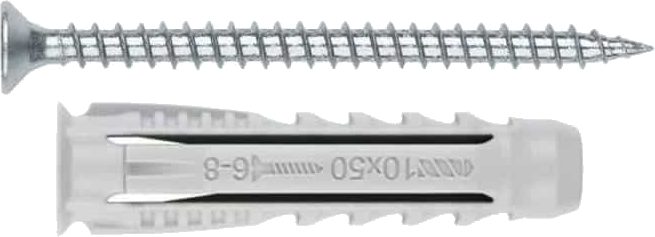
TN4S Nylon Plug
Universal nylon plug anchor with a 4-way expansion thread — one plug for every type of concrete and block, solid or hollow.
The Adit universal nylon-plug family
Choose the right plug for your base material, load and approval requirements.
Technical specification
| Property | TN4S — universal nylon plug |
|---|---|
| Characteristics | Universal nylon plug anchor suitable for every type of concrete and block, solid or hollow |
| Materials | Plug: polyamide PA6 · Screw: steel C1022 / SS304 / SS316 |
| Technology | Threaded nylon anchor — 4-way expansion, the most advanced in the world |
| Expansion directions | 4 |
| Standards | SI 1490 for drywall partitions · SI 5103 for acoustic ceilings |
Downloads
Instructional & field-test videos
What is a nylon plug? Definition and explanation
A nylon plug (or plastic anchor, also known as a “wall plug”) is an essential component in the world of construction and fastening. It is a small piece, usually made of nylon, polyamide or polypropylene, that is inserted into a hole drilled in a wall, ceiling or floor.
When a screw is tightened into the plug, the plug expands and presses firmly against the walls of the hole — creating a stable, reliable connection that holds the screw in place. The nylon plug makes it possible to fix many objects such as shelves, lamps, air conditioners, wall furniture, fences, handrails, signage and sanitary fixtures — on any type of surface. The word “plug” (in Hebrew, dibel) comes from the German Dübel and is the most common everyday term for plastic wall anchors.
The ADIT TN4S — Israel’s leading universal nylon plug
The ADIT TN4S is a universal nylon plug made by INDEX, manufactured and marketed in Israel by ADIT — the leading company in Israel in professional anchoring. The TN4S plug was designed as a single fixing solution for every type of wall, combining advanced technology with proven field reliability.
The technological advantages of the TN4S nylon plug
- 4-way expansion — four segments that expand simultaneously in every direction, ensuring a uniform, distributed grip over a wide area.
- Universal (fits everything) — suitable for concrete, solid brick, hollow brick, lightweight concrete (Ytong), drywall and stone. The perfect solution when you don’t know what is hidden behind the wall.
- Outstanding pull-out capacity — among the highest in its category. The TN4S14 holds up to 628 kg in concrete.
- Made of premium polyamide 6 (nylon) — high flexibility, excellent mechanical strength, resistance to extreme temperatures and non-brittle.
- 8 anti-spin zones — prevent the plug from spinning inside the hole while the screw is being driven.
- External marking — the required drill-bit and screw diameters are embossed on the body of the plug to prevent mistakes.
- Wide collar (optional) — prevents the plug from sinking into the hole in hollow walls or drywall.
Guide to choosing the right nylon plug for every application
Choosing the correct plug is critical to the success of the fixing. Here is how to choose correctly.
Step 1: identify the base wall material
| Wall type | Characteristic | Recommended plug (series) |
|---|---|---|
| Solid concrete | High strength, precise hole | TN4S06 – TN4S14 |
| Solid brick | Medium, may be dusty | TN4S06 – TN4S12 |
| Hollow brick | Internal cavity — challenging | TN4S06 – TN4S14 |
| Perforated concrete block | Large internal cavity | TN4S-L (the long version) |
| Plasterboard | Thin and delicate | TN4S05 – TN4S08 / TN4S-A (with collar) |
| Stone / travertine | Hard, may crack | TN4S06 – TN4S10 |
| Lightweight concrete (Ytong/AAC) | Lower density (soft) | TN4S (small to medium diameters) |
Tip: if you don’t know what is behind the wall, the universal TN4S plug is exactly the right choice.
Step 2: determine the required load
- Light load (pictures, small mirrors, hooks): TN4S05 – TN4S06
- Medium load (shelves, lamps, TVs): TN4S08 – TN4S10
- Heavy load (air conditioners, heavy cabinets, handrails): TN4S12 – TN4S14
Step 3: choose the screw diameter and plug length
The plug length is roughly equal to the thickness of the fixture being mounted plus the embedment depth into the wall (minimum 30–50 mm inside the wall). The screw diameter must match the specified range, which is marked on the plug itself.
Nylon plug installation guide — step by step
Tools required: a hammer/impact drill (mandatory for concrete; must not be used on drywall or delicate hollow block), a drill bit of the diameter matching the plug, a blower or vacuum cleaner for cleaning, and a screwdriver.
- Drill the hole — drill perpendicular to the surface to the required diameter and depth.
- Clean the hole — use an air blower or a vacuum to remove dust. A clean hole lets the plug grip the concrete walls rather than slip on dust.
- Brushing (optional) — for concrete and soft materials, brushing the inside of the hole with a tube brush greatly improves contact.
- Insert the plug — push the plug into the hole (if it has a collar, until it rests against the wall). If it is a little tight, tap it gently with a hammer.
- Drive the screw — insert the screw through the object you want to hang and into the plug. As it is driven, the plug expands in 4 directions and locks firmly inside the wall.
Why choose ADIT nylon plugs?
ADIT is the leading company in Israel in professional anchoring. It distributes INDEX products in Israel — a leading Spanish manufacturer present in 60 countries. Choosing ADIT means guaranteed quality that meets European standards (ETA), a full range of solutions, close engineering support and, above all, plugs that do not fail when it comes to your safety.
Frequently asked questions
What is the difference between a regular plastic plug and a nylon plug?
Which screw suits which plug? How do you choose the diameter?
How do you remove an old plastic / nylon plug from the wall?
What plug size should be used in a hollow brick or perforated block?
How do you know which drill-bit diameter to use in the wall?
What do I do if I drilled too large a hole and the plug spins on empty?
Can the very same plug be used for both drywall and concrete?
What is the difference between a universal plug and a “rosette” plug dedicated to drywall?
How much weight can such a plug hold in concrete?
What are the TN4S-A and TN4S-L?
Are nylon plugs suitable for installation in a ceiling?
Which universal plug should I choose?
Is a nylon plug suitable for drywall?
What is the difference between threaded and hammer-set?
Not sure which plug fits? Tell us the base material and the load — our engineers will recommend the right plug and diameter.