

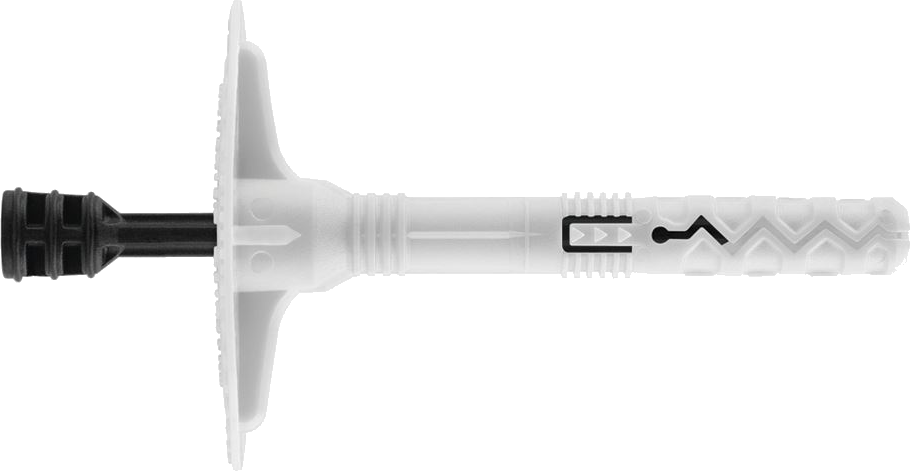
AIS-C — Thermal Insulation Plug
Nylon hammer-in plug for fixing thermal-insulation boards (ETICS) to building facades — European ETA approved, with a 25-year service life.
The Adit plug & fixing family
Choose the right plug for your base material, load and approval requirements.
Technical specification
| Property | AIS-C — thermal-insulation plug, European approval |
|---|---|
| Characteristics | Nylon hammer-in plug for fixing thermal-insulation boards (ETICS) |
| Materials | Polypropylene (PP) expansion sleeve + polyamide PA6 pin reinforced with GF30 glass fibre |
| Technology | Hammer-in (plastic pin driven in with a hammer) |
| Base materials | Concrete, solid brick, hollow blocks, lightweight concrete (categories A–E) |
| Approvals | European ETA 21/0823 · EAD 330196-01-0604 · CE Mark · AVCP System 2+ |
| Drill diameter | 10 mm |
| Drilling depth | 60 mm |
| Effective anchoring depth hef | 50 mm |
| Head / plate diameter | 60 mm (extendable to 140 mm with the AISR plate) |
| Lengths | 70 mm to 400 mm (max. insulation thickness up to 350 mm) |
| NRk concrete C16/20–C50/60 | 0.80 kN |
| NRk solid clay brick | 1.00 kN |
| Approved service life | 25 years |
| Installation temperature | 0°C to +40°C |
Downloads
Instructional & installation videos
The thermal-insulation anchor: the complete guide
The AIS-C thermal-insulation anchor is the leading plug on the Israeli market for fixing External Thermal Insulation Composite Systems (ETICS) to building facades. Carrying European ETA 21/0823, it is supplied by ADIT Ltd — Israel’s anchoring professionals since 2006.
The AIS-C is a plastic hammer-in thermal-insulation anchor: a polypropylene sleeve plus a polyamide PA6 pin reinforced with GF30 glass fibre. It is designed for anchoring insulation boards (EPS, XPS, PUR, rock wool) to concrete, solid brick, hollow blocks, lightweight concrete and aerated concrete. The approved service life is 25 years.
European ETA 21/0823 — what does it mean for you?
The ETA (European Technical Assessment) is the European Union’s official engineering approval for construction products. The AIS-C plug received ETA 21/0823 from the Instytut Techniki Budowlanej (ITB) — Poland’s technical assessment body — on 01/02/2022, based on assessment document EAD 330196-01-0604.
What does the approval cover?
- Use categories A to E: normal concrete (A), solid brick (B), hollow bricks/blocks (C), lightweight concrete (D), autoclaved aerated concrete AAC (E).
- Characteristic pull-out resistance (NRk): up to 1.00 kN in solid clay brick and up to 0.80 kN in C16/20–C50/60 concrete.
- Plate stiffness: 0.20 kN/mm (60 mm plate diameter, design load 0.84 kN).
- Minimum edge distance and spacing between anchors: 100 mm in every direction.
- Service temperature: 0°C to +40°C (long-term up to +24°C).
- Exposure to sunlight without render coverage: no more than 6 weeks.
Under the ETA, the AIS-C plug is intended solely to take wind loads (wind suction) and not to carry the dead weight of the insulation system. Design is carried out with safety factors γM = 2.0 and γF = 1.5.
Full technical description — AIS-C thermal-insulation anchor
Product components
- Expansion sleeve: polypropylene (PP) virgin material, in orange / grey / white. Outer diameter 60 mm (plate), body diameter 10 mm.
- Expansion nail: polyamide PA6 reinforced with GF30 glass fibre (virgin material), 5.7 mm diameter. Driven in with a hammer and expands the sleeve inside the drilled hole.
- Additional AISR plate (optional): a 140 mm supplementary plate made of polypropylene / PA6, to increase the holding area in soft insulation (rock wool / mineral wool).
- Countersunk installation equipment: an AISCS setting tool (for polystyrene) or AISCW (for rock wool) and an AISPS/AISPW cap for re-insertion after installation.
Dimensions and part numbers — AIS-C
| Part No. | Description | Length L (mm) | Max. insulation thickness tfix (mm) | Body diameter d₁ (mm) | Head diameter D (mm) |
|---|---|---|---|---|---|
| AISC10070 | AIS-C 10×70 | 70 | 20 | 10 | 60 |
| AISC10090 | AIS-C 10×90 | 90 | 40 | 10 | 60 |
| AISC10100 | AIS-C 10×100 | 100 | 50 | 10 | 60 |
| AISC10120 | AIS-C 10×120 | 120 | 70 | 10 | 60 |
| AISC10140 | AIS-C 10×140 | 140 | 90 | 10 | 60 |
| AISC10160 | AIS-C 10×160 | 160 | 110 | 10 | 60 |
| AISC10180 | AIS-C 10×180 | 180 | 130 | 10 | 60 |
| AISC10200 | AIS-C 10×200 | 200 | 150 | 10 | 60 |
| AISC10220 | AIS-C 10×220 | 220 | 170 | 10 | 60 |
| AISC10260 | AIS-C 10×260 | 260 | 210 | 10 | 60 |
| AISC10300 | AIS-C 10×300 | 300 | 250 | 10 | 60 |
| AISC10350 | AIS-C 10×350 | 350 | 300 | 10 | 60 |
| AISC10400 | AIS-C 10×400 | 400 | 350 | 10 | 60 |
Drilling depth: 60 mm | Effective anchoring depth hef: 50 mm | Drill diameter: 10 mm.
Maximum insulation-thickness calculation: Surface installation: hD = La − ttol − hef. Countersunk installation: hD = La − ttol − hef + hR (where ttol = levelling-layer thickness, hR = cap thickness).
Characteristic loads — AIS-C per ETA
| Base material | Category | NRk [kN] | Design load Nrd [kN] | Service load Nrec [kN] | Drilling method |
|---|---|---|---|---|---|
| Concrete C12/15 | A | 0.55 | 0.28 | 0.20 | Hammer |
| Concrete C16/20 to C50/60 | A | 0.80 | 0.41 | 0.29 | Hammer |
| Solid clay brick MZ | B | 1.00 | 0.51 | 0.36 | Hammer |
| Silicate brick KS | B | 0.40 | 0.20 | 0.14 | Hammer |
| Hollow brick Porotherm 25 P+D | C | 0.10 | 0.05 | 0.04 | Rotary |
| Hollow silicate block KSL | C | 0.65 | 0.33 | 0.23 | Rotary |
| Lightweight concrete LAC | D | 0.20 | 0.10 | 0.07 | Rotary |
Material safety factor γM = 2.0 | γF = 1.5 | Note: category C blocks — a(min) ≥ 11 mm (Porotherm) or 25 mm (KSL) required.
Note for Israel: the blocks referenced in the European approval (Porotherm, KSL, LAC) may differ slightly from the blocks sold locally. A field pull-out test is recommended before designing with Israeli blocks — ADIT assists in arranging pull-out tests.
Installation guide — AIS-C thermal-insulation anchor
Installing the AIS-C thermal-insulation anchor is simple and fast and requires no special tools. Carry out the following steps in order.
Surface assembly
- Drilling — drill a vertical hole 10 mm in diameter and 60 mm deep into the base material (for hollow masonry — no hammer mode).
- Cleaning — in solid base material, clean the hole of dust with compressed air and a brush.
- Inserting the plug — insert the plug through the insulation layer until its plate is flush against the insulation surface.
- Driving the pin — drive the polyamide pin in with a hammer until it is fully seated in the sleeve.
Countersunk assembly
- Drill the hole into the base material as above.
- Use the AISCS setting tool (polystyrene) or AISCW (mineral wool) to create a recess in the insulation layer.
- Insert the plug and make sure the plate is flush.
- Drive in the pin.
- Insert the AISPS/AISPW cap back into the recess and cover with render.
ADIT professional tip: in hollow blocks, work in rotary mode only and reduce the drilling speed as you approach the inner wall. Do not use “hammer” mode in hollow bricks — it may break the web (internal partition) and damage the anchor.
Advantages of the AIS-C thermal-insulation anchor
- Full European approval: ETA 21/0823 — the most rigorous engineering proof. Enables ETA-based calculation per EAD 330196-01-0604.
- Wide 60 mm plate head: high stiffness area (0.84 kN plate design load). Can be extended to 140 mm with the AISR plate for soft insulation.
- Fast hammer-in installation: no screws or wrenches — the pin is driven in with a hammer only. A significant saving of time and labour costs on large projects.
- High durability: approved service life of 25 years. Polyamide PA6 + GF30 withstands service temperatures of -40°C to +80°C over the life of the structure.
- For all base materials: approved for concrete, solid brick, hollow brick, silicate block and lightweight concrete.
- All insulation types: suitable for EPS, XPS, PUR, mineral wool, glass wool, cellulose panels and more — all the common ETICS used locally.
AIS-C vs. AIS-S — what’s the difference?
The AIS system comes in two main variants for ETICS:
| Property | AIS-C (plastic pin) | AIS-S (steel pin) |
|---|---|---|
| Pin material | Polyamide PA6 GF30 | Carbon steel + zinc coating ≥5µm |
| Thermal bridge | Minimal (plastic) | Higher (metal) |
| NRk concrete C16+ | 0.80 kN | 0.55 kN |
| NRk solid clay brick MZ | 1.00 kN | 0.65 kN |
| Approval for aerated concrete AAC | No (AIS-S only) | Yes (0.10 kN) |
| Relative price | Lower | Slightly higher |
| Suitable for Israeli projects | Most cases | When AAC is required |
ADIT recommendation: for most projects in Israel (concrete, brick) — AIS-C is the optimal choice in terms of performance and cost-effectiveness. For projects with aerated concrete (AAC / Ytong) — switch to AIS-S.
Thermal-insulation anchors in Israel — what you should know
The thermal-insulation market in Israel has grown significantly over the past decade, with new requirements under standard SI 1045 for thermal insulation of the building envelope. The introduction of the ETA-approved thermal-insulation anchor is gradually replacing the “generic” solutions that were common in the past.
- Anchor distribution by height: under Israeli and European regulations, the number of plugs per m² increases with building height due to the growing wind loads.
- Climate zone: in the Galilee, the highlands and cold regions, thicker insulation is required — choose AIS-C in suitable lengths (up to 400 mm).
- Pull-out test: for base materials not listed in the ETA (such as lightweight Israeli blocks), a field pull-out test per EOTA TR 051 is mandatory.
- Supervision: installation must be carried out by qualified personnel under the supervision of a responsible engineer.
- 25-year service life: matches the average Israeli building life and the SI requirements for the durability of construction products.
Frequently asked questions
What is a thermal-insulation anchor?
What’s the difference between an insulation plug and an insulation anchor?
How many insulation plugs are required per m²?
Is a European ETA required for insulation plugs in Israel?
What’s the difference between AIS-C and AIS-S?
What are AIS-DC and AIS-DS? And how do they differ from AIS-C?
How do you calculate the required insulation-plug length?
Can an insulation plug be used for fixings / in cracked concrete?
How long can the plug be exposed to sunlight before covering with render?
What drilling size is required for the AIS-C plug?
Is the AIS-C plug suitable for mineral wool (rock wool)?
Can insulation plugs be installed in winter / in the rain?
What is ETICS and why do you need an insulation plug?
What’s the difference between surface and countersunk installation?
What is the γM = 2.0 safety factor and why is it important?
What is the AISR plate and when do you need it?
Where can you buy AIS-C insulation plugs in Israel?
Planning an ETICS insulation project? Tell us the base material, insulation thickness and building height — our engineers will run the wind-load calculation and recommend the right AIS-C length and quantity.