

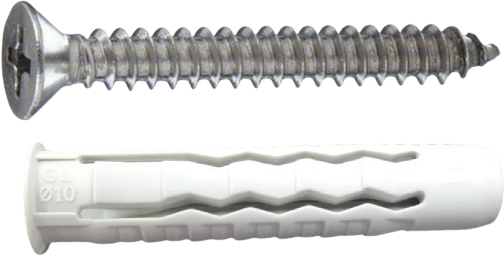
GL Nylon Plug
Universal nylon plug — for every type of concrete and block, solid or hollow. One polyamide anchor for concrete, brick, hollow block, lightweight concrete and drywall.
The Adit universal nylon-plug family
Choose the right plug for your base material, load and approval requirements.
Technical specification
| Property | GL — universal polyamide nylon plug |
|---|---|
| Characteristics | Universal nylon plug suitable for every type of concrete and block, solid or hollow |
| Base materials | Solid concrete · hollow block · brick · lightweight concrete (Ytong) · drywall · stone |
| Materials | Plug: polyamide PA6 · Screw: steel C1022 / SS304 / SS316 |
| Technology | Threaded nylon anchor — 4-way expansion with anti-spin zones |
| Standards | SI 1490 for drywall partitions · SI 5103 for acoustic ceilings |
Downloads
Proven in the field — selected projects in Israel
The GL nylon plug is installed in projects across Israel.

Instructional & field-test videos
Universal nylon plug: the complete guide
Everything you need to know about the ADIT GL universal nylon plug — a polyamide nylon anchor for concrete, block, brick, lightweight concrete and drywall. This guide was written by the experts at Adit Ltd.
What is a universal nylon plug and how does it work?
A universal nylon plug is a polyamide sleeve inserted into a drilled hole. As a screw is driven into it, the sleeve expands and locks itself against the wall of the hole, creating a stable, reliable connection that holds the screw in place. The plug lets you anchor a wide range of items — from shelves and light fixtures to air conditioners and wall furniture — on almost any type of surface.
The reason it is called "universal" is that the same plug works in solid concrete (by expansion), in hollow block (by folding behind the wall) and in brick — without changing product for each base material.
Technological advantages of the ADIT GL plug
- 4-way expansion — ensures a uniform grip distributed across a wide area inside the hole.
- Full universality — one solution for concrete, solid brick, hollow brick, lightweight concrete (Ytong), drywall and stone.
- Superior material quality — made of durable, flexible polyamide 6 (nylon) with high mechanical strength.
- 8 anti-spin zones — prevent the plug from spinning in the hole while the screw is driven in.
- External marking — the required drill-bit and screw diameters are embossed on the plug body, saving time and preventing mistakes.
Guide to choosing the right plug
Choosing the right plug is critical to a successful fixing. Here is how to choose correctly for the base material:
| Wall type | Characteristic | Recommended approach |
|---|---|---|
| Solid concrete | High strength | Standard GL by expansion |
| Hollow brick | Internal cavity — requires expansion | GL 4-way expansion behind the wall |
| Plasterboard | Thin and delicate | GL with a collar, light loads only |
| Lightweight concrete (Ytong) | Soft and less dense | GL in small / medium diameters |
Plug installation guide — step by step
- Drill the hole — drill perpendicular to the surface at the required diameter and depth (the drill-bit diameter equals the plug's outer diameter, embossed on the plug body).
- Clean the hole — use an air blower or vacuum. A clean hole lets the plug grip the walls instead of slipping on dust.
- Insert the plug — push the plug into the hole; tap gently with a hammer if needed.
- Drive the screw — insert the screw through the object and into the plug. The plug expands in 4 directions and locks firmly.
Frequently asked questions
Which universal plug should I choose?
Is a nylon plug suitable for drywall?
What is the difference between threaded and hammer-set?
What is the difference between an ordinary plastic plug and the ADIT GL nylon plug?
Which screw suits which plug?
How do you remove an old nylon plug from the wall?
What size plug should be used in hollow brick?
How do you know which drill-bit diameter to use?
What if you drilled too large a hole and the plug "spins freely"?
Can the same plug be used for drywall and concrete?
Are nylon plugs suitable for ceiling installation?
Is the plug suitable for outdoor use?
Should a hammer drill be used in hollow block?
Not sure which plug fits? Tell us the base material and the load — our engineers will recommend the right plug and diameter.