

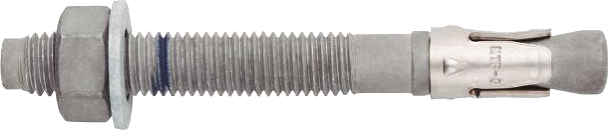
MTP-G Wedge Anchor — Hot-Dip Galvanized
Galvanized wedge anchor for cracked concrete holding European ETA1 approval — for outdoor, marine and humid environments. Same performance as MTP-X with a 30-40 micron thermodiffusion coating.
The Adit wedge anchor family
Choose the right wedge anchor for your substrate, environment and approval requirements.
Technical specification
| Property | MTP-G — galvanized wedge anchor, European approval |
|---|---|
| Characteristics | Galvanized wedge anchor for cracked and uncracked concrete |
| Technology | Wedge anchor · Thermodiffusion galvanizing 30-40 micron |
| Corrosion protection | Hot-dip / thermodiffusion galvanizing — for outdoor, marine and humid environments |
| Cracked concrete | Yes |
| Dynamic loads | Yes |
| Seismic | Yes — C1 and C2 |
| Fire rating | Yes — F120 |
| Sprinklers | Yes — VdS approval |
| Standards | European ETA1 approval for cracked concrete, sprinklers and seismic |
Downloads
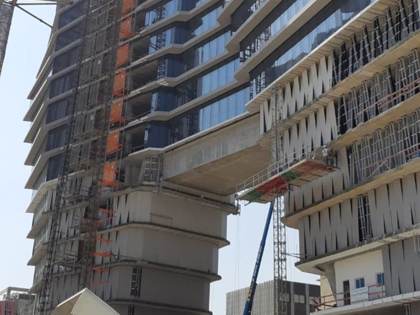
Proven in the field — selected projects in Israel
The MTP wedge anchor series is installed in hundreds of projects across Israel.
Instructional & field videos
Galvanized wedge anchor (cone anchor): the complete guide
Looking for a reliable, strong and cost-effective anchoring solution for heavy structures in challenging environmental conditions? The galvanized wedge anchor — also known professionally as a cone anchor — is the preferred choice of engineers in Israel and worldwide. This guide was written by the experts at Adit Ltd.
The ADIT MTP-G is a steel cone anchor that meets a stringent European standard, manufactured through a rigorous, controlled production process. With decades of experience and installations worldwide, it proves its durability time and again under complex field conditions, especially given the weather and humidity of the Israeli climate.
How does a wedge anchor (cone anchor) work?
A wedge anchor is a mechanical, through-set expansion anchor designed to fasten steel structures, equipment and heavy machinery to concrete. After drilling the hole, inserting the anchor and tightening the nut, the lower expansion clip (the “skirt”) opens, sets and is forced toward the cone. This creates a strong, rigid and secure anchorage capable of carrying very high tensile and shear loads. Thanks to quick, simple installation, high reliability and enormous load capacity, wedge anchors have served for decades as one of the most common anchoring solutions in construction and industry.
Key advantages of the ADIT MTP-G galvanized wedge anchor
- Approved for cracked concrete: designed and approved as a wedge anchor for cracked concrete and for seismic (earthquake) conditions.
- Maximum corrosion protection: a 30-40 micron thermodiffusion galvanized coating (Sherardizing) provides phenomenal resistance to rust and corrosion — ideal for coastal areas, industrial environments and humid regions.
- Quick and simple installation: significant savings in on-site working time.
- Immediate loading: unlike a chemical anchor, there is no need to wait for curing — load can be applied immediately after tightening the nut.
- High load capacity: excellent tensile and shear performance for heavy projects.
- Wide range: available in a variety of diameters and lengths for a precise fit to every application.
What is cracked concrete and why does it matter?
Cracked concrete is a common engineering condition in which there is a high probability of a microscopic crack (up to 0.3 mm) appearing in the tension zone of the concrete, exactly where the anchor is installed. This crack may develop from tensile loads, structural settlement, temperature changes, earthquakes, or the force the anchor itself exerts.
Whenever the engineering design defines the connection area as a “tension zone” or “cracked concrete”, it is mandatory to use a wedge anchor for cracked concrete. A galvanized wedge anchor for cracked concrete such as the MTP-G is equipped with a special flexible expansion mechanism that “rides” on the cone and adapts to movement and to the opening of the crack, so the anchorage remains stable, safe and durable and continues to carry load even if the crack widens and contracts.
Common applications
The ADIT MTP-G galvanized wedge anchor for cracked concrete is especially suitable when a strong, fast and durable mechanical connection is required in outdoor conditions with engineering certification (ETA). It is used to anchor:
- Curtain walls and structural cladding
- Safety railings and balconies
- Heavy steel structures to concrete buildings in coastal areas
- Vibrating machinery and heavy industrial equipment in humid environments
- Piping runs, ventilation ducts and service systems in ceilings
- Storage and logistics facilities and heavy-duty racking systems
- Steel posts, pergolas, electrical cabinets and communications equipment
How to choose the right galvanized wedge anchor
Choosing the right cone anchor depends on the type and strength grade of the concrete (C20/25 and above), the magnitude and direction of the loads (tension and shear), distances from the concrete edge, spacing between neighbouring anchors, and the project’s regulatory requirements. In projects requiring anchoring in cracked concrete, a demand for seismic resistance (C1/C2), or special approvals for fire protection and sprinklers, it is mandatory to choose a wedge anchor for cracked concrete with official ETA approvals such as the ADIT MTP-G.
Frequently asked questions
What is the difference between MTP-G and MTP-X?
What is the difference between a wedge anchor and a cone anchor?
When should you use a wedge anchor instead of a chemical anchor?
Is the MTP-G earthquake-resistant?
When must you use a 30-40 micron galvanized anchor rather than standard galvanizing?
Is it mandatory to clean the drilled hole before inserting a wedge anchor?
How do you correctly install a galvanized wedge anchor into concrete?
Can a wedge anchor be pulled out after installation?
Can a wedge anchor be installed in hollow blocks or Ytong?
Not sure which wedge anchor is right? Tell us the concrete type, the load and the environment — our engineers will recommend the correct model, diameter and finish.