

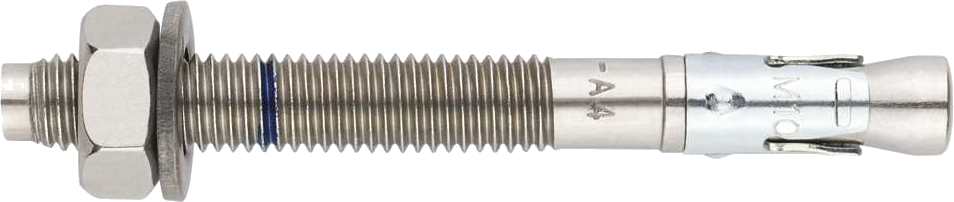
MTP A4 Stainless Steel Wedge Anchor
Wedge anchor made of solid SS316 (A4) stainless steel for cracked concrete — engineered for the most aggressive environments, with ETA1 approval and seismic C1-C2 performance.
The Adit wedge anchor family
Choose the right wedge anchor for your substrate, finish and approval requirements.
Technical specification
| Property | MTP A4 — SS316 stainless steel, European approval |
|---|---|
| Features | SS316 stainless steel wedge anchor for cracked and non-cracked concrete |
| Base material | Solid SS316 / A4 stainless steel |
| Technology | Wedge anchor (expansion) |
| Cracked concrete | Yes |
| Dynamic loads | Yes |
| Seismic (earthquake) | Yes — C1 and C2 |
| Service life approval | 50 years |
| Standards | European ETA1 approval for cracked concrete and seismic C1-C2 |
Downloads
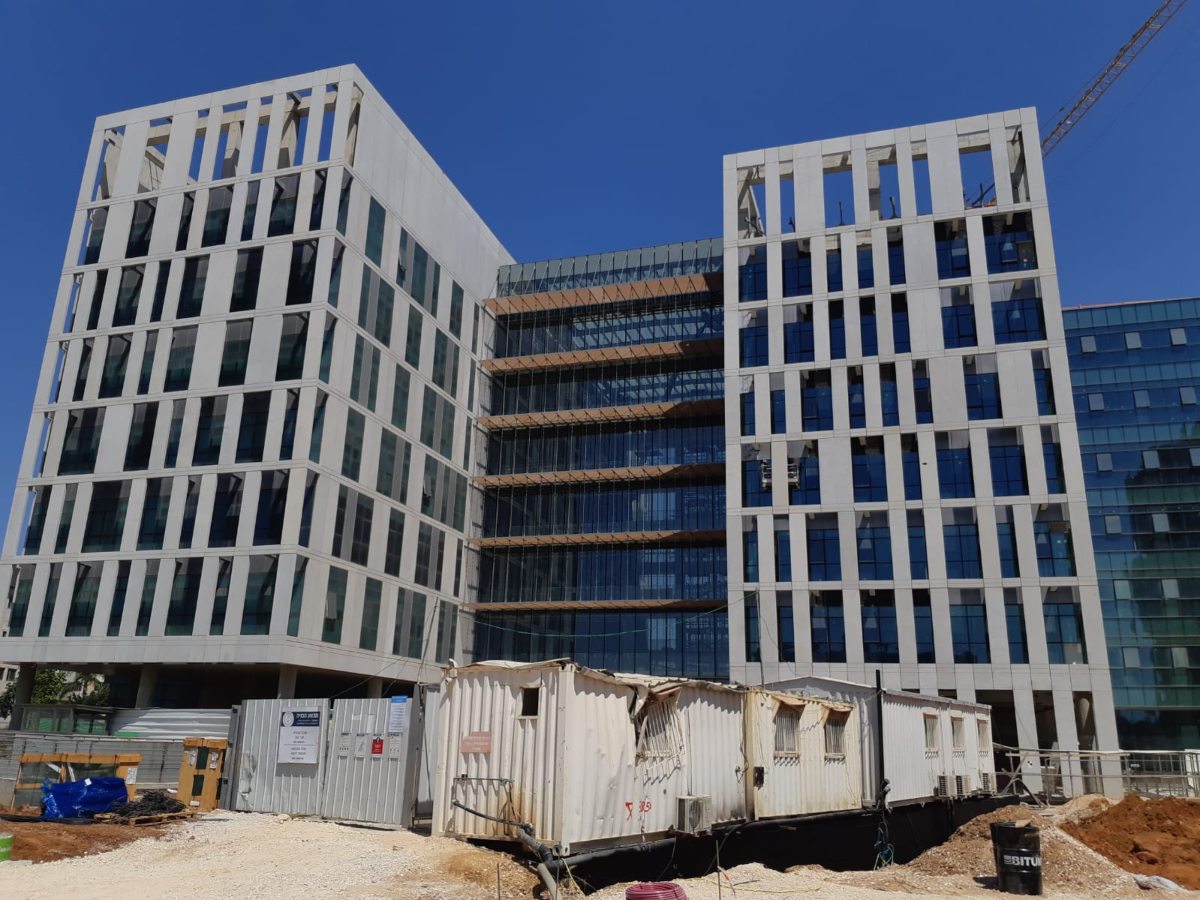
Proven in the field — selected projects in Israel
MTP A4 stainless steel wedge anchors are specified where corrosion resistance and cracked-concrete performance are both required.
Instructional & field-test videos
MTP A4 stainless steel wedge anchor: the complete guide
When a project demands the highest level of safety under the most extreme conditions, a standard wedge anchor is not enough. The ADIT MTP A4 is a premium expansion anchor manufactured from top-grade stainless steel (A4 / SS316), engineered and certified for full performance in both non-cracked and cracked concrete, and approved for seismic categories C1 and C2. It delivers complete peace of mind against structural failure and aggressive corrosion for decades.
A certified engineering solution: cracked concrete and C1/C2 seismic approval
In many modern structures, the tension zones of structural elements inevitably produce microscopic hairline cracks in the concrete. The MTP A4 was developed specifically as a certified stainless steel wedge anchor for cracked concrete, preventing any loss of load-bearing capacity when the surrounding concrete opens or shifts.
Because Israel lies along the Syrian-African Rift, earthquake-resistant design is a mandatory requirement. The MTP A4 provides a proven answer as a stainless steel wedge anchor for seismic applications, qualified in category C1 (secondary elements) and the especially demanding category C2 (primary structural elements, where crack opening during an earthquake can reach critical dimensions of up to 0.8 mm).
The winning combination: seismic resistance together with SS316 stainless steel
In complex projects across the country — from the salty coastal strip of Tel Aviv, Haifa and Ashdod to industrial zones — a combination of mechanical strength and material durability is required. The MTP A4 delivers both at once:
- Full approval for cracked and non-cracked concrete: withstands high tension and shear loads and suits advanced engineering calculations per the updated European standards.
- Seismic categories C1 and C2: designed to absorb kinetic energy and extreme structural vibrations without losing its grip on the concrete.
- Superior chemical composition (SS316): the molybdenum added to the stainless steel alloy resists rust and pitting corrosion in wet and marine environments.
Advantages of the ADIT MTP A4 stainless steel wedge anchor
- Cracked-concrete approval: engineered to perform even when hairline cracks form in the concrete at the anchoring zone.
- C1 and C2 seismic resistance: approved for primary structural elements — the safest solution as a stainless steel wedge anchor for seismic applications.
- Top-grade A4 / SS316 stainless steel: protection against rust and aggressive corrosion, tailored for Israel’s coastline and chemical plants.
- High load values: among the highest pull-out and shear values in its category, allowing a reduction in the number of anchors required.
- Fast expansion technology: a precision expansion clip allows full loading immediately after tightening the nut with a torque wrench.
Engineering comparison: MTH A4 vs. MTP A4
| Engineering criterion | ADIT MTH A4 | ADIT MTP A4 (seismic) |
|---|---|---|
| Material and steel composition | A4 stainless steel (SS316 alloy) | A4 stainless steel (premium SS316 alloy) |
| Non-cracked concrete | Fully approved | Fully approved |
| Cracked concrete | Not intended (non-cracked only) | ETA-approved for cracked concrete |
| Seismic resistance | No seismic classification | Seismic categories C1 and C2 |
| Recommended applications | Railings, pergolas, standard outdoor structures | National infrastructure, bridges, towers, curtain walls |
Common uses of the MTP A4 anchor
- Anchoring curtain walls and heavy cladding on high-rise residential and office towers.
- Engineered steel structures, bridges and industrial buildings in areas of high seismic sensitivity.
- Marine infrastructure, ports, quays and structures along the coastline exposed to salt spray and extreme humidity.
- Anchoring heavy mechanical systems, turbines and machinery that generate continuous vibrations.
- Chemical plants, desalination facilities and wastewater treatment plants exposed to aggressive substances.
- Swimming pools, where chlorine and constant humidity create the harshest conditions for mechanical anchoring.
Field installation guide
- Precise drilling — drill a hole with a diameter that matches the anchor thread, maintaining the minimum drilling depth per the project’s engineering guidelines.
- Thorough cleaning — completely remove the drilling dust with a dedicated blower or brush. Residual dust can drastically impair the expansion mechanism and the anchor’s ability to cope with crack opening.
- Inserting the anchor — drive the stainless steel anchor through the fixture into the clean hole with gentle hammer blows, until it reaches the required installation depth (identified by the marking on the anchor head).
- Controlled tightening — tighten the nut with a calibrated torque wrench to the exact torque value (Tinst) in ADIT’s technical data. Tightening pulls the internal cone, expands the stainless steel clip and locks it into the concrete.
Frequently asked questions
What is the difference between MTP and MTH?
Which finish should I choose?
What makes the MTP A4 suitable for cracked concrete?
Why insist on a C2 seismic rating?
Can the MTP A4 be used in coastal areas without concern for rust?
Is the MTP A4 suitable for blocks, natural stone or Ytong?
Not sure which wedge anchor is right? Tell us about the concrete type, the load and the environment — our engineers will recommend the correct model, diameter and finish.