

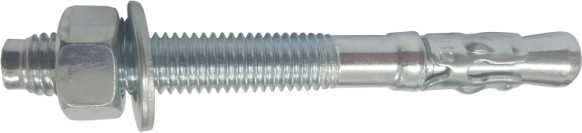
ORA Wedge Anchor
General-purpose zinc-plated carbon-steel wedge anchor for solid (uncracked) concrete — good quality at a competitive price, backed by Israeli Standards Institute lab testing. Available zinc-plated (ORA) or hot-dip galvanized (ORA-G).
The Adit wedge anchor family
Choose the right wedge anchor for your load, substrate and approval requirements.
Technical specification
| Property | ORA — general-purpose wedge anchor |
|---|---|
| Anchor type | Wedge (expansion) anchor |
| Material | Carbon steel |
| Coating | Zinc plated 5–8 µm (ORA) / hot-dip galvanized 40 µm (ORA-G) |
| Concrete | Solid, uncracked concrete |
| Israeli Standards Institute testing | Yes — local laboratory pull-out testing |
| European ETA | No — for structural anchoring use the MTP-X |
| Typical use | General, non-structural fixings where price decides |
Note: the ORA is a general-purpose wedge anchor, backed by Israeli Standards Institute testing — but without a European ETA approval. If the design calls for cracked concrete, seismic loads or approved design load values, move to the MTP-X.
Downloads
Instructional & field-test videos
The ORA wedge anchor: general-purpose fastening in concrete
The ORA is a mechanical wedge (expansion) anchor from Adit Ltd., designed for fast, reliable general-purpose fastening into solid, uncracked concrete. It delivers good quality at a competitive price and is backed by pull-out testing at the Israeli Standards Institute local laboratory. The ORA does not carry a European ETA approval and is intended for general, non-structural fixings.
How a wedge anchor works
A wedge anchor is a torque-controlled expansion anchor. It is inserted into a pre-drilled hole in concrete, and as the nut is tightened the cone at the base of the bolt draws up into an expansion clip. The clip presses outward against the walls of the borehole, creating the friction and interlock that hold the anchor in place. This makes the ORA quick to install and immediately loadable once tightened to the specified torque.
Installation stages
- Drilling — drill a hole to the diameter and depth specified for the anchor size, using a hammer drill in solid concrete.
- Cleaning the hole — blow out and brush the borehole to remove drilling dust for reliable expansion.
- Inserting the anchor — drive the ORA through the fixture into the hole until the required embedment depth is reached.
- Tightening — tighten the nut to the specified torque so the expansion clip sets against the concrete.
ORA vs. ORA-G — choosing the coating
Both versions are the same carbon-steel wedge anchor; only the corrosion coating differs:
- ORA — zinc plated 5–8 µm, for dry indoor environments.
- ORA-G — hot-dip galvanized 40 µm, for outdoor and humid environments where extra corrosion protection is needed.
When to move up to a structural anchor
The ORA is a general-purpose anchor. When a project specification calls for a European ETA approval, cracked-concrete performance, seismic loads or approved design load values, choose an ETA-approved anchor such as the MTP-X. For stainless-steel corrosion resistance, see the MTP A4 or MTH A4.
Why choose Adit Ltd.?
- Engineering support: our engineers help you match the right anchor to your application and loads.
- Quality and testing: the ORA range is backed by Israeli Standards Institute laboratory pull-out and coating tests.
- Competitive price: an excellent price-to-performance ratio for general fixings, in stock for fast supply.
- Full product family: if the job turns structural, we offer the ETA-approved MTP and MTH wedge-anchor ranges.
Frequently asked questions
When should I choose the ORA, and when the MTP-X?
What is the difference between the ORA and the ORA-G?
Does the ORA have a European ETA approval?
Is the ORA suitable for cracked concrete or seismic loads?
What testing backs the ORA?
General fixing or structural? Tell us the application, base material and load — our engineers will point you to the right anchor.