

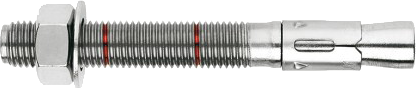
MTH A4 Wedge Anchor — SS316 Stainless Steel
SS316 / A4 solid stainless steel wedge anchor for non-cracked concrete, with European ETA7 approval and a 50-year service-life approval — built for marine, coastal and aggressive environments.
The Adit wedge-anchor family
Choose the right wedge anchor for your concrete condition, environment and approval requirements.
Technical specification
| Property | MTH A4 — SS316 stainless steel wedge anchor, European approval |
|---|---|
| Properties | Stainless steel wedge anchor for non-cracked concrete |
| Raw material | Stainless steel SS316 / A4 |
| Technology | Wedge anchor (mechanical expansion) |
| Cracked concrete | No |
| Seismic | No |
| Loads | Static and quasi-static |
| Service-life approval | 50 years |
| Fire resistance | Yes — European fire resistance approval |
| Standards | European ETA7 approval for non-cracked concrete |
Downloads
Instructional & field-test videos
Stainless steel wedge anchor: the complete guide
Everything you need to know about the MTH A4 stainless steel wedge anchor — from the working principle, through installation, all the way to corrosion protection in the harshest environments. This guide was written by the experts at Adit Ltd.
A stainless steel wedge anchor is a mechanical anchor for concrete used to fasten structures, installations and equipment by means of a mechanical expansion mechanism. After the hole is drilled and the nut is tightened, the expansion clip opens inside the concrete and creates a strong, secure anchorage capable of carrying particularly high tension and shear loads. The ADIT MTH A4 wedge anchor is intended for anchoring in non-cracked concrete and is suited to applications that demand maximum resistance to damp and aggressive environments.
A4 stainless steel and SS316: synonyms for uncompromising quality
In engineering and international standards, the terms A4 stainless steel and SS316 (Stainless Steel 316) are identical names for the same high-quality stainless steel alloy. A4 is the material designation under the European (ISO) standard, while SS316 is the designation under the American (AISI) standard. This alloy contains an essential addition of molybdenum, which gives the anchor exceptional resistance to corrosion, rust and chemical attack compared with more basic stainless steel such as A2 / SS304.
When is a stainless steel wedge anchor mandatory?
While a galvanized steel anchor is suitable for dry, indoor spaces, the MTH A4 stainless steel wedge anchor becomes mandatory in outdoor applications and in challenging environments:
- Outdoor elements exposed to rain and moisture: steel structures, railings on open balconies, pergolas and canopies.
- Proximity to the coastline (marine environment): high humidity combined with salt spray accelerates corrosion dramatically. A4 stainless steel is the standard solution for preventing engineering failure in these areas.
- Infrastructure and chemical facilities: industrial plants, channels, external service systems and locations exposed to solvents or mild chemicals.
Advantages of the ADIT MTH A4 stainless steel wedge anchor
- Complete protection against corrosion: maximum resistance to rust in outdoor applications, marine environments and damp coastal areas.
- High load-bearing capacity: a rugged, reliable mechanical mechanism with excellent tension and shear performance in concrete.
- Fast and simple installation: an intuitive process that saves working time and on-site resources.
- Immediate loading after tightening: work and structural loading can continue immediately, with no curing or drying time.
- Cost-effective: high-quality steel at a competitive price that eliminates the need to replace rusted anchors or perform future maintenance.
- Safety and precision: the embedment depth is easy to identify by means of a mark stamped on the head of the anchor.
Galvanized anchor vs. A4 stainless steel wedge anchor
| Engineering property | ADIT MTH (cold galvanized) | ADIT MTH A4 (stainless steel) |
|---|---|---|
| Material and composition | Carbon steel with a cold galvanized coating | A4 stainless steel (SS316 alloy) |
| Recommended working environment | Indoor, enclosed, dry and protected from water | Outdoor, exposed, damp, marine and aggressive |
| Rust and corrosion resistance | Basic (depends on the integrity of the galvanized layer) | Very high (inherent resistance thanks to the molybdenum) |
| Service life outdoors | Limited (may develop significant rust over the years) | Particularly long (decades with no structural damage) |
Cracked vs. non-cracked concrete
What is cracked concrete? An engineering condition in which there is a high probability of a hairline crack of up to 0.3 mm appearing in the installation area after installation, as a result of tensile loads in the concrete or the forces applied by the anchor itself. Many design offices define all concrete as cracked for extra safety, even though this is not necessarily required.
When do we choose MTH A4? The MTH A4 anchor is a professional, reliable solution for non-cracked concrete. If the engineering design specifically defines the area as cracked concrete, or requires seismic resistance (C1 / C2), choose an anchor with a matching ETA approval such as MTP A4.
Common uses of the stainless steel wedge anchor
The ADIT MTH A4 wedge anchor is especially suitable when a strong, fast and corrosion-resistant mechanical connection to concrete is required:
- Fastening curtain walls and external cladding to buildings.
- Anchoring safety railings and open balconies.
- Steel structures and metal frames exposed to the elements.
- Machinery and industrial equipment in damp, aggressive production environments.
- Channels and external service systems.
- Storage facilities, shelving and engineered equipment bases.
- Installation of posts, lighting systems and pergolas.
- Fixing outdoor electrical cabinets and heavy equipment.
On-site installation guide for a wedge anchor
The installation process is simple and fast, but requires precision to ensure load-bearing capacity:
- Drilling the hole — drill a hole in the concrete with a diameter exactly equal to the thread diameter of the wedge anchor.
- Thorough cleaning — clean the hole well of drilling dust. This is a critical step to prevent a reduction in the anchor’s holding capacity.
- Inserting the anchor — insert the stainless steel anchor into the cleaned hole using a hammer, to the required depth.
- Tightening to torque — tighten the nut with a torque wrench to the manufacturer’s recommended value. Tightening pulls the cone, opens the expansion clip and locks it into the concrete.
Frequently asked questions
What is the difference between MTP and MTH?
Which finish should I choose?
What is a wedge anchor?
What is the difference between an A2 and an A4 stainless steel wedge anchor?
Can a stainless steel wedge anchor rust?
What is the difference between a wedge anchor and a jumbo sleeve anchor?
Can a stainless steel wedge anchor be used in a block or aerated-concrete (Ytong) wall?
Can a wedge anchor be removed after it has been tightened on site?
Not sure which wedge anchor is right for you? Tell us the concrete type, the load and the environment — our engineers will recommend the correct model, diameter and finish.