

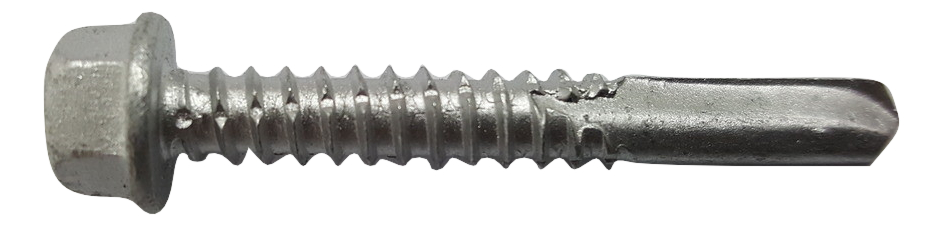
BAUTO Bi-Metal Self-Drilling Screw
BAUTO stainless-steel bi-metal self-drilling screw for steel — drills steel and aluminium up to 12 mm in a single action, with an SS304 body and Silver Ruspert corrosion protection.
The Adit self-drilling screw family
Choose the right self-drilling screw for your material, thickness and corrosion environment.
Technical specification
| Property | BAUTO — bi-metal stainless-steel self-drilling screw |
|---|---|
| Characteristics | Bi-metal self-drilling screw for steel (up to 12 mm) |
| Material | Head + threaded section: SS304 · Drill tip: SAE J403 1022 steel |
| Corrosion protection | Silver Ruspert Coating |
| Head | M8 hex socket |
| Installation tool | High-speed screwdriver (1000-1800 rpm) |
| Option | EPDM ARVUL sealing washer |
Downloads
Instructional & field-test videos
What is the ADIT BAUTO stainless-steel bi-metal self-drilling screw? A full explanation
The professional stainless-steel self-drilling screw, known in the industry as the premium bi-metal self-drilling screw from the ADIT BAUTO series, is a breakthrough engineered fastening solution that combines two metals in a single action. The screw is built from a high-grade stainless-steel body topped by a powerful drill tip made of hard, hardened steel. This advanced construction lets the screw drill through especially thick steel on its own, thread into it, and create a tight connection in one continuous action — with no need for pre-punching or pre-drilling a pilot hole.
Unlike ordinary screws that require lengthy preparation, using the BAUTO bi-metal self-drilling screw saves critical work stages, prevents drill-bit wear and provides complete protection against rust. The direct result is a massive reduction in working time, savings on tools in the field and a significantly lower overall installation cost.
When do you use the BAUTO stainless-steel self-drilling screw? The BAUTO screw series is designed for applications that demand high load capacity and maximum corrosion resistance: connecting heavy steel profiles, aluminium structures, mounting insulated panels and building envelopes in aggressive environments, the chemical industry, outdoor applications and demanding structures.
The advantages of the ADIT BAUTO bi-metal stainless-steel screw
- Phenomenal drilling ability: Direct drilling of up to 12 mm of steel or aluminium profile thickness, effortlessly and without a pilot hole.
- True bi-metal technology: A perfect engineering combination of a rust-resistant SS304 stainless-steel body and a hard, hardened steel drill tip.
- Proven durability in aggressive environments: The screw carries a Silver Ruspert coating that resists galvanic corrosion and guarantees many years of durability in harsh outdoor conditions.
- Certified technical data: Accurate pull-out, shear and design-load values, tested and defined for contractors and engineers who require complete structural precision.
- Support and specification compliance: A complete solution accompanied by detailed load tables and designed to meet the most stringent building standards.
Certified technical data — BAUTO bi-metal self-drilling screw (ST 5.5 diameter)
The following data forms the engineering basis for safe structural design using the BAUTO stainless-steel self-drilling screw. All values in the tables are given in kN for a single fastener.
Load table — connection to steel profile (ST 5.5)
| Defined load parameter (kN) | Steel 2 mm | Steel 3.5 mm | Steel 5 mm |
|---|---|---|---|
| Characteristic failure load — pull-out (Nrk) | 5.3 | 8.6 | 12.5 |
| Characteristic failure load — shear (Vrk) | 4.8 | 4.8 | 4.8 |
| Structural design load — pull-out (Nrd) | 2.5 | 4.0 | 5.8 |
| Structural design load — shear (Vrd) | 3.9 | 3.9 | 3.9 |
| Recommended service load — pull-out (Nrec) | 1.8 | 2.9 | 4.2 |
| Recommended service load — shear (Vrec) | 2.8 | 2.8 | 2.8 |
Load table — connection to aluminium profile (ST 5.5)
| Defined load parameter (kN) | Aluminium 2 mm | Aluminium 3 mm | Aluminium 4 mm |
|---|---|---|---|
| Characteristic failure load — pull-out (Nrk) | 2.9 | 4.5 | 6.3 |
| Characteristic failure load — shear (Vrk) | 4.8 | 4.8 | 4.8 |
| Structural design load — pull-out (Nrd) | 1.3 | 2.1 | 2.9 |
| Structural design load — shear (Vrd) | 3.9 | 3.9 | 3.9 |
| Recommended service load — pull-out (Nrec) | 1.0 | 1.5 | 2.1 |
| Recommended service load — shear (Vrec) | 2.8 | 2.8 | 2.8 |
Geometry and mechanical dimensions — ADIT BAUTO
The professional screw series offers precise dimensions that ensure a perfect fit for working with steel and heavy structures:
| Screw type | Outer diameter incl. thread (D) | Recommended steel thickness (mm) | Drill-tip length Z (mm) | Drill-tip diameter dp (mm) | Pitch P (mm) | Hex socket e (mm) | Head thickness K (mm) | Washer diameter dk (mm) |
|---|---|---|---|---|---|---|---|---|
| BAUTO ST 5.5 | 5.46 mm | 2.0 – 12.0 mm | 16 mm | 5.1 mm | 1.06 mm | 8 mm | 5.3 mm | 11 mm |
Installation guide and working parameters — bi-metal self-drilling screw
- Marking and entry point: It is recommended to make a light punch mark (using a center punch) at the intended entry point. This action centres the screw’s drill tip and prevents it from slipping on the stainless-steel or steel surface.
- Choosing the tool and driving the screw: BAUTO screws can be driven with a professional, suitable impact driver. Maintain constant pressure and keep the screw straight (at a 90-degree angle) to the base material in order to prevent deformation or breakage.
- Regulating speed and working torque: Adjusting the rotation speed (RPM) is critical to successful direct drilling:
- Recommended drilling speed in steel: 1000 – 1800 rpm.
- Recommended drilling speed in stainless steel: 600 – 1000 rpm.
- Maximum permitted drilling time: up to 11 seconds.
- Maximum installation torque: 6.2 Newton-metres (Nm).
- Finishing the tightening and stopping: Stop the driving action immediately once the screw head or washer contacts the profile. If an EPDM rubber sealing washer is used, make sure it is pressed evenly and fully seals against water ingress, but is not crushed or deformed.
Self-drilling screw models and fastening solutions in the ADIT catalogue
- BAUTO / BAUTO EPDM: The company’s flagship series. A stainless-steel self-drilling screw built as a bi-metal self-drilling screw with an exceptional drilling ability of up to 12 mm of steel thickness. Available in lengths of 40, 50, 65, 80 and 100 mm, with the option of a UV-resistant EPDM sealing washer to prevent water ingress.
- ABE: A classic self-drilling steel screw, hex head with washer and cold galvanizing for indoor environments.
- ABEI: A self-drilling screw made entirely of solid 304SS stainless steel, suitable for outdoor and coastal environments.
- BIE / BIE A4: A bi-metal screw combining a stainless-steel body and a hard steel drill tip for fast drilling in stainless steel and hard steels (also available in A4/316SS grade).
- AUTO: A self-drilling screw fitted with an extra-long drill tip for direct drilling into heavy, thick profiles.
- PS3 / PSL: Extra-long dedicated screws supplied with wide EPDM sealing washers, designed for insulated panel and roofing applications.
- ABP / ABR: Self-drilling screws with aesthetic, decorative heads — a countersunk conical head (ABP) or a round flat head (ABR).
- RSZ / RS A2: Self-drilling screws with a small, fine wafer head, ideal for delicate joints, aluminium work and fine frames.
Advanced engineering consultancy at ADIT Ltd.
The market is full of cheap screws that tend to break under shear loads, rust quickly or fail during drilling. ADIT Ltd. provides its customers with a complete engineering package that includes professional support, certified load tables and assistance in accurately calculating the required screw diameter and length. The company’s engineers are always available to ensure standard-compliant, safe and economical structural design in the field.
Frequently asked questions
What is a bi-metal self-drilling screw and why is it considered the leading solution for thick steel?
Under what conditions and specifications must an ADIT BAUTO stainless-steel self-drilling screw be used?
Can a bi-metal stainless-steel self-drilling screw really drill 12 mm steel without pre-drilling?
What speed and torque parameters are recommended for BAUTO screws to prevent installation failure?
Why is the EPDM sealing washer important in self-drilling and self-tapping screws?
What is the difference between the characteristic failure load (Nrk) and the design load (Nrd) shown in the ADIT tables?
Planning a steel or aluminium fastening project? Tell us the profile thickness, material and load — our engineers will help you select the right BAUTO screw length and send you the certified load tables.