

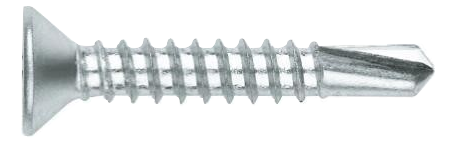
ABP Self-Drilling Countersunk Head Screw
Self-drilling Tek screw with a countersunk (flush) head that sinks fully into the surface — for connecting steel and aluminium profiles up to 5 mm, with approved pull-out and shear data.
The Adit self-drilling screw (Tek) family
Choose the right self-drilling screw for your head type, profile material and thickness.
Technical specification
| Property | ABP — self-drilling countersunk head screw |
|---|---|
| Screw type | Self-drilling screw for steel, countersunk head (up to 5 mm) |
| Material | SAE J403 1022 steel with heat treatment |
| Standard | DIN 7504K |
| Corrosion protection | Cold galvanized 5-8 micron |
| Head | Countersunk (conical, 80°) |
| Bit | PH (Phillips) |
| Installation tool | High-speed screwdriver (1000-1800 rpm) |
| Also available | Black-galvanized version (NBP) for a dark finish |
Downloads
What is a countersunk head self-drilling screw (flush-head Tek screw)? Full explanation
A countersunk head self-drilling screw (Counter-Sink Self-Drilling Screw), also known as a flush-head self-drilling screw or a countersunk-head Tek screw, is an engineered fastening solution that combines a drilling tip (drill flute) at its end with a conical head profile (80° angle) that allows the screw head to sink completely into the surface layer of the material. This structure lets the screw pierce the base material on its own and thread into it in one continuous action – with no need to pre-drill a hole.
Unlike a hex-head self-drilling screw (ABE) that remains protruding above the profile surface, the ABP countersunk head self-drilling screw sinks fully into the material and provides a uniform, smooth and aesthetic surface. That is its major advantage: the screw head does not protrude, does not interfere with adjacent surfaces and does not “catch” on clothing, tools or containers. For applications requiring a smooth, uniform face – the ABP flush-head self-drilling screw is the right solution.
When do you use a countersunk head self-drilling screw? The ABP self-drilling screw suits applications such as: installing metal panels and cladding where a smooth surface is required, connecting light gauge steel and aluminium profiles (Light Gauge Steel), drywall construction, metal finishing, framing, metal furniture and a wide range of industrial and cladding applications where aesthetics matter. Note: the screw requires a pre-formed countersink (Counter-Sinking) in the top material so that its head sinks properly and does not crack.
The advantages of the ABP countersunk head self-drilling screw – not every flush-head Tek screw is the same
- Fully flush head: an 80° conical profile lets the screw head sink exactly to surface level – giving a finished, aesthetic result with no protrusions.
- Approved technical data: accurate pull-out and shear values for every diameter and profile thickness (enabling safe engineering design) – for connecting to steel and aluminium profiles.
- Direct-threading technology: the screw drills and threads in a single action – no pre-drilling for the connection, no accessories and no “dead time” on site (after only a conical countersink in the top material).
- Proven field durability: made of C1035 steel with a cold-galvanized coating – it does not break, bend or disappoint (unlike cheap, undocumented alternatives). Also available in a black version (NBP) for a dark finish.
- Huge range of options: 5 diameters (from ST3.5 to ST5.5), dozens of lengths from 9.5 up to 50 mm, a convenient Ph bit – a complete solution for any specification.
- Support and warranty: designed for contractors and engineers who require engineering backing, load tables and compliance with strict building codes.
Approved technical data – ABP countersunk head self-drilling screw – connection to steel profile
The following data forms the basis for safe structural design. All values in the tables are in kN per single screw. Note: the values detailed below are failure loads (Failure Loads – Nrk/Vrk). For engineering design, an appropriate safety factor must be applied (to obtain the service load). The designer must also verify the tear resistance of the profile itself.
ST 3.5 – countersunk head self-drilling screw – connection to steel profile
| Characteristic failure load parameter (kN) | Steel thickness 0.8 mm | Steel thickness 1.5 mm | Steel thickness 2 mm |
|---|---|---|---|
| Failure load – pull-out (Nrk) | 1.9 | 3.0 | 3.8 |
| Failure load – shear (Vrk) | 1.9 | 1.9 | 1.9 |
| Design load – pull-out (Nrd) | 0.8 | 1.2 | 1.6 |
| Recommended load – pull-out (Nrec) | 0.6 | 0.9 | 1.1 |
ST 4.2 – countersunk head self-drilling screw – connection to steel profile
| Characteristic failure load parameter (kN) | Steel thickness 2 mm | Steel thickness 2.5 mm | Steel thickness 3 mm |
|---|---|---|---|
| Failure load – pull-out (Nrk) | 4.6 | 5.0 | 5.3 |
| Failure load – shear (Vrk) | 2.6 | 2.6 | 2.6 |
| Design load – pull-out (Nrd) | 2.1 | 2.3 | 3.7 |
| Recommended load – pull-out (Nrec) | 1.5 | 1.6 | 2.6 |
ST 4.8 – countersunk head self-drilling screw – connection to steel profile
| Characteristic failure load parameter (kN) | Steel thickness 2 mm | Steel thickness 3 mm | Steel thickness 4 mm |
|---|---|---|---|
| Failure load – pull-out (Nrk) | 5.7 | 7.1 | 7.1 |
| Failure load – shear (Vrk) | 3.6 | 3.6 | 3.6 |
| Design load – pull-out (Nrd) | 2.6 | 3.9 | 5.2 |
| Recommended load – pull-out (Nrec) | 1.9 | 2.8 | 3.7 |
ST 5.5 – countersunk head self-drilling screw – connection to steel profile
| Characteristic failure load parameter (kN) | Steel thickness 2 mm | Steel thickness 3.5 mm | Steel thickness 5 mm |
|---|---|---|---|
| Failure load – pull-out (Nrk) | 5.4 | 8.7 | 9.6 |
| Failure load – shear (Vrk) | 4.8 | 4.8 | 4.8 |
| Design load – pull-out (Nrd) | 2.5 | 4.0 | 4.8 |
| Recommended load – pull-out (Nrec) | 1.8 | 2.9 | 3.4 |
ST 4.8 – ABP countersunk head self-drilling screw – connection to aluminium profile
| Characteristic failure load parameter (kN) | Aluminium thickness 2 mm | Aluminium thickness 3 mm | Aluminium thickness 4 mm |
|---|---|---|---|
| Failure load – pull-out (Nrk) | 2.9 | 4.6 | 6.4 |
| Failure load – shear (Vrk) | 3.6 | 3.6 | 3.6 |
| Recommended load – pull-out (Nrec) | 1.0 | 1.5 | 2.1 |
Geometry and dimensions – ABP countersunk head self-drilling screw
ADIT’s ABP flush-head self-drilling screw series offers dimensions to match every profile thickness and drilling requirement. All models come with a Ph (Phillips) bit for maximum ease of use:
| Screw diameter | Head diameter (mm) | Head thickness (mm) | Bit | Drillable steel thickness (mm) | Available lengths (mm) | Drilling speed in steel (rpm) |
|---|---|---|---|---|---|---|
| ST 3.5 | 6.8 | 2.1 | Ph 2 | 0.70 – 2.25 | 9.5 – 25 | 1800 – 2500 |
| ST 3.9 | 7.5 | 2.3 | Ph 2 | 0.70 – 2.40 | 13 – 38 | 1800 – 2500 |
| ST 4.2 | 8.1 | 2.5 | Ph 2 | 1.75 – 3.00 | 13 – 38 | 1000 – 1800 |
| ST 4.8 | 9.5 | 3.0 | Ph 2 | 1.75 – 4.40 | 13 – 50 | 1800 – 2500 |
| ST 5.5 | 10.8 | 3.4 | Ph 3 | 1.75 – 5.25 | 19 – 50 | 1000 – 1800 |
Quick installation guide – countersunk head self-drilling screw (for steel)
- Form a conical countersink (Counter-Sinking) in the top material: a critical step unique to the flush-head screw – before driving the screw, form a countersink cone in the top material at an 80° angle and a diameter matching the screw head, so the conical head sinks exactly to surface level and does not crack the steel.
- Mark the drilling point: a light tap with a center punch for accurate centering will prevent the screw’s drilling tip from slipping at the start of rotation.
- Prepare the correct screwdriver: use a screwdriver with the speed and torque per the table. An impact driver may be used – but only if you stop immediately once the screw head seats against the profile, to prevent stripping the thread (“wallowing the screw”) and damaging the flush finish.
- Drive perpendicular to the profile: hold the screwdriver at 90 degrees to the material with uniform, continuous pressure. Driving at an angle breaks the drilling tip, weakens the connection and leaves a head that does not sit flush.
- Stop when the head seats: when the screw sinks and reaches the required tightening torque – stop. Over-tightening may crack the steel or damage the thread and finish quality.
All self-drilling screw (Tek) models in the ADIT catalog
- ABE: classic self-drilling steel screw, hex head with washer, cold galvanized. The basic professional series for steel and aluminium profile connections.
- ABEI: identical to ABE but made of 304SS stainless steel. Suitable for aggressive environments, outdoors, coastal areas and the chemical industry.
- BIE / BIE A4: bi-metal screw (stainless body, hard steel drilling tip). Designed for fast, direct drilling into stainless and hard steel (also available in A4/316SS).
- AUTO / BAUTO: self-drilling screw with an extra-long drilling tip – enabling drilling up to 12 mm steel thickness! For heavy profiles. The BAUTO is the stainless bi-metal version.
- PS3 / PSL: extra-long screws for connecting insulated (sandwich) panels. Always come with an EPDM sealing washer for perfect protection against rain.
- ABP / NBP: self-drilling screws with a countersunk (Counter-Sink) flush head for smooth surfaces. ABP – cold galvanized. NBP – black galvanized. This is the series described on this page.
- ABR: self-drilling screw with a round, flat head.
- RSZ / RS A2: self-drilling screw with a small lens head for fine seams and framing.
Engineering consultation + a quality countersunk head self-drilling screw = a complete solution
The market is flooded with cheap self-drilling screws from obscure sources that often break under load, drill slowly, rust quickly, or whose conical head does not sink accurately and leaves ugly protrusions. What sets ADIT Ltd. apart from other suppliers is the knowledge and the standardization. The company’s engineers are available to help calculate and select the screw diameter, screw length and correct model, which saves the cost of field failures and enables standard, approved structural design.
Frequently asked questions – countersunk head self-drilling screw and flush-head Tek screw
What is the difference between a countersunk head self-drilling screw (ABP) and a hex head self-drilling screw (ABE)?
What is the difference between a countersunk head self-drilling screw (ABP) and an ordinary countersunk head self-tapping screw?
Is pre-drilling required before driving a countersunk head self-drilling screw?
How do I know which diameter of countersunk head self-drilling screw to choose?
What is the difference between ABP and NBP?
Does a steel countersunk head self-drilling screw rust outdoors?
Can a countersunk head self-drilling screw (ABP) be used to connect aluminium?
Why does the conical screw head not sink properly and leave a protrusion?
What is the difference between Nrd (design load) and the characteristic failure load (Nrk)?
Can a countersunk head self-drilling screw be removed and re-driven into the same hole?
How many countersunk head self-drilling screws do I need to buy – what is the pack size?
What is the correct driving bit for the ABP countersunk head self-drilling screw?
What quantity of countersunk head self-drilling screws is required for a structural connection – how is it calculated?
Planning a steel or aluminium cladding project? Tell us the profile thickness and load – our engineers will select the correct screw diameter and length and provide the pull-out and shear data.