

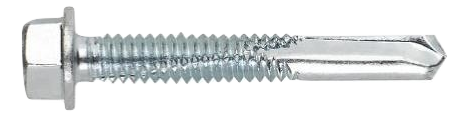
ADIT AUTO Self-Drilling Screw
Structural self-drilling screw for particularly thick steel — a long No. 5 drill point that pierces, threads and forms a nut thread in structural steel from 4 mm up to 12 mm in one continuous action, with no pre-drilling.
The Adit self-drilling screw family
Choose the right self-drilling screw for your steel thickness, head type and environment.
Approved technical data — fastening to structural steel profiles
Values are the engineering basis for designing safe structural connections. All table values are in kN per single screw.
Please note: the values below are characteristic failure loads (Nrk/Vrk). For engineering design, apply appropriate safety factors to obtain the allowable service load, and verify the profile’s tear-out capacity.
ADIT AUTO ST 5.5 — fastening to a thick steel profile
| Characteristic failure-load parameter (kN) | Steel thickness 5 mm | Steel thickness 8 mm | Steel thickness 12 mm |
|---|---|---|---|
| Failure load — pull-out (Nrk) | 11.2 | 14.8 | 15.5 |
| Failure load — shear (Vrk) | 8.4 | 8.4 | 8.4 |
ADIT AUTO ST 6.3 — fastening to a thick steel profile (the heavy-duty diameter)
| Characteristic failure-load parameter (kN) | Steel thickness 6 mm | Steel thickness 10 mm | Steel thickness 12 mm |
|---|---|---|---|
| Failure load — pull-out (Nrk) | 14.1 | 18.9 | 19.6 |
| Failure load — shear (Vrk) | 11.5 | 11.5 | 11.5 |
Geometry and dimensions — the ADIT AUTO series
| Screw diameter | Steel thickness range (mm) | Drill point length Z (mm) | Recommended drilling speed (rpm) | Maximum installation torque (Nm) |
|---|---|---|---|---|
| ADIT AUTO ST 5.5 | 4.00 – 12.00 | 14.0 | 1000 – 1500 | 13.0 |
| ADIT AUTO ST 6.3 | 4.00 – 12.00 | 15.0 | 800 – 1200 | 20.0 |
Proven in the field — selected projects in Israel
The ADIT AUTO steel self-drilling screw is installed in demanding structural-steel projects.

What is the ADIT AUTO heavy-steel self-drilling screw? A full explanation
The steel self-drilling screw from the ADIT AUTO series (known in the construction industry as a self-drilling screw for thick steel or a structural self-drilling screw) is an advanced engineering solution designed for direct fastening to particularly heavy and thick steel profiles. Its unique feature is a long, reinforced drill point (Drill Point #5) that lets it pierce structural steel up to 12 mm thick, thread itself and form a perfect nut thread in a single, fast, continuous action — with no need for pre-drilling.
While every standard self-drilling screw is limited to thin plates or light profiles, the ADIT AUTO steel self-drilling screw completely eliminates the need for expensive external drill bits, prevents drill-bit breakage on site, and cuts structural work time by tens of percent. The direct result is a low installation cost and fast, safe and precise engineering execution.
When do you use a self-drilling screw for thick steel?
The ADIT AUTO series is designed for demanding applications such as: fastening to hot-rolled steel profiles (like IPE and HEB beams and UNP channels), installing heavy structures, industrial steel frames, fastening insulated panels to thick profiles, and building large-span sheds and steel structures.
Advantages of the ADIT AUTO steel self-drilling screw — engineering power up to 12 mm
- Exceptional drilling capacity: an extra-long No. 5 drill point designed to penetrate structural steel from 4 mm up to 12 mm thick effortlessly.
- Approved structural values: detailed load tables for pull-out and shear values that let designers and structural engineers perform safe, approved static calculations.
- Reinforced steel and durable coating: the screws are manufactured from the highest-quality heat-treated steel with a protective coating that prevents failure, stripping or breakage while penetrating the profile.
- Available in a bi-metal version (BAUTO): a perfect solution combining a stainless-steel body for maximum corrosion resistance with a hard carbon-steel drill tip for direct drilling.
- Complete field-work efficiency: eliminating the pre-drilling stage, reducing wear on mechanical tools and zero “downtime” on construction sites.
Correct installation guide for self-drilling screws in thick steel (12 mm)
- Accurate centering — it is recommended to make a light mark with a center punch at the fastening point. This prevents the screw’s long drill point from “dancing” or sliding across the structural profile when starting.
- Adjusting the driver speed (RPM) — drilling in 12 mm thick steel requires working at a steady, moderate speed in line with the technical table. Too high a speed will overheat the drill point, cause it to lose its hardness and burn the screw tip.
- Maintaining a 90-degree angle — hold the tool perfectly perpendicular to the steel surface. Applying pressure at an angle will break the drilling wings and seriously harm the quality of the thread being formed.
- Controlling the seating torque — as soon as the screw head or the EPDM sealing washer seats against the surface, stop the driver immediately. Applying excess torque (especially with powerful impact drivers) can shear the screw head or destroy the internal thread cut into the profile.
Engineering support, standards and uncompromising quality
The construction market is saturated with cheap, unregulated products labeled as self-drilling or steel-drilling screws that in practice suffer from frequent breakage, slow drilling rates or rapid rusting that leads to serious structural failure.
ADIT Ltd. offers you engineering expertise, complete technical documentation and certified load tables. The company’s engineers are available to provide professional guidance, match the exact screw diameter and length to your project, and ensure a code-compliant, safe and durable connection solution for years to come.
Frequently asked questions — heavy-steel self-drilling screws
What is an ADIT AUTO steel self-drilling screw, and what sets it apart from a regular self-drilling screw?
Why is the drill-point length (dimension Z) so critical when working with 12 mm thick steel?
What is the difference between the AUTO steel self-drilling screw and the BAUTO model?
What is the essential difference between a self-drilling screw (for steel) and a self-tapping screw?
What working speeds (RPM) should be used when installing a heavy-steel self-drilling screw?
Can a regular steel self-drilling screw be used inside aluminum structures?
What is the difference between the technical value Nrk and the value Nrd that appears in engineering specifications?
Can the same steel self-drilling screw or the same drilled hole be reused?
Fastening to thick structural steel? Tell us the profile thickness, load and diameter — our engineers will match the exact AUTO screw and send you the certified load tables.