

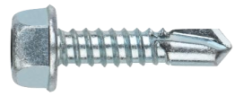
ABE Self-Drilling Steel Screw
Self-drilling metal screw for steel up to 6 mm — direct fixing in a single action, hex washer head, cold galvanized, with approved pull-out and shear data.
The Adit self-drilling screw family
Choose the right self-drilling screw for your material, thickness and environment.
Technical specification
| Property | ABE — self-drilling steel screw |
|---|---|
| Characteristics | Self-drilling screw for steel (up to 6 mm) |
| Material | SAE J403 1022 steel with thermal treatment |
| Standards | DIN 7504K |
| Corrosion protection | Cold galvanizing 5-8 micron |
| Head | Hex washer head |
| Installation tool | High-speed screw gun (1000-1800 rpm) |
| Option | EPDM ARVUL sealing washer |
Downloads
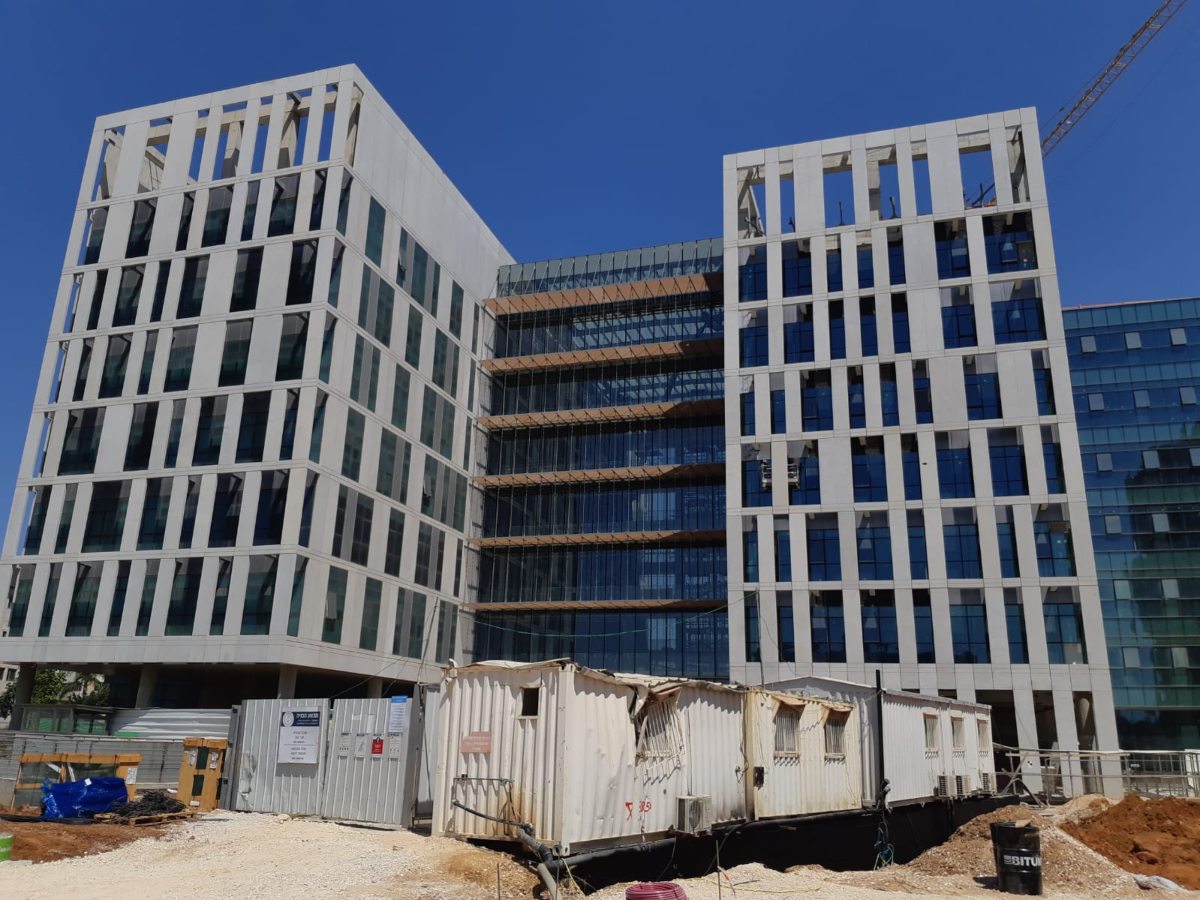
Proven in the field — selected projects in Israel
The ABE self-drilling screw is installed in projects across Israel.
ABE self-drilling screw — installation videos
ABE self-drilling metal screw — installation guide.
What is a self-drilling steel screw? A full explanation
A self-drilling (steel) screw is an engineered fastening solution that combines a drilling tip (drilling flute) at its end. This structure allows the screw to pierce the base material by itself and thread into it in a single continuous action — without the need for pre-punching or pre-drilling a hole.
Unlike a regular self-tapping screw, which requires a pre-drilled hole, the ABE self-drilling screw eliminates an entire installation step. The result: minimal working time, fewer tools, and a significantly lower overall installation cost.
When are self-drilling steel screws used? The ABE self-drilling screw is suitable for applications such as: connecting light-gauge steel profiles, mounting metal panels and cladding, drywall construction, frame construction, metal roofing, and a wide range of structural, cladding, and industrial applications.
The advantages of the ABE self-drilling screw — not every self-drilling screw is the same
- Approved technical data: Precise pull-out and shear values for every diameter and profile thickness (enabling safe engineering design).
- Direct-fixing technology: The screw drills and threads in a single action — no pre-punching, no accessories, and no “dead time” on site.
- Proven field durability: Made of C1035 steel with a cold galvanized coating — it does not break, bend, or disappoint (unlike cheap, undocumented alternatives).
- A vast range of options: 5 diameters (from ST3.5 to ST6.3), dozens of lengths from 13 to 240 mm, and different head types (countersunk, pan, hex) — a complete solution for every specification.
- Support and reliability: Designed for contractors and engineers who require engineering backup, load tables, and compliance with strict building regulations.
Approved technical data — connection to a steel profile
The following data forms the basis for safe structural design. All values in the tables are in kN per single screw. Note: the values listed below are failure loads (Nrk/Vrk). For engineering design, an appropriate safety factor must be applied (to obtain the service load). The designer must also verify the load capacity of the profile itself against tear-out.
All values are characteristic failure loads (kN) per single screw.
ST 4.8 — connection to a steel profile
| Typical characteristic failure load (kN) | Steel thickness 2 mm | Steel thickness 3 mm | Steel thickness 4 mm |
|---|---|---|---|
| Failure load — pull-out (Nrk) | 5.7 | 7.1 | 7.1 |
| Failure load — shear (Vrk) | 3.6 | 3.6 | 3.6 |
ST 6.3 — connection to a steel profile (the largest screw in the series)
| Typical characteristic failure load (kN) | Steel thickness 2.5 mm | Steel thickness 4 mm | Steel thickness 5 mm |
|---|---|---|---|
| Failure load — pull-out (Nrk) | 4.3 | 9.6 | 13.4 |
| Failure load — shear (Vrk) | 6.9 | 6.9 | 6.9 |
Geometry and dimensions — ABE self-drilling screw
Adit’s self-drilling screw series offers dimensions matching every steel thickness and drilling requirement:
| Screw diameter | Recommended steel thickness (mm) | Drilling length Z (mm) | Recommended drilling speed in steel (rpm) | Max installation torque (Nm) |
|---|---|---|---|---|
| ST 3.5 | 0.70 – 2.25 | – | 1800 – 2500 | 2.8 |
| ST 4.2 | 1.75 – 3.00 | – | 1000 – 1800 | 4.7 |
| ST 4.8 | 1.75 – 4.40 | 5.1 | 1800 – 2500 | 6.9 |
| ST 5.5 | 1.75 – 5.25 | 7.9 | 1000 – 1800 | 10.4 |
| ST 6.3 | 2.50 – 6.00 | 9.3 | 1000 – 1800 | 16.9 |
Quick installation guide — self-drilling (steel) screw
- Mark the drilling point: A light tap with a punch (center punch) for precise centering will prevent the screw’s drilling tip from slipping at the start of rotation.
- Prepare the right screw gun: Use a screw gun with the speed and torque per the table. An impact driver may be used — but only if you stop immediately once the screw head seats against the profile, to prevent stripping the thread.
- Drive perpendicular to the profile: Hold the driver at 90 degrees to the material with steady, continuous pressure. Driving at an angle causes the drilling tip to break and results in a weak, defective connection.
- Stop when the screw seats: When the screw seats and reaches the required tightening torque — stop. For self-drilling screws with a rubber (EPDM) sealing washer, stop when the washer is compressed evenly but not fully crushed.
All self-drilling screw models in the Adit catalog
- ABE: Classic self-drilling steel screw, hex head with washer, cold galvanized. The basic professional series for connecting steel and aluminium profiles.
- ABEI: Identical to ABE but made of 304SS stainless steel. Suitable for aggressive environments, exterior use, coastal areas, and the chemical industry.
- BIE / BIE A4: Bi-metal screw (stainless steel body, hard steel tip). Designed for fast, direct drilling in stainless and hardened steel (also available in A4/316SS).
- AUTO / BAUTO: Self-drilling screw with an extra-long tip — drills up to 12 mm steel thickness! For heavy profiles. The BAUTO is the bi-metal stainless version.
- PS3 / PSL: Extra-long screws for connecting insulated (sandwich) panels. Always come with an EPDM sealing washer for perfect protection against rain.
- ABP / ABR: Screws with aesthetic heads. ABP — conical countersunk head for smooth surfaces. ABR — round, flat head.
- RS / RS A2: Self-drilling screw with a small pan head for fine joints and frames.
Engineering consultation + a quality self-drilling screw = a complete solution
The market is flooded with cheap self-drilling screws from unknown sources that often break under load, drill slowly, or rust quickly. What sets Adit Ltd. apart from other suppliers is the knowledge and the standards. The company’s engineers are available to help calculate and select the screw diameter, screw length, and correct model (including corrosion-resistant self-drilling screws), saving the costs of field failures and enabling standard-compliant, approved structural design.
Frequently asked questions — self-drilling (steel) screw
What is the difference between a self-drilling steel screw and a regular self-tapping screw?
How do I know which self-drilling screw diameter to choose?
Does a regular steel self-drilling screw rust outdoors? Is there a stainless self-drilling screw?
Why does the screw’s drilling tip break or fail to drill?
Can a self-drilling steel screw be used to connect aluminium?
What is an EPDM washer and why is it critical in a self-drilling screw?
What is the difference between Nrd (design load) and the characteristic failure load (Nrk), and which do the tables here refer to?
Can a self-drilling steel screw be removed and re-driven into the same hole?
Planning a steel or cladding connection? Tell us the profile thickness, load and environment — our engineers will help you select the right ABE diameter, length and coating.