

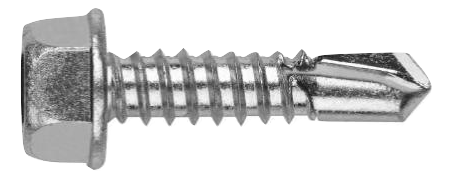
ABEI Stainless Steel Self-Drilling Screw
A2 (304) stainless steel self-drilling screw for fastening aluminum profiles — drills and threads in a single action, with high corrosion resistance, per DIN 7504K.
The Adit self-drilling screw family
Choose the right self-drilling screw for your substrate, thickness and corrosion requirements.
Technical specification
| Property | ABEI — A2 stainless steel self-drilling screw for aluminum |
|---|---|
| Characteristics | Stainless steel self-drilling screw (self-tapping) |
| Drilling thickness | Up to 6 mm in aluminum |
| Material | A2 (304) stainless steel |
| Standard | DIN 7504K |
| Head | Hex washer head |
| Diameters | ST 4.2 · ST 4.8 · ST 5.5 · ST 6.3 |
| Installation tool | High-speed screwdriver (600–1500 rpm) |
| Option | EPDM sealing washer |
Downloads
Stainless steel self-drilling screw: the complete guide to the ABEI model
The stainless steel self-drilling screw, model ABEI, is a self-drilling screw manufactured entirely from austenitic 304 stainless steel (304SS, also known as A2), designed specifically for fastening aluminum profiles. A sharp drilling tip (drilling wing) is formed at its end, allowing it to pierce the aluminum and thread into it in a single continuous action — with no need to pre-drill a pilot hole.
Unlike a regular self-tapping screw that requires a pre-drilled hole, the ABEI stainless steel self-drilling screw saves an entire installation step and an additional tool on site. Unlike a regular self-drilling screw with a galvanized coating, the entire body of the screw is made of stainless steel throughout its cross-section — so there is no external coating that can peel or wear away over the years, but rather a passivation layer that further strengthens the stainless steel’s corrosion resistance.
When do you use a stainless steel self-drilling screw for aluminum? The ABEI screw is suitable for aluminum connections with a profile thickness of up to about 6.5 mm, and is common in applications such as: aluminum and composite cladding, aluminum window and door frames, signage and commercial structures, aluminum railings and pergolas, and projects in coastal areas and industrial environments requiring corrosion resistance higher than that offered by a standard galvanized self-drilling screw.
Advantages of the ABEI stainless steel self-drilling screw — not every stainless steel screw is the same
- High-quality 304 (A2) stainless steel with passivation: Significant corrosion resistance compared to galvanized steel screws, suitable for outdoor environments, the coastline, and chemical-industry environments.
- Approved technical data for aluminum connection: Pull-out (Nrk/Nrd) and shear (Vrk/Vrd) values, as well as recommended load for regular service (Nrec/Vrec), for each diameter and aluminum profile thickness.
- Direct-fastening technology: The ABEI stainless steel self-drilling screw drills and threads the aluminum in a single action, with no need for pre-drilling or additional accessories.
- A range of diameters and lengths: Four diameters (ST4.2 to ST6.3) and a variety of lengths, according to the thickness of the connected aluminum profile.
- Strength that does not fall short of a steel screw: A stainless steel self-drilling screw does not have to be a “compromise” on strength in exchange for corrosion resistance — for full details, see the questions and answers below.
Approved technical data — stainless steel self-drilling screw connection to aluminum profile
The following data form the basis for safe structural design of stainless steel self-drilling screw connections to aluminum profiles. All values in the tables are in kN per single screw. Please note: Nrk/Vrk are characteristic failure loads measured in the laboratory; Nrd/Vrd are the safe design loads after applying a safety factor; and Nrec/Vrec are the recommended service loads for regular use. In addition, the designer must also verify the tear resistance of the aluminum profile itself.
ST 4.8 — stainless steel self-drilling screw for aluminum profile connection
| Load parameter (kN) | Aluminum thickness 2 mm | Aluminum thickness 3 mm | Aluminum thickness 4 mm |
|---|---|---|---|
| Failure load — pull-out (Nrk) | 2.9 | 4.6 | 6.4 |
| Failure load — shear (Vrk) | 3.6 | 3.6 | 3.6 |
| Design load — pull-out (Nrd) | 1.3 | 2.1 | 2.9 |
| Design load — shear (Vrd) | 2.7 | 2.7 | 2.7 |
| Recommended load — pull-out (Nrec) | 1.0 | 1.5 | 2.1 |
| Service load — shear (Vrec) | 2.0 | 2.0 | 2.0 |
ST 5.5 — stainless steel self-drilling screw for aluminum profile connection
| Load parameter (kN) | Aluminum thickness 2 mm | Aluminum thickness 4 mm | Aluminum thickness 5 mm |
|---|---|---|---|
| Failure load — pull-out (Nrk) | 2.0 | 7.6 | 9.6 |
| Failure load — shear (Vrk) | 4.8 | 4.8 | 4.8 |
| Design load — pull-out (Nrd) | 0.9 | 3.5 | 4.8 |
| Design load — shear (Vrd) | 3.7 | 3.7 | 3.7 |
| Recommended load — pull-out (Nrec) | 0.7 | 2.5 | 3.4 |
| Service load — shear (Vrec) | 2.6 | 2.6 | 2.6 |
ST 6.3 — stainless steel self-drilling screw for aluminum profile connection (the largest diameter in the series)
| Load parameter (kN) | Aluminum thickness 2 mm | Aluminum thickness 4 mm | Aluminum thickness 6 mm |
|---|---|---|---|
| Failure load — pull-out (Nrk) | 2.3 | 7.4 | 13.4 |
| Failure load — shear (Vrk) | 6.9 | 6.9 | 6.9 |
| Design load — pull-out (Nrd) | 1.1 | 3.5 | 6.3 |
| Design load — shear (Vrd) | 5.3 | 5.3 | 5.3 |
| Recommended load — pull-out (Nrec) | 0.8 | 2.5 | 4.5 |
| Service load — shear (Vrec) | 3.8 | 3.8 | 3.8 |
Note: The shear resistance does not take into account tearing of the (aluminum) profile. The designer must check the profile’s tear resistance to determine the final shear resistance.
Geometry and dimensions — ABEI stainless steel self-drilling screw
ADIT’s stainless steel self-drilling screw ABEI series offers dimensions matching every aluminum profile thickness and drilling requirement:
| Screw diameter | Outer diameter incl. thread D (mm) | Screw core diameter d (mm) | Head diameter dk (mm) | Head thickness K (mm) | Length range (mm) | Recommended drilling range (mm) |
|---|---|---|---|---|---|---|
| ST 4.2 | 4.22 | 3.10 | 8.5 | 4.1 | 13 – 19 | 1.75 – 3.00 |
| ST 4.8 | 4.80 | 3.58 | 10.0 | 4.3 | 13 – 32 | 1.75 – 4.40 |
| ST 5.5 | 5.46 | 4.17 | 10.5 | 4.3 | 19 – 25 | 1.75 – 5.25 |
| ST 6.3 | 6.25 | 4.88 | 12.6 | 6.3 | 19 – 25 | 2.50 – 6.00 |
Maximum aluminum profile thickness by screw length
| Screw length (mm) | ST 4.2 | ST 4.8 | ST 5.5 | ST 6.3 |
|---|---|---|---|---|
| 13 | 4.3 | 3.7 | – | – |
| 16 | 7.3 | 5.5 | – | – |
| 19 | 10.3 | 8.7 | 8.7 | 7 |
| 22 | – | – | 11.7 | – |
| 25 | – | 14.7 | 14.7 | 13 |
| 32 | – | 21.5 | – | – |
Quick installation guide — stainless steel self-drilling screw for aluminum
- Mark the drilling point: A light tap with a punch (center punch) for precise centering will prevent the drilling tip of the stainless steel self-drilling screw from slipping across the aluminum surface at the start of rotation.
- Prepare the right screwdriver: The recommended drilling speed for the ABEI stainless steel self-drilling screw is 600–1000 rpm for ST4.2, ST5.5 and ST6.3, and 1000–1500 rpm for ST4.8. A speed higher than recommended may “burn” the drilling wing and prevent penetration into the aluminum.
- Drive perpendicular to the profile: Hold the screwdriver at 90 degrees to the material with steady, continuous pressure. Driving at an angle breaks the drilling tip and results in a weak, defective connection.
- Stop when the screw seats: When the screw head seats against the aluminum and reaches the required tightening torque — stop. Over-tightening may scratch the coating or damage the thread formed in the aluminum.
All stainless steel and steel self-drilling screw models in the ADIT catalog
- ABEI: 304 (A2) stainless steel self-drilling screw, hex head with washer, designed for fastening aluminum profiles up to about 6.5 mm thick.
- ABE: Classic galvanized steel self-drilling screw, non-stainless — suitable for steel and aluminum connections in protected indoor environments, at a lower cost than ABEI.
- BIE / BIE A4: Bi-metal self-drilling screw — stainless steel body (304 or 316) with a hardened steel drilling wing. Unlike ABEI, it is designed to drill directly into steel and stainless steel profiles.
- AUTO / BAUTO: Self-drilling screw with an extra-long tip for heavy steel profiles, up to 12 mm thick. The BAUTO is the bi-metal stainless steel version.
- ABRA2 / ABPCA2 / BCPA2: Additional head models (round, countersunk, and more) with an A2 stainless steel body — for aesthetic connections that also require corrosion resistance.
- RS A2: Stainless steel self-drilling screw with a small lens head, for fine seams and thin aluminum frames.
Engineering consulting + a quality stainless steel self-drilling screw = a safe aluminum connection for years to come
The market is flooded with cheap stainless steel screws from obscure sources, sometimes manufactured from a low-strength stainless steel alloy or with only a partial passivation coating. What sets ADIT Ltd. apart from other suppliers is its full engineering knowledge and documentation. The company’s engineers are available to assist in calculating and selecting the screw diameter, screw length, and appropriate stainless steel grade (304 or 316) according to the working environment and aluminum profile thickness, which saves the costs of field failures and enables standard, approved structural design. For any engineering question, you can contact ADIT Ltd.’s engineer at 054-7976110.
Frequently asked questions — stainless steel self-drilling screw
What is the difference between a stainless steel self-drilling screw (Self-Drilling) and a stainless steel self-tapping screw (Self-Tapping)?
How do you choose the right stainless steel self-drilling screw diameter for an aluminum profile?
Is the stainless steel self-drilling screw (ABEI) also suitable for drilling a steel profile or a stainless steel profile?
Is a stainless steel self-drilling screw always weaker than a steel self-drilling screw?
What is the difference between 304 (A2) and 316 (A4) stainless steel, and when should you choose each?
What is an EPDM washer, and why is it important in outdoor stainless steel self-drilling screw connections?
What is the difference between Nrk (failure load), Nrd (design load) and Nrec (recommended load)?
Can a stainless steel self-drilling screw be removed and re-driven into the same hole in the aluminum?
Why does the drilling wing of a stainless steel self-drilling screw break or fail to drill aluminum?
Planning an aluminum connection? Tell us the profile thickness, environment and load — our engineers will help you select the right ABEI diameter, length and stainless grade.