

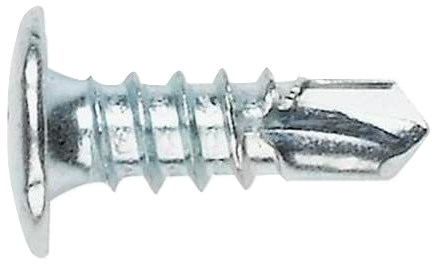
Flat Head Self-Drilling Screw — RSZ / RS A2
Self-drilling tapping screw with a low flat rivet-style head — for aluminum profiles, sliding doors and windows, and steel connections, with certified pull-out and shear data.
ADIT’s range of self-drilling screws
Choose the right self-drilling screw for your material, profile thickness and head profile.
Technical specification
| Property | RS — flat head self-drilling screw |
|---|---|
| Type | Self-drilling tapping screw with a flat head |
| Drilling thickness | Up to 4.4 mm — no pre-drilling |
| Coating | Cold galvanizing / passivation |
| Material | Steel C1035 (RSZ) / Stainless steel SS304 (RS A2) |
| Head | Flat, low rivet-style — 1.2–1.85 mm high |
| Bit | PH2 |
| Diameters | ST3.5 / ST4.2 / ST4.8 |
| Lengths | 9 – 38 mm |
| Applications | Steel-to-steel, steel-to-aluminum and aluminum profiles |
Downloads
What is a flat head self-drilling screw? A full guide to the flat head self-tapping screw
A flat head self-drilling screw, also commonly known as a flat head self-tapping screw (Self-Drilling Rivet Head Screw), is a self-drilling screw for steel that, instead of a protruding head (hex or pan head), has a low, flat head resembling a rivet head — combined with a drilling tip at its end. This structure lets the screw pierce the base material itself and thread into it in one continuous action, exactly like a regular self-drilling screw, but with a head suited to connections that require a low profile and a clean, aesthetic finish.
The RS series by ADIT is a classic flat head self-drilling screw, available in two material versions: RSZ — made of steel (grade C1035) with a cold-galvanized coating, suitable for steel-to-steel as well as steel-to-aluminum connections; and RS A2 — made of 304/A2 stainless steel, suitable only for connecting aluminum profiles (no risk of galvanic corrosion). Both models drill up to a 4.4 mm profile thickness, with no need for pre-drilling.
When do you use a flat head self-drilling screw? A flat head self-tapping screw suits any place where a protruding head gets in the way: sliding doors and windows, aluminum tracks, profile frames, aluminum and steel cladding, metal furniture, and products that require a clean, flat finish that does not catch or rub against moving elements.
The advantages of the RS flat head self-drilling screw from ADIT
- Flat, low head: Does not protrude and does not catch on fabrics, rubber seals or sliding parts — a perfect solution for aluminum profiles and sliding doors.
- Certified technical data: Accurate pull-out (Nrk/Nrd) and shear (Vrk/Vrd) values for every diameter and profile thickness, for both steel and aluminum connections.
- Direct-threading technology for steel: The screw drills and threads in a single action — no pre-punching and no additional accessories.
- Two materials for every application: Galvanized RSZ for steel connections, stainless RS A2 for aluminum connections without corrosion.
- A range of diameters and lengths: Diameters ST3.5 / ST4.2 / ST4.8, lengths from 9 up to 38 mm — a complete solution for any structural specification.
Certified technical data — load tables for the flat head self-drilling screw
The following data forms the basis for the safe engineering design of a connection using a flat head self-drilling screw. All values in the tables are in kN per single screw. Note: the characteristic failure load (Nrk/Vrk) is not a design load. Use the design load (Nrd/Vrd) or the recommended load (Nrec/Vrec) in actual design, and also verify the tear resistance of the profile itself.
RSZ — connection to a steel profile (galvanized flat head self-drilling screw)
| Screw diameter | Steel thickness (mm) | Pull-out failure Nrk (kN) | Shear failure Vrk (kN) | Pull-out design Nrd (kN) | Shear design Vrd (kN) |
|---|---|---|---|---|---|
| ST3.5 | 0.8 | 1.9 | 1.9 | 0.8 | 1.5 |
| ST3.5 | 2.0 | 3.8 | 1.9 | 1.6 | 1.5 |
| ST4.2 | 2.0 | 4.6 | 2.6 | 2.1 | 2.0 |
| ST4.2 | 3.0 | 5.3 | 2.6 | 3.7 | 2.0 |
| ST4.8 | 2.0 | 5.7 | 3.6 | 2.6 | 2.7 |
| ST4.8 | 4.0 | 7.1 | 3.6 | 5.2 | 2.7 |
RS A2 / RSZ — connection to an aluminum profile (stainless flat head self-drilling screw)
| Screw diameter | Aluminum plate thickness (mm) | Pull-out failure Nrk (kN) | Shear failure Vrk (kN) | Pull-out design Nrd (kN) | Shear design Vrd (kN) |
|---|---|---|---|---|---|
| ST4.8 | 2 | 2.9 | 3.6 | 1.3 | 2.7 |
| ST4.8 | 3 | 4.6 | 3.6 | 2.1 | 2.7 |
| ST4.8 | 4 | 6.4 | 3.6 | 2.9 | 2.7 |
* The shear resistance does not account for tearing of the profile (steel or aluminum). The designer must check the profile’s tear resistance to determine the final capacity. Using a steel screw (RSZ) for an aluminum connection may cause corrosion — for aluminum connections it is recommended to prefer the stainless version RS A2.
The aesthetic aspect of the flat head — not just strength, but a clean look too
One of the standout advantages of the flat head self-tapping screw is its aesthetic dimension. The head of the RS is low, round and bevelled (Flat Bevelled Head), only about 1.2–1.5 mm high, so that after installation it looks “sunken” and partly hidden within the line of the profile — with no ugly protrusion or prominent shadow on the metal surface.
- Clean, concealed finish: The flat head does not emphasize the fastening point, which is especially important on exposed cladding, aluminum frames and glass doors.
- An aesthetic alternative to a rivet: A flat head self-drilling screw can serve as a substitute for a rivet in a range of applications, with the added benefit that it can be removed and reattached.
- No interference with sliding parts: The low head prevents rubbing against sliding doors and windows, tracks, and other sliding mechanisms.
- Ring groove under the head: Collects the drilling chips created during the process, so the screw sits straight and completely flush against the profile — a further improvement to the final finish.
Geometry and dimensions — RS flat head self-drilling screw
| Screw diameter | Head diameter dk (mm) | Head thickness K (mm) | Thread outer diameter D (mm) | Available lengths L (mm) | Recommended drilling (mm) |
|---|---|---|---|---|---|
| ST3.5 | 6.7 | 1.2 – 1.5 | 3.5 | 9 – 16 | 0.70 – 2.25 |
| ST4.2 | 8.0 | 1.3 – 1.65 | 4.2 | 13 – 32 | 1.75 – 3.00 |
| ST4.8 | 9.3 | 1.5 – 1.85 | 4.8 | 13 – 38 | 1.75 – 4.40 |
The head thickness ranges reflect the slight difference between RSZ (steel) and RS A2 (stainless), while both models remain in the “flat head” category with minimal protrusion above the profile surface.
Pull-out and thread load by diameter (general screw strength)
| Screw diameter | Pull-out load (Tension, kN) | Shear load (Shear, kN) |
|---|---|---|
| ST3.5 | 3.81 | 1.91 |
| ST4.2 | 5.26 | 2.63 |
| ST4.8 | 7.11 | 3.56 |
Maximum recommended profile thickness for threading (mm), by screw length
| Screw length (mm) | ST3.5 | ST4.2 | ST4.8 |
|---|---|---|---|
| 9.5 | 2.85 | – | – |
| 13 | 6.2 | 4.3 | 3.7 |
| 16 | 9.2 | 7.3 | 5.5 |
| 19 | 12.1 | 10.3 | 8.7 |
| 22 | 15.1 | 13.3 | 11.7 |
| 25 | 18.1 | 16.3 | 14.7 |
| 32 | – | 23.0 | 21.5 |
| 38 | – | 29.0 | 27.5 |
Quick installation guide — flat head self-drilling screw
- Mark the drilling point: A light tap to mark the penetration point prevents the drill tip from “slipping” at the start of rotation.
- Drive with an impact driver: The recommended drilling speed is 1800–2500 RPM for steel with ST3.5/ST4.8, and 1000–1800 RPM with ST4.2; in stainless steel (RS A2) the speed is lower — 1000–1500 RPM with ST3.5/ST4.8 and 600–1000 RPM with ST4.2.
- Drive perpendicular to the profile: Hold the driver at 90 degrees to the material with even pressure. Driving at an angle breaks the drill tip and results in a defective connection.
- Stop once the flat head is seated: Because the RS head is flat and low, it is easy to miss the stopping point and keep driving beyond what is needed. Stop the moment the head seats evenly against the profile surface and before it “sinks” too far into the material.
Which flat head models (and additional finishes) are in the ADIT catalog
- RSZ: A flat head self-drilling screw made of galvanized steel, for steel-to-steel or steel-to-aluminum connections.
- RS A2: A flat head self-drilling screw made of 304 stainless steel, dedicated to aluminum connections without galvanic corrosion.
- ABR: A self-drilling screw with a round flat head (Round Flat) — an aesthetic alternative with a slightly higher head.
- ABP: A self-drilling screw with a countersunk conical head (Counter-Sink) for completely smooth surfaces, with no protrusion at all.
- BCP: A self-drilling screw with an extra-fine flat head (Extra-Flat Bevelled), also available in a stainless version for aluminum connections.
- ABE / ABEI: A self-drilling screw with a hex head and washer — for connections requiring high tightening torque and a protruding head, unlike RS.
Engineering consulting + a quality flat head self-drilling screw = a complete solution
The market is flooded with cheap flat head self-tapping screws from obscure sources that often break under load, drill slowly or rust quickly. What sets ADIT apart from other suppliers is the knowledge and the standards. The company’s engineers are available to help calculate and select the screw diameter, the screw length, and the suitable model (RSZ or RS A2), which saves the costs of field failures and enables compliant, certified structural design.
Frequently asked questions — flat head self-drilling and self-tapping screws
What is the difference between a flat head self-drilling screw and a hex head self-drilling screw?
What is the difference between RSZ and RS A2?
How do you choose the right flat head self-drilling screw diameter?
Is a flat head self-drilling screw suitable for sliding doors and windows?
Does a flat head self-drilling screw rust? Is there a stainless version?
Can a flat head self-drilling screw be used for connecting aluminum?
Why does the drill tip of a flat head self-drilling screw break or fail to drill?
What is the difference between Nrd (design load) and the characteristic failure load (Nrk)?
Can a flat head self-drilling screw be removed and re-threaded into the same hole?
Planning an aluminum or steel connection? Tell us the profile material, thickness and load — our engineers will select the right RS diameter, length and material and send you the certified pull-out and shear data.