

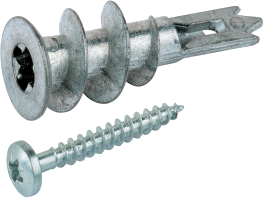
TAPLA ZK — Drywall Screw Anchor
Self-drilling drywall screw anchor (metal auger) — driven straight into the board with no pre-drilling, made of rigid Zamak by INDEX.
The Adit drywall anchor family
Choose the right anchor for your load level and installation method.
Technical specification
| Property | TAPLA ZK — self-drilling drywall anchor (INDEX) |
|---|---|
| Official model code | TAPLAZK |
| External anchor dimensions | 13×37 mm |
| Head type / driver bit | PZ3 |
| Installation | Direct — no pre-drilling |
| Suitable drywall board thickness | 9 mm to 16 mm |
| Minimum required rear cavity depth | 25 mm |
| Product material | Zamak metal |
| Recommended safe pull-out load | 8 kg per anchor point |
| Recommended matching screws | 4.5×50 chipboard screw or DIN-7981 4.2×38 sheet-metal screw |
| Approved base materials | Drywall boards and hollow blocks / partitions |
| Manufacturer | INDEX — Spain (Europe) |
Downloads
What is a drywall screw anchor and how does it work?
A drywall screw anchor (also known as an auger anchor or self-drilling anchor) is a fixing component designed for fast, direct and safe installation of fixtures, light shelves and equipment on drywall walls and hollow partitions.
A drywall panel is a thin skin with a cavity behind it, so an ordinary screw simply pulls straight out. A drywall anchor solves this by gripping within the thickness of the board and spreading the load over a larger area, instead of relying on the thickness of the board alone. The ADIT TAPLA is screwed directly into the panel with no pre-drilling; its coarse thread and self-drilling conical tip cut into the gypsum and create a strong internal metal thread.
Types of drywall fixing solutions and anchors
In the construction-solutions market there are several main types of drywall anchors, each suited to different load levels and installation needs:
1. Direct self-drilling drywall screw anchor (metal auger) — ADIT TAPLA
A professional anchor with a conical drilling tip that allows clean, direct penetration into the drywall with no pre-drilling. The anchor sets firmly within the thickness of the board and creates a strong, durable internal metal thread.
- Advantages: no pre-drill required, extremely fast installation, made of strong Zamak metal that does not strip or break under the screwdriver, and also suitable for hollow blocks.
- Disadvantages: intended for light to medium loads (up to 8 kg recommended pull-out, per the manufacturer’s spec).
- Load capacity: medium and reliable — 8 kg recommended pull-out load in a standard drywall board.
2. Universal expanding nylon anchor such as ADIT TN4S
The simplest, most basic plastic solution. It requires pre-drilling a hole in the wall, after which tightening the screw makes the plastic expand at the back of the board. See ADIT TN4S.
- Advantages: a cheap, accessible product that is simple for very basic installations.
- Disadvantages: very low load capacity; the plastic tends to deform or crack the board under weight, and it is not suitable for hanging from ceilings.
- Load capacity: very low — only 2 to 8 kg depending on board quality.
3. Professional toggle / butterfly anchor such as ADIT IN-CO
A dedicated folding anchor inserted into a drilled hole that spreads out on the inner side of the wall, creating broad pressure over the rear surface of the board. See ADIT IN-CO.
- Advantages: relatively high load capacity, suitable for both drywall walls and ceilings.
- Disadvantages: requires a relatively wide drilled hole, installation is slightly more complex, and if the screw is fully removed the anchor drops into the cavity.
- Load capacity: high — ranges from 20 to 50 kg, greatly affected by installation quality and technique.
4. Advanced American strap-toggle anchor — BA-NY
Advanced fixing technology that combines a wide metal channel with plastic guide straps to create a very broad support surface behind the board. See BA-NY.
- Advantages: the highest working load capacity in the category, allows the screw to be removed and reinstalled, and the channel does not fall into the cavity.
- Disadvantages: higher product cost compared with the simple anchors.
- Load capacity: the highest — reaches up to 90 kg pull-out and up to 127 kg shear in double drywall.
Comparison table — drywall fixing solutions by load capacity
| Anchor type / drywall screw anchor | Recommended capacity (kg) | Pre-drill required | Suitable for hollow ceiling | Body material |
|---|---|---|---|---|
| Classic expanding plastic | 2–8 | Yes | No | Plastic / nylon |
| Zamak auger drywall anchor (ADIT TAPLA) | 8 kg safe pull-out | No | No | Zamak metal |
| Professional toggle / crank anchor | 20–50 | Yes | Yes | Metal / rigid plastic |
| Heavy strap anchor (BA-NY) | Up to 127 (shear load) | Yes | Yes | Combined metal channel |
Why is the ADIT TAPLA ZK drywall screw anchor the right choice?
The ADIT TAPLA ZK drywall screw anchor represents the peak of convenience and efficiency when working on drywall walls and partitions:
- Made of strong Zamak metal: unlike plastic auger products that wear, deform or break under screwdriver force, the TAPLA is a rigid, durable metal alloy that drives smoothly and stably.
- Smooth penetration without drilling: the self-drilling conical tip lets the anchor be installed directly into the board very quickly, with no pilot hole or drill bits.
- Full fit for standard board thicknesses: designed and tested for a full fit to drywall boards from 9 mm to 16 mm thick.
- Versatility in screw types: works with a range of common screws, such as 4.5×50 chipboard screws or DIN-7981 4.2×38 sheet-metal screws.
- International quality: made in Europe by INDEX, one of the world’s leading manufacturers of advanced fixing solutions.
Fast installation in 5 simple steps
- Mark the point — use a pencil to mark the exact anchoring location on the drywall wall (no pre-drilling needed).
- Drive the anchor — place the drilling tip of the TAPLA directly on the mark and screw it in with a drill/driver or manual screwdriver (PZ3 bit) until the head is fully flush with the wall surface.
- Position the fixture — place the element, bracket, shelf or picture against the internal thread opening of the anchor.
- Insert the screw — pass a suitable fixing screw (such as a 4.5 mm chipboard screw) through the mounting hole of the fixture into the centre of the anchor.
- Final tightening — screw and tighten securely until the fixture is fully, strongly and stably fastened to the wall.
Why choose Adit Ltd.?
When it comes to the safety and integrity of your building’s walls, there is no room for compromise. ADIT Ltd. markets its own quality products and the European premium brand INDEX, with a full professional wrap-around for contractors, installers and engineers:
- Many years of experience in the Israeli market supplying advanced construction, fixing and fastening solutions.
- Quality products imported directly from the world’s leading manufacturers (such as INDEX of Spain), tested and compliant with stringent standards.
- Comprehensive professional and engineering consultation for every project, from initial planning through execution.
- Full technical support including precise load calculation, tailored custom solutions and on-site installation training.
- A wide, rich range of fixing products and anchors for all types of walls and ceilings under one roof.
Frequently asked questions
What is an auger drywall screw anchor and when should it be used?
What is the difference between a plastic auger drywall anchor and Adit’s metal (Zamak) auger?
Do you need to drill a hole in the wall before installing the TAPLA?
How many kilograms can a single Zamak auger drywall anchor carry?
Which screws are best suited for use with the TAPLA?
Is an auger drywall anchor suitable for hanging from a drywall ceiling?
Can an auger drywall screw anchor be used for hollow blocks?
How do you remove an auger-type drywall screw anchor, and does it leave a large hole?
How much weight can you hang on drywall?
Can you use an ordinary nylon anchor in drywall?
What if there is a metal stud behind the drywall?
Hanging something on drywall? Tell us the weight and the board thickness — our engineers will recommend the right anchor and send you the technical data.