

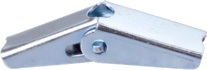
CA-PA — Metal Spring Toggle for Plasterboard
Full-metal spring toggle anchor — the two metal wings spring open behind the plasterboard sheet and spread the load over a wide area for safe suspension on walls and ceilings.
The Adit plasterboard anchor family
Choose the right cavity fixing for your load, board thickness and installation method.
Technical specification
| Property | CA-PA — metal spring toggle for plasterboard |
|---|---|
| Mechanism | Two metal wings that spring open behind the board |
| Material | Zinc-plated steel (SAE 1010, Zinc plated ≥5µm, ISO 4042) |
| Screw range | M4 · M5 · M6 · M8 |
| Loads | Medium to high — up to about 69 kg pull-out |
| Suitable substrates | Single & double plasterboard, hollow block, aerated concrete |
| Standard | INDEX (Spain) |
Installation data by screw size
| Product code | Screw diameter (M) | Overall length (mm) | Closed head height (mm) | Drill diameter (mm) | Minimum cavity depth (mm) |
|---|---|---|---|---|---|
| CAPA004 | M4 | 39 | 10 | 12 | 26 |
| CAPA005 | M5 | 50 | 12 | 15 | 33 |
| CAPA006 | M6 | 55 | 14 | 18 | 37 |
| CAPA008 | M8 | 76 | 16 | 22 | 54 |
The matching screw (Threaded rod 975ZM) is not included with the dowel and is sold separately.
Recommended pull-out loads (kg) by board thickness
| Screw size | 9.5 mm | 12.5 mm | 12.5×2 mm | 15 mm | 15×2 mm | Aerated concrete |
|---|---|---|---|---|---|---|
| M4 | 18.9 | 23.7 | 20.4 | 23.7 | 29.9 | 10.0 |
| M5 | 19.7 | 24.4 | 26.2 | 36.1 | 28.0 | 12.0 |
| M6 | 21.9 | 25.5 | 36.4 | 36.4 | 40.1 | 13.0 |
| M8 | 23.3 | 30.2 | 49.2 | 44.8 | 68.8 | 14.0 |
All values in kg, recommended pull-out load per the INDEX standard, for a single anchoring point (without the effect of spacing or edge distance). The data apply to all products based on the CA-PA head (including PA-GA and PA-ES).
Which plasterboard anchor should you choose?
| The load / need | The anchor |
|---|---|
| The heaviest loads | BA-NY |
| High load + female thread | IN-CO (requires installation tool) |
| Medium load, simple installation | CA-PA |
| Light load, quick installation without drilling | TAPLA |
Downloads
Installation & field videos
Why does plasterboard require a special anchor?
A plasterboard sheet is a thin wall with a cavity behind it. An ordinary screw simply pulls out — it has nothing to grip.
A plasterboard anchor solves this by opening or folding behind the board, spreading the load over a large area on the back of the board instead of relying on the thickness of the board itself.
What is a metal spring toggle for plasterboard?
A metal spring toggle for plasterboard is a professional anchoring dowel consisting of a slotted metal “head” (wings) that opens automatically with an internal spring the moment it passes through the plasterboard sheet. The open head rests against the back face of the board and spreads the load over a large area, allowing a much safer suspension than an ordinary plastic dowel.
Unlike a concrete or brick wall, a plasterboard wall is thin and made of gypsum boards with an air cavity between them — therefore a unique technology is required, one that can hold loads safely and stably without cracking the board.
Choosing the right dowel is critical to safety: an unsuitable dowel can cause a shelf, light fixture, air conditioner or any other component to fall — endangering the integrity of the wall and the safety of the occupants.
Types of plasterboard dowels — a comprehensive comparison
Several types of plasterboard dowels exist on the market, each with its own advantages and disadvantages:
1. Universal expanding nylon dowel, such as ADIT TN4S
This is the simplest and most common dowel in stores. You drill a hole, insert the dowel, and tighten a screw that causes the plastic to expand behind the board.
- Advantages: cheap and accessible, easy to install, suitable for very light loads.
- Disadvantages: very low load capacity — usually only up to 5–8 kg. The plastic tends to crack the plasterboard under load. Not suitable for ceiling suspension. Limited range of sizes.
- Load capacity: very low (2–8 kg depending on the board type)
2. Threaded screw-in dowel (“self-drilling”) such as ADIT TAPLA
A dowel with a conical tip that allows direct penetration into the plasterboard without pre-drilling. The dowel is anchored within the thickness of the board only.
- Advantages: no pre-drilling required, quick to install, available in stores.
- Disadvantages: medium load capacity, only up to 20 kg. Anchoring only within the board thickness and not beyond into the cavity — therefore relatively weak. Not suitable for use in thin plasterboard (9.5 mm).
- Load capacity: medium (10–20 kg depending on the board thickness)
3. Standard toggle dowel (plastic) such as ADIT IN-CO
A folding dowel that is inserted into the wall and spreads out behind the board. The mechanism creates pressure on the inner face of the board, but is made mainly of plastic rather than metal.
- Advantages: relatively high load capacity, suitable for ceilings and walls.
- Disadvantages: if the screw is withdrawn, the dowel falls into the wall. Relatively hard to install. The screw must be installed together with the dowel. A large hole is left open if the screw is removed.
- Load capacity: high (20–50 kg), but highly dependent on installation technique
4. Metal spring toggle for plasterboard — CA-PA
A classic, well-known metal “toggle head” spring technology: two metal wings connected on a hinge with a spring, which open automatically to about 180 degrees the moment they pass through the plasterboard sheet. The metal wing rests over a wide area behind the board, and allows a standard screw (M4 to M8) to be connected directly into the head.
- Advantages: full metal head (not plastic) — significantly higher durability and load capacity, a wide range of sizes from M4 to M8, suitable for plasterboard walls and ceilings, suitable for both single and double plasterboard as well as hollow block, allowing relatively high loads at an accessible price.
- Disadvantages: as with most classic toggle dowels — if the screw is fully withdrawn, the toggle falls into the cavity behind the wall and cannot be pulled back out.
- Load capacity: high — up to about 69 kg pull-out in a double 12.5×2 mm board (M8 screw)
Comparison table — plasterboard dowels by load capacity
| Dowel type | Load capacity (kg) | Drilling required | Suitable for ceiling | Metal head |
|---|---|---|---|---|
| Expanding plastic | 2–8 | Yes | No | No |
| Self-drilling screw | 10–20 | No | No | No |
| Plastic toggle / crank | 20–50 | Yes | Yes | No |
| ADIT CA-PA — metal spring toggle | Up to 69 | Yes | Yes | Yes |
Why is ADIT CA-PA the recommended solution as a metal spring toggle for plasterboard?
ADIT’s metal spring toggle for plasterboard, the Adit CA-PA, is the most classic and reliable metal toggle head in its category, manufactured to the Spanish INDEX standard — a world leader in anchoring. Here are the main reasons to choose it:
- Full metal head, not plastic: made of zinc-plated steel (Zinc plated ≥5µm), so it is far more durable under load and over time than cheap plastic toggle dowels.
- Full range of sizes: available in four sizes — CAPA004 (M4), CAPA005 (M5), CAPA006 (M6) and CAPA008 (M8) — so there is a precise solution for every load and every screw diameter.
- Suitable for any plasterboard thickness: relatively small drilling requirement (only 12–22 mm, depending on size) and a minimum cavity depth of only 26–54 mm — suitable even for limited spaces behind the board.
- Flexibility of use: the CA-PA head is the “building block” of ADIT’s PA product family — it can be combined with a straight screw, with a hook (PA-GA) or with a stud screw (PA-ES), as needed.
- International standards: manufactured by INDEX — one of the world’s leading anchoring manufacturers — from SAE 1010 steel with a zinc coating compliant with ISO 4042.
Simple installation in 4 steps (CA-PA metal spring toggle)
- Drill a hole in the plasterboard sheet at the diameter matching the screw size (12–22 mm according to the table).
- Fold the two metal wings together with the spring, and insert the head through the hole until it passes the board into the inner cavity.
- The head “springs” and opens automatically with the spring and rests against the back face of the board.
- Screw in the bolt (not included) through the item being hung, through the hole in the board, until it engages the internal thread of the CA-PA head and tightens firmly against the board.
Why choose ADIT Ltd.?
On the market there are many products called “plasterboard dowel” or “spring toggle”, but not all of them meet the same levels of quality, safety and load capacity. When it comes to the safety of a product hanging from a ceiling or a wall — such as a lamp, fan, shelf, air conditioner, screen or heavy equipment — there is no room for compromise.
- Many years of experience in the Israeli market in the field of construction and anchoring solutions.
- Products imported from leading manufacturers worldwide (such as INDEX) — tested and approved.
- Professional engineering consultation for every project — from the initial stage through execution.
- Full technical support: load calculation, selecting the appropriate solution, installation guidance.
- A wide range of anchoring products for all types of walls and ceilings under one roof.
Frequently asked questions
What is the difference between a metal spring toggle and a regular plasterboard dowel?
How many kilograms can a metal spring toggle for plasterboard carry?
How does a metal spring toggle for plasterboard work?
How do you install a metal spring toggle (CA-PA) step by step?
Is a spring toggle also suitable for ceiling suspension (e.g., a lamp or a fan)?
What drilling size is required for a metal spring toggle for plasterboard?
Can a metal spring toggle be removed after installation?
What is the difference between M4, M5, M6 and M8 in a metal spring toggle?
Can a metal spring toggle be used in a hollow block (Ytong/pumice) or aerated concrete?
What is the minimum plasterboard thickness for using the CA-PA metal spring toggle?
Which plasterboard dowel holds the strongest — a metal spring toggle or a Strap Toggle?
How many spring toggle dowels are needed for a plasterboard ceiling?
How much weight can be hung on plasterboard?
Can a regular nylon dowel be used in plasterboard?
What if there is a metal profile behind the plasterboard?
Hanging something heavy on plasterboard? Tell us the weight and the board thickness — our engineers will recommend the right anchor and screw size.