

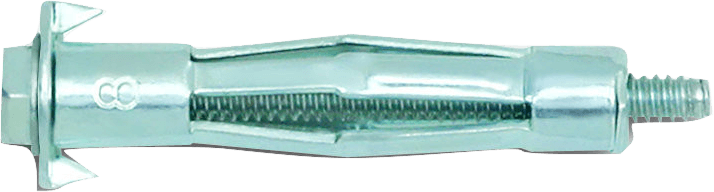
IN-CO — Metal Molly Anchor for Drywall
A metal "molly" cavity anchor that opens into 4 arms behind the board — high pull-out and shear on plasterboard, plaster panel and hollow block.
The Adit drywall anchor family
Choose the right cavity fixing for your load and board thickness.
Technical specification
| Property | IN-CO — metal molly cavity anchor |
|---|---|
| Type | Metal "molly" cavity anchor for drywall |
| Mechanism | 4 arms that lock against the back of the board |
| Material | Carbon steel, galvanized for corrosion protection |
| Setting tool | Required — dedicated IN-CO molly-anchor setter |
| Thread | Female — the fixture is screwed on after installation |
| Reusable | Yes — the screw can be removed and reinserted after expansion |
| Suitable base materials | Plasterboard, plaster panel and hollow block |
| Diameters | M5, M8 |
| Service load — M5 (12.5 mm board) | 100 kg shear · 50 kg pull-out |
| Service load — M8 (12.5 mm board) | 120 kg shear · 80 kg pull-out |
| Manufacturer | INDEX |
Downloads
Instructional & field-test videos
The IN-CO molly anchor for drywall: the professional solution for heavy loads
A metal molly anchor with an internal expansion mechanism, designed for hanging heavy elements on plasterboard walls and plaster panels. The most reliable and safe solution, ensuring optimal load distribution behind the wall and preventing collapse of the plasterboard sheet. Supplied with detailed load tables from the manufacturer INDEX. Adit Ltd. offers professional anchoring solutions of the highest quality at the most competitive prices in the country.
Why does drywall need a special anchor?
A plasterboard sheet is a thin skin with a cavity behind it. An ordinary screw simply pulls straight out — it has nothing to grip. A drywall anchor solves this by opening or folding out behind the board, spreading the load over a large area on the back of the sheet instead of relying on the thickness of the board itself.
Please note: the IN-CO requires a dedicated setting tool. Without it the installation is not effective — the arms will not open properly behind the board.
Features
- Technology: a molly anchor that opens behind the plasterboard sheet and creates a wide bearing surface for a powerful grip.
- Material: made of high-quality carbon steel that provides long-term durability (unlike plastic anchors, which tend to dry out and wear away).
- Galvanizing: provides protection against corrosion.
- Versatility: suitable for use in plasterboard, plaster panel and even hollow block (backed by tests carried out in Israel).
- Reusable: the anchor’s structure lets you remove the screw and reinsert it after expansion, without the anchor falling into the drywall cavity.
- Ideal fit: available in a range of diameters (do) and lengths (L) for a perfect match to the base-material thickness.
Applications
- Ideal for hanging TVs, heavy bathroom cabinets, shelves and air-conditioning systems on plasterboard walls.
- Excellent for connections and locations where a standard threaded drywall anchor does not provide a sufficiently safe answer against pull-out and shear forces.
Which drywall anchor should you choose?
| The load / need | The anchor |
|---|---|
| The heaviest loads | BA-NY |
| High load + female thread | IN-CO (requires a setting tool) |
| Medium load, simple installation | CA-PA |
| Light load, fast installation without drilling | TAPLA |
Advantages of the IN-CO over its competitors
While screw-in anchors are excellent for light loads and fast work without drilling, the IN-CO molly anchor wins by a landslide when it comes to heavy loads and maximum safety. The anchor’s expansion mechanism creates a resistance area many times larger behind the board, so it does not rely on the thread inside the brittle plasterboard.
It is critically important to match the anchor length (its smooth section) to the wall thickness. For example, the INCO 5×52 model is intended for a board thickness of 5–16 mm (standard plasterboard), and the INCO 5×65 model for a thickness of 16–32 mm (double plasterboard). This match ensures that the wings clamp the wall to exactly the right degree.
Installation instructions (the importance of the IN-CO setter)
A common mistake is opening the molly anchor by screwing it in with a screwdriver — an action that can spin the anchor inside the hole and crumble the plasterboard. The setting tool (IN-CO setter) is critical! It performs a smooth, straight pull on the anchor head and opens the wings symmetrically behind the wall.
- Drill a hole in the wall (for example, an 8.9 mm drill bit for an M5-diameter anchor).
- Insert the anchor into the hole with a hammer until the anchor’s collar sits flush against the wall.
- Open the anchor by pulling inward with the dedicated IN-CO setter.
- Remove the screw out of the anchor.
- Pass the screw back through the fixture being mounted (the shelf / TV) and tighten it fully for a complete fixing.
Technical data (manufacturer’s load table)
The manufacturer’s data demonstrates strong performance (capacity for a single anchor in a 12.5 mm plasterboard wall):
- Diameter M5: a service load of 100 kg in shear and 50 kg in pull-out.
- Diameter M8: a service load of 120 kg in shear and 80 kg in pull-out (also approved for 80 kg pull-out in hollow block according to tests carried out in Israel).
Frequently asked questions
How much weight can be hung on drywall?
Can an ordinary nylon anchor be used in drywall?
What if there is a metal profile behind the drywall?
Hanging something heavy on drywall? Tell us the weight and the board thickness — our engineers will recommend the right anchor.