

ADIT TFE vs Würth W-BS: Which Concrete Screw Is Better?
12 בJuly 2026
ADIT TFE/TXE vs Hilti HUS4/HUS4-HR: Which Concrete Screw Is Better?
12 בJuly 2026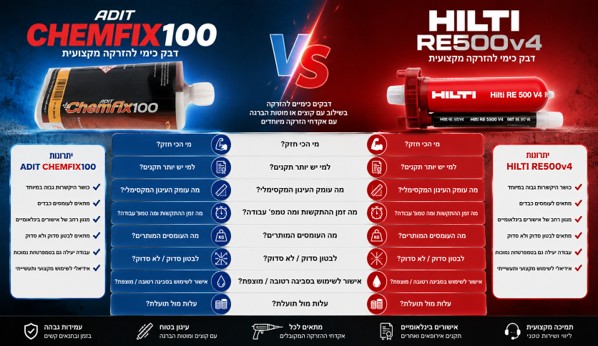
Chemfix 100 (Adit) vs Hilti HIT-RE 500 V3 — Injection Adhesive Comparison
Two injectable epoxy adhesives, two valid European approvals (ETA), the same design standard — but not the same price gap. A numbers-based comparison, from the official ETA data, for concrete anchors and for rebar.
In short
Both are injectable epoxy adhesives with a valid ETA, designed to exactly the same standards — EN 1992-4 for anchors and EAD 330087 for post-installed rebar. On threaded rod the Chemfix 100 matches or beats the Hilti across the range, with a clear lead in cracked concrete. On rebar the picture reverses: the Hilti leads in most diameters, while the Chemfix overtakes it at the large diameters in cracked concrete and is approved to a larger bar size (Ø40 vs Ø32). The steel resistance is identical for both — every difference comes from the adhesive-to-concrete bond. And the price gap, which never appears in an ETA table, is often the deciding factor on medium-to-large projects.
Why compare the two at all?
Designers and contractors in Israel face this question constantly: pick a “known” adhesive like Hilti at a premium price, or an adhesive like Chemfix 100 that also carries a compliant European approval (ETA) to exactly the same standards — EN 1992-4 for anchors and EAD 330087 for rebar — but at a significantly lower cost. This comparison is not built on sales sheets; it uses the official figures from the two products’ ETAs: ETA-19/0705 and ETA-18/1157 for Chemfix 100, and ETA-18/0745 for Hilti HIT-RE 500 V3.
The key point: both products are designed to the same European standard (EN 1992-4), so the load values taken from their approvals can be compared directly — this is not a case of apples and oranges.
Methodology — read this before the tables
The ETA certificates themselves publish only characteristic bond strength (Rk, the 5% fractile), not a ready-made design resistance. To obtain a real, comparable NRd for both products, the design resistance in this article was calculated as NRd = NRk / γM, with γM = 1.5 — the standard value in the absence of a national regulation, and the same factor Adit itself applies in its official catalogue tables, verified directly against that data. The same embedment depth (hef) was used for both products: the minimum hef listed in the Hilti certificate for each diameter, so the comparison is not biased in favour of a deeper embedment for one product. This is a transparent engineering exercise for the purpose of comparison, and not a substitute for a full design calculation in PROFIS or equivalent official design software, which also accounts for spacings, edge distances and anchor groups.
1. Single anchor with threaded rod — design resistance (NRd)
The tables show the tension design resistance (NRd) in kN for a single anchor, grade-8.8 steel, in the same C20/25 concrete, at the same embedment hef (using Hilti’s minimum hef for each diameter) and the same safety factor γM = 1.5, with the governing failure mode (bond or steel, whichever is smaller).
Uncracked concrete
| Rod size | M8 | M10 | M12 | M16 | M20 | M24 | M27 | M30 |
|---|---|---|---|---|---|---|---|---|
| hef [mm] | 60 | 60 | 70 | 80 | 90 | 96 | 108 | 120 |
| Chemfix 100 | 19.5 | 27.1 | 36.9 | 51.3 | 66.4 | 90.1 | 101.8 | 131.9 |
| Hilti RE 500 V3 | 19.5 | 27.1 | 34.9 | 48.3 | 62.2 | 84.4 | 95.0 | 114.4 |
Cracked concrete — the governing case in real design
| Rod size | M8 | M10 | M12 | M16 | M20 | M24 | M27 | M30 |
|---|---|---|---|---|---|---|---|---|
| hef [mm] | 60 | 60 | 70 | 80 | 90 | 96 | 108 | 120 |
| Chemfix 100 | 12.6 | 14.3 | 18.5 | 25.6 | 35.2 | 45.0 | 50.9 | 66.0 |
| Hilti RE 500 V3 | 6.9 | 9.8 | 14.4 | 19.6 | 24.9 | 31.0 | 37.3 | 44.0 |
In cracked concrete the Chemfix 100 leads clearly across the whole range. In uncracked concrete the gap is much smaller, and at the small diameters (M8) the two reach the same resistance — because steel failure governs there, not bond. The steel resistance itself (NRk,s) is identical for both products at the same steel grade (8.8); the difference comes only from the adhesive-to-concrete bond.
What this means in practice
- In cracked concrete — the realistic condition under load — the design resistance of Chemfix 100 is higher than Hilti RE 500 V3 by roughly 30% to 80% depending on diameter, using the transparent calculation method set out above.
- In uncracked concrete the difference is much smaller, and at the small diameters (M8) the two products reach the same resistance — because steel failure governs there, not bond.
- The steel resistance itself (NRk,s) is identical for both products at the same steel grade (8.8). The difference comes entirely from the adhesive-to-concrete bond.
Important engineering note: in practice the final NRd on a project also depends on the edge distance, the spacing between anchors and anchor-group effects (per EN 1992-4), which may change the working values on any given project. The tables above show a single anchor without those effects, purely so that the two products can be compared fairly.
2. Post-installed rebar — design resistance (NRd)
Same method: a shared embedment (Hilti’s minimum hef for each diameter), C20/25 concrete, γM = 1.5, and the governing failure mode (bond or steel) selected automatically. The rebar steel resistance is based on B500B per both certificates.
Uncracked concrete
| Bar Ø | Ø8 | Ø12 | Ø16 | Ø20 | Ø25 | Ø28 | Ø32 |
|---|---|---|---|---|---|---|---|
| hef [mm] | 60 | 70 | 80 | 90 | 100 | 112 | 128 |
| Chemfix 100 | 16.6 | 22.6 | 36.9 | 51.8 | 73.7 | 90.3 | 118.0 |
| Hilti RE 500 V3 | 17.6 | 28.7 | 46.9 | 63.3 | 81.7 | 97.6 | 139.4 |
Cracked concrete
| Bar Ø | Ø12 | Ø16 | Ø20 | Ø25 | Ø28 | Ø32 |
|---|---|---|---|---|---|---|
| hef [mm] | 70 | 80 | 90 | 100 | 112 | 128 |
| Chemfix 100 | 13.3 | 23.5 | 33.0 | 46.9 | 61.6 | 80.4 |
| Hilti RE 500 V3 | 15.4 | 25.1 | 33.9 | 44.0 | 52.5 | 69.7 |
Here, unlike threaded rod, the Hilti RE 500 V3 shows the higher design resistance in most diameters — across the whole range in uncracked concrete, and at the small-to-medium diameters (up to Ø20) in cracked concrete. At the large diameters in cracked concrete (Ø25–Ø32) the Chemfix 100 overtakes the Hilti. And on range: the Chemfix 100 (ETA-18/1157) is approved up to Ø40, while the RE 500 V3 is approved only up to Ø32.
The design takeaway: unlike threaded rod, the rebar picture is more nuanced and depends on the specific diameter. On a project with small-to-medium bar anchoring, check the actual demand against the table — there is no single conclusion across the whole range.
Which has the advantage with rebar?
- For post-installed rebar, unlike threaded rod, Hilti RE 500 V3 shows the higher design resistance across most diameters — throughout the range in uncracked concrete, and at small to medium diameters (up to Ø20) in cracked concrete.
- At the large diameters in cracked concrete (Ø25–Ø32), Chemfix 100 overtakes Hilti on design resistance.
- Diameter range: Chemfix 100 (ETA-18/1157) is approved up to Ø40 mm, whereas Hilti RE 500 V3 is approved only up to Ø32 mm.
What it means for design
Unlike the threaded-rod case, the picture here is more nuanced and depends on the specific diameter. On a project with rebar dowels at small to medium diameters, check the actual requirement against the table — there is no single conclusion that holds across the whole range.
3. Conditions of use, design life and drilling methods
| Parameter | Chemfix 100 | Hilti HIT-RE 500 V3 |
|---|---|---|
| Design life — threaded rod | 50 years (all drilling methods); 100 years (hammer drilling only) | 100 years (whole range, single ETA) |
| Design life — rebar | 50 and 100 years | 100 years |
| Supported drilling | Hammer (HD), compressed air (CD), dust-free dry (HDB), diamond coring (DD) | Hammer (HD), hammer with dust-extraction (TE-CD/TE-YD), diamond coring (DD), coring with roughening (TE-YRT) |
| Flooded holes | Yes, uncracked concrete only | Yes, hammer drilling, uncracked concrete only |
| Concrete classes | C12/15–C50/60 (rebar) / C20/25–C50/60 (anchor) | C20/25–C50/60 |
| Max. service temperature | Up to 60°C (range II) | Up to 70°C (range II) |
| Gel (working) time at 20°C | 25 min | ~25–30 min (at 20–24°C) |
| Min. cure time at 20°C, dry concrete | 18 hours | 7 hours |
| Fire resistance | Classified R120 | Not tested under ETA-18/0745 (Hilti has a separate fire ETA) |
| Seismic performance | Category C1 (M8–M30), C2 (M12–M24) | Category C1 (M8–M30), C2 (M16–M24, grade-8.8 steel only, requires the Hilti fill set) |
Cure time — the practical advantage for Hilti: per the ETA tables, the Hilti RE 500 V3 reaches a markedly shorter minimum cure time in dry concrete at room temperature (about 7 hours against 18 hours for Chemfix 100). On works with a tight loading schedule that is a real operational advantage, and worth weighing against the price gap.
4. Price — the difference that never appears in the ETA table
ETAs set allowable loads, not a price tag. But in practice the budget difference between the two products is often the deciding factor on medium-to-large projects, especially when substantial cartridge quantities are needed. The market rule of thumb: on projects that call for a high volume of cartridges (infrastructure works, extensive strengthening, large numbers of rebar anchors), the total cost gap between the two systems can reach tens of percent — while, per the ETA tables, the Chemfix 100 gives up nothing on threaded-rod anchor performance, and on rebar it stays within a competitive, reasonable range against Hilti.
Why Chemfix 100 costs significantly less
Hilti positions HIT-RE 500 V3 as a global premium product, with an engineering support network, PROFIS design software and an established brand — and the cost of that global marketing and support is built into the price tag. Chemfix, as an importer holding its own independent ETA with direct engineering support from Adit in Israel, offers the same approved performance values, and on some parameters higher ones, on a far lower cost base — without a brand premium that translates into no numerical value in the ETA.
5. Summary — when to choose which product
Chemfix 100 is the right choice when:
- A higher calculated resistance is required on threaded rod — it leads across the full M8–M30 range in cracked concrete, and matches or beats the Hilti in uncracked concrete.
- Rebar anchoring is needed at bar diameters greater than Ø32 (up to Ø40), which the Hilti ETA does not support.
- Budget is a central consideration on large volumes and an ETA-approved adhesive at a competitive price is needed.
- The programme can accommodate longer cure times (18 hours in dry concrete at 20°C) without holding up the schedule.
Hilti HIT-RE 500 V3 is the right choice when:
- The work centres on rebar anchoring at diameters up to Ø32 — where Hilti gives the higher design resistance (NRd).
- A very fast cure is needed on a tight programme (just 7 hours in dry concrete).
- A higher service temperature is required (up to 70°C), or global engineering support with dedicated design software.
- A project standard or specification mandates a specific brand.
Common questions
Are Chemfix 100 and Hilti RE 500 V3 designed to the same standard?
Yes. Both products are designed to EN 1992-4 (anchors in concrete) and to the corresponding EAD for bonded rebar connections. The ETA certificates themselves publish characteristic bond strength (Rk), so the design resistance (NRd) in the tables above was calculated from both ETAs using the same formula, the same safety factor and the same embedment depth — which makes the comparison fair and consistent.
Why does Chemfix 100 have the advantage on threaded-rod anchors but not on rebar?
That is what emerges from calculating the design resistance (NRd) from the two separate ETA certificates. Per ETA-19/0705 (anchor in concrete), the characteristic bond strength of Chemfix 100 with threaded rod is higher than Hilti in cracked concrete, so the calculated design resistance is higher as well. Comparing ETA-18/1157 (rebar) against Hilti ETA-18/0745, the picture reverses across most diameters. The precise technical reason for that gap — resin content, rib geometry or test method — is not set out in the certificates themselves.
Does the price gap affect the engineering approval of the product?
No. An ETA is an independent approval based on laboratory testing, and it is not influenced by market price. Both products are approved for structural use in concrete at the values stated, so the choice between them is a question of matching the specific performance figures — diameter, type of anchoring, site conditions — alongside budget, and not a question of an approved product against an unapproved one.
Which adhesive is right for a mixed project of anchors plus rebar?
Check the two types of use separately against the tables, at the specific diameter required, rather than generalising from a single conclusion. On mixed projects the two can also be combined: Chemfix 100 for the threaded-rod anchors, with the rebar connections assessed separately against the exact engineering demand at the relevant diameter.
Chemfix 100 + ATR — details and suitability for your project
The Adit engineering team will be glad to help you select the right diameter and embedment depth. See the product on the Adit site.
Sources
- ETA-19/0705 and ETA-18/1157 — ADIT Chemfix 100 (anchors and post-installed rebar).
- ETA-18/0745 — Hilti HIT-RE 500 V3.
- EN 1992-4:2018 — Design of fastenings for use in concrete; EAD 330087 — post-installed rebar connections.
Sources and calculation method. The data in this comparison is based on the official European Technical Assessment (ETA) certificates: Chemfix 100 — ETA-19/0705 (anchor in concrete, issued 22/07/2022) and ETA-18/1157 (rebar, issued 12/12/2023), both from ETA-Danmark A/S; Hilti HIT-RE 500 V3 — ETA-18/0745 (anchor in concrete and rebar, issued 04/10/2018), from CSTB. The ETA certificates publish characteristic bond strength (Rk,ucr / Rk,cr) rather than a ready-made design resistance. The design resistance shown in tables 1 and 2 was calculated in this article as NRd = min(NRk,bond, NRk,steel) / γM, with γM = 1.5 (the factor used in the absence of a national regulation, verified against the official NRd tables Adit itself publishes in the Chemfix100 + ATR catalogue), and at the same embedment depth for both products (Hilti minimum hef per diameter, C20/25 concrete, temperature range I, hammer drilling HD, dry or damp concrete). This calculation does not replace a full design to EN 1992-4 including spacing, edge and anchor-group effects. Price data is presented qualitatively only and is not based on a formal quotation; obtain an up-to-date quotation from both sides according to the scope of the project. ETA certificates are subject to update and expiry — verify against the current version when carrying out structural design.