
Is the Hilti Dynamic Set Engineering-Justified — or Just Marketing?
12 בJuly 2026
Chemfix 100 vs Hilti HIT-RE 500 V3: Which Adhesive Is Better?
12 בJuly 2026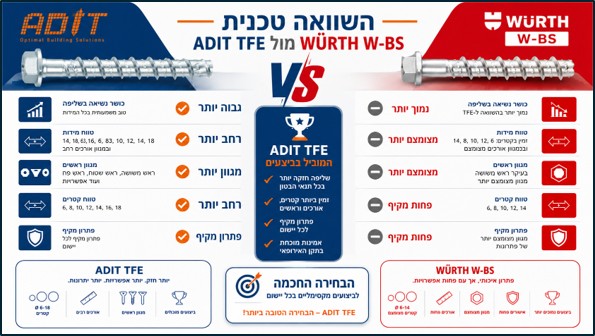
Concrete Screws Compared: ADIT TFE vs Würth W-BS
A standards and characteristic-load comparison (NRk / VRk) in tension and shear — galvanised carbon steel, static / quasi-static loads to EN 1992-4.
In short
Both products are direct-threaded concrete screws (screw anchors) in galvanised carbon steel, set in a pre-drilled hole where they cut their own thread into the concrete. This comparison runs on two planes: the standards basis, then the characteristic failure load (NRk / VRk) in tension and shear, in cracked and uncracked concrete, across the overlapping sizes M8–M14.
- Tension — the TFE leads consistently across every size (roughly +20% to +42%).
- Shear — the TFE leads at M8; from M10 to M14 the W-BS has the shear edge (about 6–19%).
- Size range — the TFE goes up to M18; the W-BS stops at M14.
- Special approvals (fire, seismic, hollow-core) — equivalent.
1. The standards basis
| Parameter | ADIT TFE | Würth W-BS/S |
|---|---|---|
| ETA | ETA-20/0046 (IETcc, Spain) | ETA-16/0043 (DIBt, Germany) |
| EAD / design method | EAD 330232 · Design Method A · EN 1992-4 | EAD 330232 · Design Method A · EN 1992-4 |
| Material tested | Carbon steel, cold galvanised | Carbon steel, white zinc ≥5 µm |
| Diameters | 6, 8, 10, 12, 14, 16, 18 | 6, 8, 10, 12, 14 |
| Concrete | C20/25–C50/60, cracked & uncracked | C20/25–C50/60, cracked & uncracked |
| Seismic | C1 and C2 | C1, and C2 (galvanised version) |
| Fire resistance | R30–R120 (TR020) | R30–R120 (TR020) |
| Hollow-core / Spiencrete | Yes — ETA-20/0494 (sizes 5–6) | Yes — ETA-16/0128 (size 6) |
| Sprinkler approval (VdS) | Yes — VdS CEA 4001 | Yes — VdS (sizes 6–14) |
On the standards basis the two are near-identical: the same EAD, the same Design Method A under EN 1992-4, the same concrete range, and the same fire and seismic envelope. The differences that matter are in the load values and the size range.
2. Characteristic failure load — tension (NRk) and shear (VRk)
The table values are NRk (characteristic tension failure load — the governing minimum) and VRk (characteristic shear failure load), for a single anchor without edge effects, in kilonewtons [kN]. The difference is expressed relative to Würth: a positive figure means the TFE is stronger; a negative figure means the W-BS is stronger.
M8
| Concrete condition | ADIT TFE · hef 43 (C30) NRk / VRk | Würth W-BS · hef 44 (C20/25) NRk / VRk | Difference (tension / shear) |
|---|---|---|---|
| Uncracked | 17.0 / 19.6 | 12.0 / 13.5 | +42% / +45% |
| Cracked | 11.9 / 19.6 | 9.0 / 9.7 | +32% / +102% |
At M8 the TFE leads in both categories — tension (17.0 vs 12.0) and characteristic shear (19.6 vs 13.5) — before any adjustment for concrete strength. This is a real advantage at the characteristic-load level, independent of the concrete grade.
M10
| Concrete condition | ADIT TFE · hef 67 (C30) NRk / VRk | Würth W-BS · hef 68 (C20/25) NRk / VRk | Difference (tension / shear) |
|---|---|---|---|
| Uncracked | 33.0 / 27.4 | 26.0 / 34.0 | +27% / −19% |
| Cracked | 23.1 / 27.4 | 19.3 / 34.0 | +20% / −19% |
From M10 the pattern settles: the TFE leads in tension, the W-BS leads in shear.
M12
| Concrete condition | ADIT TFE · hef 84 (C30) NRk / VRk | Würth W-BS · hef 80 (C20/25) NRk / VRk | Difference (tension / shear) |
|---|---|---|---|
| Uncracked | 46.0 / 37.2 | 35.2 / 42.0 | +31% / −11% |
| Cracked | 32.2 / 37.2 | 24.6 / 42.0 | +31% / −11% |
Similar embedment (84 vs 80). The consistent pattern holds: the TFE leads in tension (46.0 vs 35.2), the W-BS leads in shear (42.0 vs 37.2).
M14
| Concrete condition | ADIT TFE · hef 92 (C30) NRk / VRk | Würth W-BS · hef 92 (C20/25) NRk / VRk | Difference (tension / shear) |
|---|---|---|---|
| Uncracked | 53.2 / 52.7 | 43.4 / 56.0 | +23% / −6% |
| Cracked | 37.2 / 52.7 | 30.4 / 56.0 | +22% / −6% |
Identical embedment (92). The TFE is stronger in tension (53.2 vs 43.4); the W-BS is slightly stronger in characteristic shear (56.0 vs 52.7).
3. The pattern in one view
| Category | Tension (NRk) | Shear (VRk) |
|---|---|---|
| Size M8 | TFE leads · +32% to +42% | TFE leads · +45% to +102% |
| Sizes M10–M14 | TFE leads · +20% to +31% | W-BS leads · 6%–19% |
| Diameter range | TFE leads — up to M18 versus M14 | |
| Approvals (fire / seismic / hollow-core) | Equivalent | |
Recommendation — which screw, and when
- Tension (pull-out) applications — hangers, brackets, loads suspended from a soffit: prefer the TFE. It gives a consistently higher characteristic tension resistance across every size.
- Size M8, any application: the TFE leads in both tension and shear — the preferred choice.
- Shear-dominated applications in M10–M14 — formwork legs, profiles, in-plane connections: the W-BS has a shear advantage (already at characteristic load, and magnified by its ductility factor k7). If the TFE is specifically required, compensate with a greater embedment depth or a larger size.
- Large sizes (M16, M18): only the TFE is available and approved — the W-BS does not go beyond M14.
- Hollow concrete / Spiencrete, seismic C2, fire R120: both screws are approved; the choice comes down to size and stock availability.
- Accurate comparative design: always run the ULS calculation at the same concrete strength, the same hef, and the same edge/spacing distances, using the design software or EN 1992-4. Note that VRd is affected by the ductility factor k7, which differs between the two screws.
Sources
- ETA-20/0046 (IETcc) — ADIT TFE concrete screw; ETA-20/0494 — hollow-core.
- ETA-16/0043 (DIBt) — Würth W-BS/S concrete screw; ETA-16/0128 — hollow-core.
- EAD 330232 — Screw anchors for use in concrete (Design Method A).
- EN 1992-4:2018 — Design of fastenings for use in concrete.
This comparison is based on ETA-20/0046 and ETA-20/0494 (ADIT / Index) and on ETA-16/0043 together with the Würth designers’ data sheet. The values are for a single anchor with no edge effects; in real design, edge distances, spacings and anchor-group effects must be taken into account. For any technical question, contact the ADIT Ltd engineering department on +972 54-7976110.