
Chemfix 100 vs Hilti HIT-RE 500 V3: Which Adhesive Is Better?
12 בJuly 2026
EASY, HC or TFF: The Best Anchor for Hollow-Core (Spancrete) Slabs?
12 בJuly 2026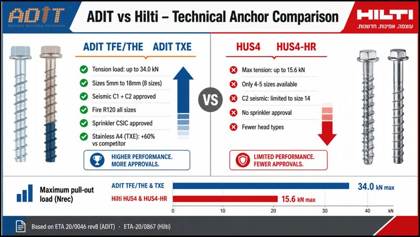
Concrete Screws, Material for Material: ADIT TFE/TXE vs Hilti HUS4/HUS4-HR
The sensible comparison pairs like with like: carbon-steel screw against carbon-steel screw, A4 stainless against A4 stainless. All figures from the official ETAs — ETA 20/0046 rev.8 (TFE/TXE, Jan 2026) and ETA-20/0867 (HUS4/HUS4-HR, Apr 2024). C20/25 concrete · single anchor · spacings ≥ copt.
In short
Two carbon-steel screws (ADIT TFE/THE vs Hilti HUS4) and two A4 stainless screws (ADIT TXE vs Hilti HUS4-HR), compared strictly within each material class. On recommended pull-out load (Nrec) the ADIT screws lead across the parallel sizes — the TFE by roughly 15–40% over the HUS4, the TXE by 12–63% over the HUS4-HR. The ADIT range is also wider (up to M18 in carbon steel; M5/M6 hollow-core), and only the ADIT carbon screw carries seismic C2 approval. Both brands cover C1 seismic and fire R30–R120.
1. Overview — the four products
| Parameter | Adit TFE / THE (carbon) | Hilti HUS4 (carbon) | Adit TXE (A4) | Hilti HUS4-HR (A4) |
|---|---|---|---|---|
| ETA / standard | ETA 20/0046 rev.8 (IETcc · Jan 2026) | ETA-20/0867 (DIBt · Apr 2024) | ETA 20/0046 rev.8 (IETcc) | ETA-20/0867 (DIBt) |
| Material / coating | TFE: cold galv. (≥5 µm); THE: Atlantis (enhanced hot-dip) | HF multilayer coating | A4 stainless (SS316) — full body + head | A4 stainless (SS316) — body + head |
| Sizes (d₀) | M5, 6, 8, 10, 12, 14, 16, 18 (8 sizes) | M8, 10, 12, 14, 16 (5 sizes) | M6, 8, 10, 12 (4 sizes) | M6, 8, 10, 14 (4 sizes) |
| Head types | E, A, N, P, T, W, S, M, F, J (10+) | H, HF, C, A/AF (4) | E, A, P, T, S, M, F (7) | HR (hex) · CR (countersunk) (2) |
| Seismic C1 | M6–18 | M8–16 | M6–12 | M8–14 |
| Seismic C2 | M8–18 | M8–14 only | Not approved | Not approved |
| Fire resistance | R30–R120 (head-dependent) | R30–R120 | R30–R120 | R30–R120 |
| Sprinkler (CSIC) | THE M6–18 | No | Check with Adit | No |
| Hollow-core approval | M5 + M6 (ETA 20/0494) | No | No | No |
| Design software | Adit software + Index | PROFIS Engineering | Adit software + Index | PROFIS Engineering |
2. Pair A — recommended pull-out load Nrec [kN]: TFE/THE vs HUS4
Uncracked C20/25 concrete, single anchor. Compared at each product’s own installation depth (hnom), the TFE exceeds the HUS4 by 15–40% at every parallel size.
Nrec in uncracked concrete [kN] — TFE/THE against HUS4 (baseline: TFE M18, hnom 140 mm = 34.0 kN)
| Size / hnom | TFE/THE Nrec [kN] | HUS4 Nrec [kN] | TFE advantage |
|---|---|---|---|
| M8 · hnom 50/60/65 | 5.5 (hnom 50) · 10.3 (hnom 65) | 7.7 (hnom 60) | TFE65: +34% |
| M10 · hnom 75 | 13.3 | 10.5 | +27% |
| M10 · hnom 85 | 15.7 | — | Depth with no equivalent |
| M12 · hnom 75/80 | 12.7 (hnom 75) | 11.7 (hnom 80) | +9% (at a shallower depth!) |
| M12 · hnom 105 | 21.9 | — | Depth with no equivalent |
| M14 · hnom 85/115 | 25.3 (hnom 115) | 12.6 (hnom 85) | +101% |
| M16, M18 | 25.3 / 34.0 | Not available | Exclusive to TFE |
3. Pair B — recommended pull-out load Nrec [kN]: TXE vs HUS4-HR
Uncracked C20/25 concrete, single anchor. Two shared sizes (M8 and M10); M12 is exclusive to the TXE, M14 exclusive to the HUS4-HR.
Nrec in uncracked concrete [kN] — TXE against HUS4-HR (baseline: 15.6 kN)
| Size / hnom | TXE Nrec [kN] | HUS4-HR Nrec [kN] | TXE advantage |
|---|---|---|---|
| M6 | 4.7 (hnom 40) · 2.6 (hnom 35) | 3.1 (hnom 55) | TXE40: +52% |
| M8 · hnom 50/65/80 | 5.5 (hnom 50) · 10.3 (hnom 65) | 3.6 (hnom 50) · 6.3 (hnom 80) | TXE50: +53%; TXE65 vs HR80: +63% |
| M10 · hnom 55/75/90 | 7.7 (hnom 55) · 13.3 (hnom 75) | 4.8 (hnom 60) · 11.9 (hnom 90) | TXE55 vs HR60: +60%; TXE75 vs HR90: +12% |
| M12 · hnom 75 | 12.7 | Not in HR | Exclusive to TXE |
| M14 · hnom 110 | Not in TXE | 15.6 | Exclusive to HUS4-HR |
Important — installation depths: the TXE and the HUS4-HR are not always compared at exactly the same hnom. The TXE offers a wider choice of embedment depths (hnom 35–85 mm on most sizes), while the HUS4-HR has fewer options (hnom 50–110 mm). The table above reports the official approval figures — for a specific project, run the calculation in software at the hnom the design actually requires.
4. Seismic — C1 and C2
| Criterion | TFE/THE | HUS4 | TXE | HUS4-HR |
|---|---|---|---|---|
| C1 approved | M6–18 | M8–16 | M6–12 | M8–14 |
| C2 approved | M8–18 | M8–14 | No | No |
| Nrec C1 · M8 | 4.6 kN (hef 50.5) | ~4.5 kN* | 4.6 kN (hef 50.5) | ~4.5 kN* |
| Nrec C1 · M10 | 7.7 kN (hef 67) | ~6.0 kN* | 7.7 kN (hef 67) | ~6.0 kN* |
| Nrec C2 · M10 | 3.6 kN | ~4.0 kN* | — | — |
* HUS4 / HUS4-HR C1/C2: estimated from ETA-20/0867. Note: a standard epoxy fill achieves the same C1 shear resistances as Hilti’s dedicated Filling Set.
Clear advantage to the TFE/THE on seismic: C2 is approved from M8 all the way up to M18 — including M16 and M18, which have no Hilti equivalent at all. The TXE and the HUS4-HR are both C1 only, so on this point the two stainless screws are level.
5. Fire resistance — R30–R120
Critical point for the TFE/THE: fire resistance depends heavily on the head type — an E/K/J head carries 4–5 times the load of an N/A/S/W head. The TXE and the HUS4-HR are hex-head only, which makes their comparison simpler.
| Size | TFE/THE NRk,s,fi R120 [kN] | HUS4 R120 [kN]* | TXE NRk,s,fi R120 [kN] | HUS4-HR NRd,fi R120 [kN] |
|---|---|---|---|---|
| M6 | 0.58 (E head) | — | 0.58 (E head) | 1.3 (hnom 55) |
| M8 | 1.00 (E) · 0.23 (N) | ~0.7* | 1.00 (E) | 1.2 (hnom 60) |
| M10 | 1.58 (E) | ~1.0* | 1.58 (E) | 1.8 (hnom 90) |
| M12 | 2.57 (E) | ~1.5* | 2.57 (E) | Not available |
| M14 | 3.33 (E) | ~2.0* | Not available | 5.0 (hnom 110) |
TFE/TXE: ETA 20/0046 rev.8, Annexes C14–C27. * HUS4 values estimated. Note the source mixes characteristic steel-fire values (NRk,s,fi) for the ADIT/HUS4 columns with a design value (NRd,fi) for the HUS4-HR column — compare like with like.
6. Installation
| Parameter | TFE/THE | HUS4 | TXE | HUS4-HR |
|---|---|---|---|---|
| Hole cleaning per ETA | Required (blow + clean) | Exempt per ETA (M8–14, horizontal/downward) | Required (blow + clean) | Exempt per ETA (M8–10) |
| Re-use | Yes | Yes | Yes | Yes |
| Min. concrete thickness (M8) | 100 mm | 80 mm | 100 mm | 100 mm |
On hole cleaning: the HUS4/HUS4-HR exemption is a formal one, granted in the ETA. In practice basic cleaning equipment — a hand pump or compressed air — is available on every ordinary site, so this is a difference on paper rather than a difference in the work itself.
7. Weighted score
Five criteria, weighted by how much they usually decide a specification. Each product is scored out of five.
Pair A — carbon steel: TFE/THE against HUS4
| Criterion (weight) | ADIT TFE / THE | Hilti HUS4 |
|---|---|---|
| Pull-out capacity (30%) | 5 / 5 | 3.5 / 5 |
| Range of sizes and head types (20%) | 5 / 5 | 2.5 / 5 |
| Standards coverage and approvals (20%) | 5 / 5 | 3.5 / 5 |
| Ease of installation (15%) | 3.5 / 5 | 4.5 / 5 |
| Cost (15%) | 5 / 5 | 2.5 / 5 |
| Overall | 4.8 / 5 | 3.2 / 5 |
Pair B — stainless steel: TXE against HUS4-HR
| Criterion (weight) | ADIT TXE | Hilti HUS4-HR |
|---|---|---|
| Pull-out capacity (30%) | 5 / 5 | 3 / 5 |
| Range of sizes and head types (20%) | 4 / 5 | 2 / 5 |
| Standards coverage and approvals (20%) | 3.5 / 5 | 3 / 5 |
| Ease of installation (15%) | 3.5 / 5 | 4.5 / 5 |
| Cost (15%) | 4 / 5 | 2.5 / 5 |
| Overall | 4.1 / 5 | 2.8 / 5 |
8. Conclusions
Compared strictly material-for-material, the ADIT screws lead where it matters most — recommended pull-out load: the TFE is 15–40% above the HUS4 across the parallel sizes (and +101% at M14 at its deeper embedment), and the TXE is 12–63% above the HUS4-HR. Beyond raw load, the ADIT screws bring a wider size range (up to M18 in carbon steel; M5/M6 approved for hollow-core), far more head types, and — uniquely in this group — seismic C2 approval on the carbon-steel screw. The Hilti screws’ advantages are a slightly thinner minimum concrete for the HUS4 (80 vs 100 mm at M8) and the ETA hole-cleaning exemption in certain orientations. For fire and C1 seismic the two brands are comparable. When a specification is open on brand, the ADIT TFE/TXE is the stronger and more flexible choice within each material class; always confirm the final selection with a ULS calculation at the project’s concrete strength, embedment and spacings.
Which one to specify
ADIT TFE/THE — choose it when: pull-out loads are high (15–40% above the HUS4); seismic C2 is required, from M8 up to M18; CSIC sprinkler approval is needed (THE only); a wide choice of heads and sizes matters (M5 to M18); the fixing goes into hollow-core slabs (M5, M6); an E/K/J head is wanted for maximum R120 fire resistance; or cost is a factor.
Hilti HUS4 — consider it when: the specification names the HUS4 explicitly; the concrete is thin (hmin 80 mm at M8); or seismic C2 up to M14 is enough. Note that the hole-cleaning exemption, the Filling Set and PROFIS are not substantive advantages — each is easily matched when working with the TFE.
ADIT TXE — choose it when: the environment is marine, external or damp (CRC II); A4 stainless with a full ETA is required; M6–M12 with C1 seismic and R120 fire cover the design; pull-out loads 50–63% above the HUS4-HR are useful; or cost is a factor, as the TXE is usually cheaper than the HUS4-HR.
Hilti HUS4-HR — consider it when: M14 in stainless is required, which is exclusive to the HUS4-HR; or the specification names the HUS4-HR specifically. At every shared size the TXE carries 12–63% more pull-out load.
Engineering advice and pricing
The ADIT engineering team will help you pick the right concrete screw, run the load calculation and get the specification approved. Call +972 54-7976110.
Sources
- ETA 20/0046 rev.8 (IETcc) — ADIT TFE / THE / TXE concrete screws; ETA 20/0494 — hollow-core.
- ETA-20/0867 (DIBt) — Hilti HUS4 / HUS4-HR.
- ADIT TFE / THE / TXE technical datasheet, 2026.
- Hilti HUS4-HR / CR technical datasheet (June 2024).
- EN 1992-4:2018 — Design of fastenings for use in concrete; EAD 330232.