

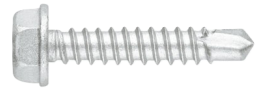
ADIT BIE Bi-Metal Self-Drilling Screw
Bi-metal self-drilling screw with an AISI 304 stainless steel body and a hardened C1035 carbon-steel drill tip — drills, drives and fastens in one pass into steel and sheet up to 6.5 mm, with no pilot hole. Atlantis C3-H tip coating and ISO 10666 mechanical data.
The Adit self-drilling screw family
Choose the right self-drilling screw for your substrate, profile thickness and environment.
What is the ADIT BIE bi-metal self-drilling screw?
The bi-metal self-drilling screw from the ADIT BIE series is an engineered fastening solution that combines two metals in a single screw: the body and thread are made of AISI 304 stainless steel (SS304) for maximum corrosion resistance, alongside a drilling tip made of hardened C1035 carbon steel that provides high hardness for direct drilling. This bi-metal self-drilling screw lets you pierce, drill and fasten in one continuous operation — with no need for a pilot hole — into sheet-metal and steel profiles up to 6.5 mm thick.
The screw is supplied with an Atlantis C3-H coating on the drilling tip, protecting it from moisture even under aggressive conditions. The reference standard is ISO 10666 — identical to the mechanical data of classic self-drilling screws. The series is also available in a BIE A4 version with an AISI 316 body for marine and especially aggressive environments.
Advantages of the ADIT BIE bi-metal self-drilling screw
- Direct drilling with no preparation: the screw drills, drives and fastens in a single step — no separate drill bit or pilot hole required.
- True bi-metal technology: SS304/SS316 stainless steel body + hardened C1035 steel tip — a combination that delivers full corrosion protection together with high drilling hardness.
- Atlantis C3-H coating: proven protection for the drilling tip in aggressive environments — marine, chemical industry and outdoor conditions.
- ISO 10666 compliance: mechanical data identical to self-drilling screws, enabling standards-based structural design.
- Diameter range: ST 4.8 / ST 5.5 / ST 6.3 — drilling up to 6.5 mm profile thickness.
- A4/316 version: the BIE A4 series for marine and especially aggressive environments — AISI 316 body, the same bi-metal technology.
Approved technical data — BIE bi-metal self-drilling screw
Geometry and general dimensions
| Parameter | Unit | BIE 4.8 | BIE 5.5 | BIE 6.3 |
|---|---|---|---|---|
| Outer diameter incl. thread (D) | mm | 4.80 | 5.46 | 6.25 |
| Screw core diameter (d) | mm | 3.58 | 4.17 | 4.88 |
| Head washer diameter (dk) | mm | 10.0 | 10.5 | 12.6 |
| Head thickness (K) | mm | 4.3 | 5.3 | 6.3 |
| Washer thickness (C) | mm | 0.9 | 1.0 | 1.0 |
| Thread pitch (P) | mm | 1.6 | 1.8 | 1.8 |
| Hex socket size (e) | mm | 8 | 8 | 10 |
| Drilling tip diameter (dp) | mm | 3.90 | 4.65 | 5.50 |
| Drilling tip length (Z) | mm | 5.1 | 7.9 | 9.3 |
| Thread length (X) | mm | 14 | 16 | 18 |
| Drilling capacity (profile thickness) | mm | 1.75 – 4.40 | 1.75 – 5.25 | 2.50 – 6.00 |
| Available lengths (l) | mm | 25 | 25 – 80 | 25 |
| Recommended magnetic socket | – | BOCA008 | BOCA008 | BOCA010 |
Characteristic failure loads (per ISO 10666)
| Load type | BIE ST 4.8 (kN) | BIE ST 5.5 (kN) | BIE ST 6.3 (kN) |
|---|---|---|---|
| Tension (Nrk) | 5.65 | 9.34 | 13.36 |
| Shear (Vrk) | 2.82 | 4.67 | 6.68 |
Single-screw load tables — connection to a steel profile
All values in the tables below are intended for engineering design and are given in kN for a single bi-metal stainless steel screw. Note: the shear capacity does not account for profile tear-out. The designer must separately verify the profile’s tear-out resistance.
Diameter BIE ST 4.8 — connection to a steel profile
| Load parameter (kN) | Steel thickness 2 mm | Steel thickness 3 mm | Steel thickness 4 mm |
|---|---|---|---|
| Characteristic failure load – tension (Nrk) | 5.7 | 5.7 | 5.7 |
| Characteristic failure load – shear (Vrk) | 2.8 | 2.8 | 2.8 |
| Design load – tension (Nrd) | 2.6 | 3.9 | 5.2 |
| Design load – shear (Vrd) | 2.2 | 2.2 | 2.2 |
| Recommended service load – tension (Nrec) | 1.9 | 2.8 | 3.7 |
| Recommended service load – shear (Vrec) | 1.5 | 1.5 | 1.5 |
Diameter BIE ST 5.5 — connection to a steel profile
| Load parameter (kN) | Steel thickness 2 mm | Steel thickness 3.5 mm | Steel thickness 5 mm |
|---|---|---|---|
| Characteristic failure load – tension (Nrk) | 5.4 | 8.7 | 9.3 |
| Characteristic failure load – shear (Vrk) | 4.7 | 4.7 | 4.7 |
| Design load – tension (Nrd) | 2.5 | 4.0 | 4.8 |
| Design load – shear (Vrd) | 3.6 | 3.6 | 3.6 |
| Recommended service load – tension (Nrec) | 1.8 | 2.9 | 3.4 |
| Recommended service load – shear (Vrec) | 2.6 | 2.6 | 2.6 |
Diameter BIE ST 6.3 — connection to a steel profile
| Load parameter (kN) | Steel thickness 2.5 mm | Steel thickness 4 mm | Steel thickness 5 mm |
|---|---|---|---|
| Characteristic failure load – tension (Nrk) | 4.3 | 9.6 | 13.4 |
| Characteristic failure load – shear (Vrk) | 6.7 | 6.7 | 6.7 |
| Design load – tension (Nrd) | 2.0 | 4.5 | 6.8 |
| Design load – shear (Vrd) | 5.1 | 5.1 | 5.1 |
| Recommended service load – tension (Nrec) | 1.4 | 3.2 | 4.8 |
| Recommended service load – shear (Vrec) | 3.7 | 3.7 | 3.7 |
Single-screw load tables — connection to an aluminum profile
Note: for connections to aluminum it is recommended to use only the BIE bi-metal stainless steel screw (and not a galvanized steel screw) to prevent galvanic corrosion. The shear capacity does not account for profile tear-out — the designer must verify this separately.
Diameter BIE ST 4.8 — connection to an aluminum profile
| Load parameter (kN) | Aluminum thickness 2 mm | Aluminum thickness 3 mm | Aluminum thickness 4 mm |
|---|---|---|---|
| Characteristic failure load – tension (Nrk) | 2.9 | 4.6 | 5.7 |
| Characteristic failure load – shear (Vrk) | 2.8 | 2.8 | 2.8 |
| Design load – tension (Nrd) | 1.3 | 2.1 | 2.9 |
| Design load – shear (Vrd) | 2.2 | 2.2 | 2.2 |
| Recommended service load – tension (Nrec) | 1.0 | 1.5 | 2.1 |
| Recommended service load – shear (Vrec) | 1.5 | 1.5 | 1.5 |
Diameter BIE ST 5.5 — connection to an aluminum profile
| Load parameter (kN) | Aluminum thickness 2 mm | Aluminum thickness 4 mm | Aluminum thickness 5 mm |
|---|---|---|---|
| Characteristic failure load – tension (Nrk) | 2.0 | 7.6 | 9.3 |
| Characteristic failure load – shear (Vrk) | 4.7 | 4.7 | 4.7 |
| Design load – tension (Nrd) | 0.9 | 3.5 | 4.8 |
| Design load – shear (Vrd) | 3.6 | 3.6 | 3.6 |
| Recommended service load – tension (Nrec) | 0.7 | 2.5 | 3.4 |
| Recommended service load – shear (Vrec) | 2.6 | 2.6 | 2.6 |
Diameter BIE ST 6.3 — connection to an aluminum profile
| Load parameter (kN) | Aluminum thickness 2 mm | Aluminum thickness 4 mm | Aluminum thickness 6 mm |
|---|---|---|---|
| Characteristic failure load – tension (Nrk) | 2.3 | 7.4 | 13.4 |
| Characteristic failure load – shear (Vrk) | 6.7 | 6.7 | 6.7 |
| Design load – tension (Nrd) | 1.1 | 3.5 | 6.3 |
| Design load – shear (Vrd) | 5.1 | 5.1 | 5.1 |
| Recommended service load – tension (Nrec) | 0.8 | 2.5 | 4.5 |
| Recommended service load – shear (Vrec) | 3.7 | 3.7 | 3.7 |
Installation guide and working parameters
- Marking the entry point: a light tap (using a center punch) at the intended entry point is recommended. This centers the tip of the drilling point and prevents slipping on smooth stainless steel sheet.
- Driving with a high-speed screwdriver: use a high-speed screwdriver with a magnetic socket that matches the screw head (BOCA008 for diameters 4.8 and 5.5, BOCA010 for diameter 6.3). An impact driver may be used provided that driving is stopped as soon as the screw is seated against the profile.
- Correct drilling speed:
- In steel: ST4.8 – 1800–2500 rpm; ST5.5 / ST6.3 – 1000–1800 rpm.
- In stainless steel: ST4.8 – 1000–1500 rpm; ST5.5 / ST6.3 – 600–1000 rpm.
- Maximum drilling time: ST4.8 – 7 seconds; ST5.5 – 11 seconds; ST6.3 – 13 seconds.
- Maximum installation torque: ST4.8 – 4.0 Nm; ST5.5 – 6.2 Nm; ST6.3 – 10.4 Nm.
- Final tightening: stop immediately once the screw head is seated against the profile. When using the BIE16 version with an EPDM sealing washer, make sure the washer is compressed evenly and seals against water ingress, but is not crushed or deformed.
Self-drilling screw models in the ADIT catalog
- BIE: the flagship series for sheet-to-sheet and sheet-to-beam connections. Bi-metal stainless steel self-drilling screw in AISI 304, Atlantis C3-H coating, ST4.8–ST6.3 diameters, lengths 25–80 mm. BIE16 comes with a stainless steel P16 sealing washer to seal against water ingress.
- BAUTO / BAUTO16: bi-metal self-drilling screw for heavy IPN beams. ST5.5 diameter, lengths 40–100 mm, drilling capacity up to 12 mm. BAUTO16 comes with a P16 sealing washer.
- BIE A4: an AISI 316 stainless steel version of the bi-metal self-drilling screw for marine and aggressive environments — available in ST5.5 and ST6.3 diameters.
- ABE: classic steel self-drilling screw, hex head with washer and cold galvanizing for indoor environments.
- ABEI: self-drilling screw made entirely of solid SS304 stainless steel, suitable for outdoor and coastal environments.
- AUTO: self-drilling screw with an extra-long drilling point for direct drilling into heavy, thick profiles.
- PS3 / PSL: dedicated long screws with wide EPDM washers, intended for insulated-panel and roofing applications.
- ABP / ABR: self-drilling screws with attractive heads — conical countersunk head (ABP) or round flat head (ABR).
- RSZ / RS A2: self-drilling screws with a small wafer head, ideal for fine seams and aluminum work.
Advanced engineering consultation at Adit Ltd.
The market is full of cheap screws that tend to break under shear loads, corrode quickly, or fail during the drilling stages. Adit Ltd. provides its customers with a complete engineering envelope that includes professional support, certified load tables, and assistance in precisely calculating the required screw diameter and length. The company’s engineers are available by phone at +972-54-7976110 for any engineering question.
Frequently asked questions
What is a bi-metal self-drilling screw and why is it better than a regular stainless steel screw?
What is the difference between BIE and BAUTO — which bi-metal self-drilling screw should you choose?
Is the BIE stainless steel self-drilling screw suitable for a marine environment?
What is the correct drilling speed for a BIE screw in steel versus stainless steel?
What is the difference between the characteristic failure load (Nrk) and the design load (Nrd)?
What is the Atlantis C3-H coating and why is it important in a bi-metal self-drilling screw?
Why is it essential to use a bi-metal stainless steel screw and not a galvanized steel screw when connecting to aluminum?
What is the maximum profile thickness for drilling with BIE — can it drill 6 mm steel?
Planning a steel or aluminum fastening job? Tell us the profile thickness, substrate and load — our engineers will recommend the right BIE diameter and length and send you the certified load tables.