

3 Methods for Calculating Post-Installed Rebar with Chemical Adhesive — a 25× Gap
12 בJuly 2026
What Loads Does EN 795 Require of a Work-at-Height Anchor — and Why?
12 בJuly 2026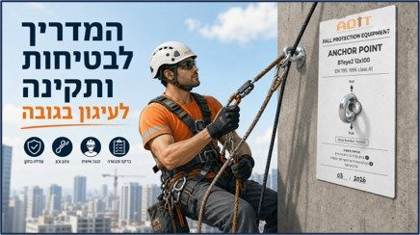
Anchor Points for Work at Height: The Complete Guide to Safety, Standards and Signage
Work at height is one of the most dangerous activities in construction and maintenance. Personal fall-protection equipment is essential — but useless without an anchor point that is correctly installed, marked and inspected.
In short
An anchor point is the first and most critical link in a fall-arrest system — the physical connection between the worker (through harness and lanyard) and the structure. This guide covers what an anchor point is, the types and EN 795 classes, the loads and inspection duties the standards require, the signage EN 365 mandates on the anchor itself, the full personal-protection system around it, and the often-forgotten rescue plan.
What is an anchor point for work at height?
An anchor point is the first and most critical component in a fall-arrest or restraint system — the physical connection between the worker (through a harness and lanyard) and the structure being worked on. Its job is to absorb the enormous forces generated in a fall and prevent the worker from detaching from the structure.
Common types of anchor point
Different anchoring solutions suit different surfaces and kinds of work:
- Fixed anchor points: installed on concrete roofs, walls or steel structures, for long-term routine maintenance — e.g. the BTeye2 12×100.
- Temporary anchor points: portable devices (anchor straps or removable fittings) fitted at the start of the work and removed at the end.
- Lifelines: a system of several anchor points connected by a steel cable or rail, letting the worker move along the structure without disconnecting.
- Anchors for lightweight roofs: dedicated solutions for profiled-metal or insulated-panel roofs that spread the load over a wider surface.
Classification per EN 795
The European standard EN 795 divides anchor points into classes by how they are installed and used:
| Class | Description | Typical example |
|---|---|---|
| Type A | Single fixed anchor, fastened to a load-bearing substrate (concrete, steel) | An eye bolt such as the BTeye2 |
| Type B | Portable/temporary anchor, movable between structures | Removable anchor strap |
| Type C | Flexible horizontal lifeline (cable) tensioned between two end points | Horizontal lifeline system |
| Type D | Rigid lifeline (rail) between two end points | Overhead aluminium rail |
| Type E | Dead-weight anchor relying on friction and its own weight, with no mechanical fixing | Anchor blocks for flat roofs |
What loads must an anchor point withstand?
The minimum load requirement depends on the system’s role:
| System purpose | Required load | Note |
|---|---|---|
| Fall arrest | 22.2 kN (~2,200 kg) | A safety factor of 2× the force actually generated in a fall |
| Fall restraint | 4.4 kN (~450 kg) | Suitable when the worker is restrained and cannot reach the fall edge |
Remember that this load is required per worker connected individually. If several workers connect to the same anchor point at once, its required capacity rises accordingly, and the point must be verified for that combined load or replaced with one explicitly approved for multiple simultaneous users.
Standards and inspections — what the law requires
Installing an anchor point for work at height is not something anyone may do. Under the Israeli regulations:
- EN 795: the European standard accepted in Israel, which defines the technical requirements for anchor points.
- After installation: every anchor point must pass a pull-out test or receive a structural engineer’s approval.
- Periodic inspection: the anchor points must be checked at least once a year by a “certified inspector of lifting accessories” or an authorised installer.
- EN 365: the standard governing the overall management of personal fall-protection systems — signage, instruction leaflets, inspection records and maintenance.
Required signage per EN 365
One thing very few parties actually enforce is the duty to mark the anchor point itself. EN 365 sets out which markings must be burned, engraved or embossed on an anchor point (including on an eye bolt such as the EN 795-rated BTeye2), so they stay durable, legible and permanent for its whole service life.
The markings EN 365 requires
- Manufacturer’s name or identifying mark.
- Trade/model designation or product description.
- CE mark (where relevant) and reference to the compliance documents / manufacturer’s declaration.
- Year of manufacture (full year).
- Serial or batch number for production traceability.
- Reference to the applicable standard(s) (e.g. EN 795 and EN 365, and any others as needed).
- A clear use limit: the maximum number of simultaneous users, or a statement of single-user only where that applies.
- The load limit or maximum capacity, or a reference to the manual holding the load values.
- The preferred direction of use or loading, where relevant (arrows or explanatory text).
- A pictogram or instruction to read the instruction leaflet before use.
- Any special warnings or use restrictions, where they exist (environmental conditions, permanent or temporary use, and so on).
- A reference to periodic inspection and maintenance, or to the inspection record.
Beyond the markings on the product body, EN 365 also requires the instruction leaflet supplied with the anchor point to carry fuller detail: installation guidance, correct use, maintenance, how the periodic inspections are performed, the expected service life and the required storage conditions. For exact load values and the specific requirements of each type and sub-type, refer directly to the full EN 795 and EN 365 standards.
For a fuller treatment of this subject see the article Signage Required Under EN 365 for an EN 795 Work-at-Height Anchor Point on the Adit site.
The full personal-protection system — not just an anchor point
A compliant anchor point is necessary but is only one part of a complete fall-arrest system. A full, compliant system includes:
- A full-body harness (EN 361) — distributes the fall force across the body and protects the spine.
- An energy-absorbing lanyard (EN 355) — reduces the arresting force applied to the body in a fall.
- Connectors and karabiners (EN 362) — with a double-locking mechanism to prevent accidental opening.
- The anchor point itself (EN 795), marked per EN 365 as above.
Also account for the free-fall clearance — the total distance needed below the worker to the nearest surface or obstacle, allowing for the lanyard length, the energy-absorber’s extension and the worker’s height. Miscalculating this can cause the worker to strike the surface below even when the anchor point itself is fully compliant.
A rescue plan — the requirement that is often overlooked
The work-at-height safety regulations, and EN 365, require every job at height to have a pre-defined rescue plan — rather than passively waiting for rescue services to arrive. A worker left suspended after a fall is at risk of suspension trauma within minutes, so the plan must allow a fast, safe recovery.
Suspension trauma is a life-threatening condition caused by restricted blood flow in the legs, and it can set in within a few minutes. Before work at height starts, define who is responsible for carrying out the rescue, what equipment will be used (a dedicated rescue or lifting system, for example), and how long the rescue is expected to take. The absence of a written rescue plan is a common and dangerous breach, even when the anchor point and the personal protective equipment are fully compliant.
How to choose the right anchor point
Before selecting a product, weigh several factors:
- Substrate type: concrete, steel or timber?
- Number of users: must the point hold one worker or two at once?
- Environment: is it exposed to moisture and corrosion (which calls for stainless steel)?
- Nature of use: a fixed point for routine maintenance, or a temporary point for one-off work?
- Access for periodic inspection: can the point and its label be reached for the annual check without endangering the inspector?
Common questions
What is the difference between EN 795 and EN 365?
EN 795 defines the technical requirements for the anchor point itself — strength, loads, installation and device types. EN 365 defines the overall management of personal fall-protection systems: signage, instruction leaflets, periodic-inspection records and maintenance. The two are complementary and both are required in practice.
Must every anchor point carry EN 365 signage?
Yes. EN 365 applies to all personal fall-protection equipment, including anchor points; a compliant label specifying the product’s details is mandatory. A compliant label giving the manufacturer, the applicable standards and the load and use limits lets any worker verify on site that the point suits the task about to be performed.
Who is qualified to inspect an anchor point once a year?
The periodic inspection must be carried out by a certified inspector of lifting accessories, or by an authorised installer trained to inspect fall-protection equipment — not by an ordinary worker.
What load must an anchor point withstand?
22.2 kN (~2,200 kg) for fall arrest, or 4.4 kN (~450 kg) for fall restraint — per worker connected.
What happens if an anchor point is unmarked?
Without compliant signage the worker cannot identify the point’s purpose or use limits, opening the door to misuse at the critical moment; the installation is also non-compliant with EN 365. Such a point must not be used until it has been checked and verified with a competent professional, and a matching replacement label fitted if required.
Summary
A safe work-at-height set-up is a chain: a compliant anchor point (EN 795) of the right class and capacity, correctly installed and pull-out tested, marked per EN 365, used within a full personal-protection system (harness, energy-absorbing lanyard, locking connectors), with the free-fall clearance calculated and a rescue plan in place. Skip any link — most often the signage or the rescue plan — and the whole system is compromised.
Sources
- EN 795 — Personal fall-protection equipment: anchor devices.
- EN 365 — General requirements for instructions for use, maintenance, inspection and marking.
- EN 361 (harness), EN 355 (energy-absorbing lanyard), EN 362 (connectors).