
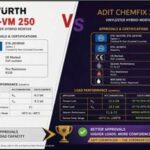
Which Adhesive Is Better — ADIT Chemfix200 or Würth WIT-VM 250?
12 בJuly 2026
A Dangerous Deception in the Adhesive Market: Selling Epoxy-Acrylate as Epoxy
12 בJuly 2026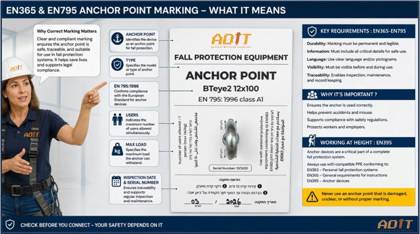
Signage Required Under EN 365 for an EN 795 Work-at-Height Anchor Point
Below are the markings EN 365 requires on personal protective equipment (PPE), including a safety anchor (to complete the anchor-specific requirements, such as a work-at-height bolt carrying EN 795 or EN 795). Make sure these markings are durable, legible and permanent on the product or the accompanying sign.
In short
EN 365 covers the general requirements for the instructions for use, maintenance, periodic examination, repair, marking and packaging of personal fall-protection equipment. A correct sign is the anchor’s “identity card”: it enables traceability and supervision, prevents overload by stating the permitted number of users and load directions, and gives the worker the information needed to decide whether the point suits the task. A sign must be installed as soon as an anchor point or lifeline is installed and before first use, and updated at every periodic inspection.
The engineering and safety importance of EN 365 signage
The critical importance of the signage stems from the need for ongoing supervision and maximum safety on the worksite:
- Traceability and supervision: a correct sign lets safety inspectors verify that the equipment was checked by a competent inspector, approved for use, and has not passed its periodic inspection date.
- Preventing overload: a clear statement of the permitted number of simultaneous users and the authorised load directions prevents a critical system failure in real time.
- Immediate identification of limits: the sign gives the worker in the field the information needed to decide whether the anchor point suits the task, with no guesswork that endangers human life.
The required list of markings
- The manufacturer’s name or identifying mark.
- A trade/model marking or product description (model identifier / product name).
- The CE mark (if relevant) and a reference to compliance documents / manufacturer’s declarations.
- Year of manufacture (full year).
- Serial number or batch/production identification number.
- Reference to the applicable standard(s) (for example EN 795 and EN 365 / where needed EN 795 or others) or a suitable standard marking.
- A clear use limit: the maximum number of simultaneous users, or a note “for a single user” if appropriate.
- A load limit / maximum resistance, or loading instructions (or a reference to the guide with load values).
- Direction of use / loading (if required — arrows or text indicating the preferred load direction).
- A symbol or read prompt for the instructions for use (an instruction to read the instruction leaflet / guide).
- Warnings or special use restrictions if any (chemistry, temperature, permanent/temporary use, etc.).
- Instructions regarding periodic inspections / maintenance, or a reference to the inspection record / a periodic-inspection section.
Important note
EN 365 also states that the information detailed in the instruction leaflet accompanying the markings on the product must include fuller details (installation instructions, correct use, maintenance, periodic inspections, service life and storage conditions). To determine exact load/strength values and specific requirements for anchors (for example Type A per EN 795), refer directly to the full relevant standards.
ADIT offers you signage that meets all the requirements together with the BTeye2 12×100 concrete bolt for work at height — the only eye bolt carrying the EN 795 standard.
Common questions (FAQ) — work-at-height signage and safety anchors
When is it mandatory to install a sign next to an anchor point or lifeline?
Clear, permanent signage must be installed as soon as the installation of the anchor point or lifeline is completed, and before their first use. The sign is the anchor’s “identity card”; without it, connecting to it is absolutely forbidden, because its fitness and validity cannot be verified.
Who is qualified to install and approve signage for an anchor station?
Installing the sign and entering its data must be done by an installer qualified for fall-protection systems. Then, a competent inspector (usually an engineer or technician who has undergone appropriate training in inspecting work-at-height equipment) is the party authorised to inspect the system and update the sign with the next periodic-inspection due date.
How long is a lifeline / anchor point inspection valid, and when must the sign be updated?
Per the European standards and the workplace safety regulations, anchor points and lifelines must be inspected at least once every 12 months, or per the manufacturer’s instructions (whichever is stricter). After each inspection, the competent inspector must document the inspection date and stamp the next inspection date on the sign.
Is it mandatory to state the maximum load or number of users on the anchor sign?
Absolutely. The standard (EN 365) explicitly requires the sign to display the maximum number of simultaneous users permitted (for example: “intended for one user only” or “up to 2 workers”). This information is critical to prevent an overload that would collapse the system during a fall.
What do you do if the anchor point’s sign is missing, faded, or the recorded inspection has expired?
In such a case, the anchor point is deemed unfit for use. Connecting to it is forbidden under any circumstances. A competent inspector must be called in immediately to perform a periodic inspection of the system, confirm its fitness, and install or update the sign accordingly.
Sources
- EN 365 — PPE against falls from a height: general requirements for instructions for use, maintenance, periodic examination, repair, marking and packaging.
- EN 795 — Personal fall-protection equipment: anchor devices.
- ADIT BTeye2 12×100 work-at-height eye bolt and signage data.