
ADIT TFE/TXE vs Hilti HUS4/HUS4-HR: Which Concrete Screw Is Better?
12 בJuly 2026
Which Anchor for Hollow-Core (Spancrete) Slabs — Standard and Efficient?
12 בJuly 2026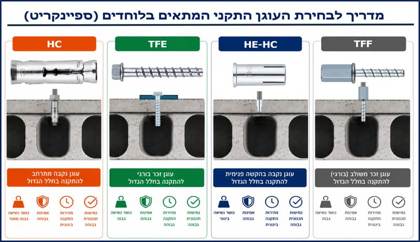
Anchoring to Hollow-Core (Spancrete) Slabs: MKT Easy vs Adit HC vs TFF Concrete Screw
A comprehensive comparison of the three most common anchoring solutions in Israel for hollow-core () slabs — by ETA resistance, ease of installation and cost.
In short
Prestressed hollow-core (Spancrete) floor slabs are everywhere in modern Israeli construction — multi-storey floors, car parks, warehouses and logistics centres. Anchoring services (HVAC, sprinklers, electrical, drainage) to them is one of the most common field challenges. Three products compete for the job: the MKT Easy (the veteran German expansion anchor), the Adit HC (a dedicated Israeli female anchor for hollow-core), and the TFF concrete screw (a direct-threaded screw). There is no universal winner — but on ETA pull-out resistance the Adit HC leads, the TFF is fastest and cheapest and beats the Easy across the whole shell range, and the Easy’s main edge is its M12 size. All three must be installed over the void, not in the solid rib.
1. How each one works in a hollow-core slab
MKT Easy — an expansion anchor for the void
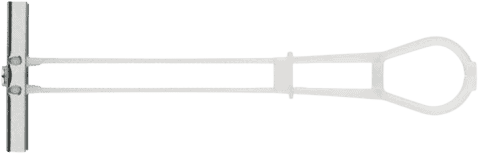
The Easy is a single-use metal anchor made of an outer sleeve and an inner expansion cone. Tightening the screw draws the cone into the sleeve, which expands and grips inside the slab’s internal air void — much like a “sock” opening out beyond the shell. Like the HC, it must be installed over the internal void: Annex 4 of its approval (Z-21.1-1785) shows the anchor expanding into the void, and there is no approval for installation in the solid rib. The explicit geometric condition is a void width w ≥ 4.2 × rib thickness e. A practical plus: it is approved for installation from both the floor side and the ceiling side. On standard status, though, Z-21.1-1785 is a German national approval (DIBt) only — below a European ETA, and it may not be accepted on specifications that require an ETA.
Advantages
- Long-established and familiar in the trade
- Explicit geometric rule: void width w ≥ 4.2 × rib thickness e
- Fire resistance R30–R120
- Sizes M6–M12
Disadvantages
- Single-use only
- Lower resistance than the HC in thin shells
- Needs a separate external screw/rod
- Relatively high anchor cost
Adit HC — a female anchor with advanced form-lock
The Adit HC is a female anchor (an internally threaded sleeve) designed specifically for hollow-core slabs. Its internal expansion cone is rigidly attached to the sleeve and is released from it as the anchor is tightened. That makes the sleeve fold and open out as “wings” directly inside the air void, creating a complete form-lock against the inner face of the shell. Unlike the Easy, the HC locks itself from the inside — physical pull-out of the anchor is all but impossible even under significant tension, which allows higher resistances, especially in thin shells.
Advantages
- Highest pull-out resistance of the three
- Suitable for shells from 25 mm
- Form-lock — not reliant on friction
- Fire R30–R120 inside the ETA itself (ETA 15/0912 p.5, TR020)
- Dedicated CSIC sprinkler approval; ETA 15/0912 covers multiple uses
- Sizes M6, M8, M10
Disadvantages
- Single-use
- Only up to M10
- Must be installed over the void (Annex D)
- Costs more than the TFF
TFF / THF concrete screw — internal female head, direct threading into the shell
Unlike the other two, the TFF is not an expansion anchor — it is a direct-threaded screw with an internal female thread, allowing a threaded rod to be hung directly below the slab without an external nut. The screw cuts its own thread into the walls of the drilled hole in the shell.
In a hollow-core slab the screw anchors only inside the lower shell (the flange), with an embedment of roughly 20–26 mm — a depth that depends directly on the shell thickness (db).
A critical point to understand: the TFF comes in two “sizes” defined by drill diameter — size 5 (5 mm hole) and size 6 (6 mm hole). The internal thread in the female head, however, is M8 or M10 only. In other words, an M6 rod cannot be connected to a TFF — anyone who needs to hang from an M6 rod has to use a different solution, such as the TFE. The TFF is approved for hollow-core slabs under ETA 20/0494, with a minimum shell thickness of 25 mm.
Advantages
- Fastest to install; lowest cost — the screw is the anchor (no separate rod/nut)
- ETA in solid concrete for every size; hollow-core approval in sizes 5 and 6 (ETA 20/0494)
- Fire R120; seismic C1–C2 in solid concrete; CSIC sprinkler approval
Disadvantages
- Lower pull-out resistance in hollow-core than the HC
- Internal thread M8/M10 only — not suited to an M6 rod
- No hollow-core-specific fire approval
- Very small hef (20–26 mm) — sensitive to shell thickness
2. Resistances by ETA — the headline: Nrec by wall thickness (db)
The thickness of the lower concrete shell (db) is the single most critical factor for both the HC and the TFF — the effective hef moves directly with it, so the failure load changes significantly. Recommended service pull-out load (Nrec), all three products side by side:
| Wall db | MKT Easy | Adit HC (M6–M10) | TFF (M6 body, M8–M10 female) |
|---|---|---|---|
| 25–30 mm | 0.7–0.9 kN | 1.4–3.4 kN | 2.5–2.8 kN |
| 30–40 mm | 0.9–1.2 kN | 2.8–4.8 kN | 2.8–3.7 kN |
| ≥ 40 mm | 2.0–3.0 kN | 3.4–5.6 kN | 3.7 kN |
HC: ETA 15/0912 · hollow-core C40/50 · γM 1.8 (M6, M10) / 1.5 (M8). TFF: Adit technical data, ETA 20/0494 · prestressed/hollow/Spancrete ≥ C30/37. Easy: Z-21.1-1785 · single anchor, c > ccr 150 mm.
Adit HC — FRk / FRec by wall thickness
| Size | db 25–30 mm | db 30–40 mm | db ≥ 40 mm |
|---|---|---|---|
| HC M6 | FRk 3.5 · FRec 1.4 kN | FRk 7.0 · FRec 2.8 kN | FRk 8.5 · FRec 3.4 kN |
| HC M8 | FRk 5.0 · FRec 2.0 kN | FRk 10.0 · FRec 4.8 kN | FRk 11.5 · FRec 4.8 kN |
| HC M10 | FRk 8.5 · FRec 3.4 kN | FRk 11.5 · FRec 4.6 kN | FRk 14.0 · FRec 5.6 kN |
TFF — resistance by wall thickness (M6 body, female M8–M10)
| Parameter | db 25 mm | db 30 mm | db 40 mm |
|---|---|---|---|
| Effective hef [mm] | 20 | 22 | 26 |
| NRk,cone — pull-out [kN] | 6.2 | 7.2 | 9.2 |
| Nrd — design tension [kN] | 3.5 | 4.0 | 5.1 |
| Nrec — service tension [kN] | 2.5 | 2.8 | 3.7 |
| Vrd — design shear [kN] | 4.1 | 4.8 | 6.1 |
| Vrec — service shear [kN] | 3.0 | 3.4 | 4.4 |
NRk,s steel failure 25.2 kN — never governs (concrete cone governs). Internal thread M8–M10 only (Ø6 mm drill) — not M6.
MKT Easy — Nrec by wall thickness
| Size | db 25–30 mm | db 30–40 mm | db ≥ 40 mm | db ≥ 50 mm |
|---|---|---|---|---|
| Easy M6 | 0.7 kN | 0.9 kN | 2.0 kN | 2.9 kN |
| Easy M8 | 0.7 kN | 0.9 kN | 2.0 kN | 3.6 kN |
| Easy M10 | 0.9 kN | 1.2 kN | 3.0 kN | 3.6 kN |
| Easy M12 | 1.0 kN | 1.2 kN | 3.0 kN | 4.3 kN |
3. Side-by-side pull-out resistance by shell thickness
The tables above give each product separately. Set against each other, on official data only, the recommended service pull-out load Nrec reads as follows. All figures in kN.
| Product | db = 25 mm (thin shell) | db = 30 mm (medium shell) | db = 40 mm (thick shell) |
|---|---|---|---|
| MKT Easy M6 / M8 | 0.7 | 0.9 | 2.0 |
| MKT Easy M10 / M12 | 0.9 | 1.2 | 3.0 |
| TFF size 6 — female M8–M10 | 2.5 (hef 20 mm) | 2.8 (hef 22 mm) | 3.7 (hef 26 mm) |
| Adit HC M6 | 1.4 | 2.8 | 3.4 |
| Adit HC M8 | 2.0 | 4.8 | 4.8 |
| Adit HC M10 | 3.4 | 4.6 | 5.6 |
A result worth noticing. At db = 25 mm the TFF (2.5 kN) outperforms both HC M6 and HC M8. On the thinnest shells the concrete screw is not the compromise choice — it is the stronger one, and it is also the fastest to install.
4. Ease and speed of installation
| Installation parameter | MKT Easy | Adit HC | TFF / THF |
|---|---|---|---|
| Steps | drill → insert → tighten screw | drill → insert → tighten screw | drill → drive screw → attach rod |
| Hole cleaning | not required | not required | not applicable — the hole breaks through into the open void |
| Average speed | medium | medium | very fast |
| Tools | drill + torque wrench | drill + torque wrench | drill + impact driver |
| Tightening torque | M6: 10 · M8: 20 · M10: 30 · M12: 40 Nm | M6: 10 · M8: 20 · M10: 30 Nm | max 5 Nm (size 5) / 10 Nm (size 6) |
| Reusable | no | no | yes |
| Separate screw or rod needed? | yes — supplied separately | yes — supplied separately | no — the rod threads directly into the female head |
The TFF is without question the fastest to install — a hundred fixing points in a working day is realistic. Both the HC and the Easy need a separate external fixing element, a screw or a threaded rod. The HC is distinctive in that its external collar prevents over-insertion and makes it easy to find the optimum position.
5. Standards status (ETA) — comparison
| Standard category | MKT Easy | Adit HC | TFF / THF |
|---|---|---|---|
| Approval number | Z-21.1-1785 (DIBt) — German national only | ETA 15/0912 | ETA 20/0494 |
| Hollow-core approval | Yes | Yes | Sizes 5, 6 only |
| Solid-concrete approval | Yes (if the void is grouted) | No | Yes — an ETA per size |
| Fire in hollow-core | R30–R120 | R30–R120 (ETA 15/0912 p.5) | R120 |
| Fire in solid concrete | R30–R120 | — | Yes |
| Seismic | No | C1 (EAD 330232) | C1–C2 (in solid concrete) |
| Sprinkler approval | Yes | Yes (CSIC) | Yes (CSIC) |
| CE marking | Yes | Yes | Yes |
6. Cost — an economic view
The three products sit in completely different cost tiers. Important: what matters is the total installed cost, not the price of the anchor alone.
| Cost element | MKT Easy | Adit HC | TFF / THF |
|---|---|---|---|
| Anchor itself | High | Medium | Low |
| Accessories | Screw/rod + nut | Screw/rod + nut | None — the screw is the anchor |
| Install time per point | Medium | Medium | Very fast |
| Re-use | No | No | Yes |
| Total cost (unit + labour) | Highest | Medium | Lowest |
Economically the TFF is the clear winner: it is the cheapest per unit, needs no additional accessories and is fast to install. The HC costs more, but justifies it with significantly higher resistances. The Easy is the most expensive of the three, especially once the separate screw or rod is counted in.
When to choose each one
MKT Easy — choose it when
- M12 is required in a hollow-core slab, a size in which the HC is not made;
- a specific project specification names the MKT Easy.
Two cautions. Approval Z-21.1-1785 is a German national approval — a lower standing than a European ETA, and it may be rejected where the specification requires an ETA. And the Easy, like the others, must be installed over the void: there is no approval for installing it in the solid rib.
Adit HC — choose it when
- maximum pull-out resistance in hollow-core is what governs;
- the shell is thin (25–40 mm) and the loads are heavy;
- the application is sprinkler or fire-fighting systems, where the CSIC approval matters;
- the design calls for the largest available safety margin;
- C1 seismic approval for hollow-core is required.
TFF / THF — choose it when
- an M8 or M10 rod is hung directly from a hollow-core soffit — the female head is built in;
- loads are medium to high: Nrec of 2.5–3.7 kN depending on shell thickness;
- the work rate matters — drill and drive, faster than the HC;
- db ≥ 40 mm, where the TFF at 3.7 kN competes directly with the HC M6 at 3.4 kN;
- cost per unit of performance is the deciding factor in thicker shells.
7. The full comparison table
| Criterion | MKT Easy | Adit HC | TFF / THF |
|---|---|---|---|
| Product identity | |||
| Manufacturer | MKT, Germany | Index/Clover, imported by Adit | Index, imported by Adit |
| Technology | Expansion sleeve anchor | Female anchor, form-lock | Directly threaded screw |
| Sizes available for hollow-core | M6, M8, M10, M12 | M6, M8, M10 | 6 mm hole, female M8 or M10 |
| M6 rod connection possible? | Yes | Yes | No — M8 and M10 only |
| Steel | Galvanised carbon (Zn) | Galvanised carbon 6.8 (Zn5) | Carbon 8.8 (TF) / Atlantis (TH) |
| Resistance in hollow-core, by shell thickness (db) | |||
| Nrec, db = 25 to 30 mm | 0.7 to 0.9 kN | 1.4 to 3.4 kN (M6 to M10) | 2.5 to 2.8 kN (6 mm body, female M8 to M10) |
| Nrec, db = 30 to 40 mm | 0.9 to 1.2 kN | 2.8 to 4.8 kN (M6 to M10) | 2.8 to 3.7 kN |
| Nrec, db of 40 mm and above | 2.0 to 3.0 kN | 3.4 to 5.6 kN (M6 to M10) | 3.7 kN |
| Conditions of use | |||
| Minimum shell thickness (db) | 25 mm | 25 mm | 25 mm |
| Effect of db on hef and resistance | High — Nrec rises three to four times from 25 to 50 mm | Moderate — FRk rises about 1.5 to 2.5 times | Critical — hef of 20 to 26 mm follows db directly |
| Thin shell (25 mm) | Yes | Yes | Yes (5 and 6 mm bodies) |
| Must sit over the void | Yes — Z-21.1-1785, condition w ≥ 4.2 × e | Yes — Annex D, ETA 15/0912 | Yes — the hole must break into the void |
| Minimum distance from a pre-stressing strand | 50 mm | 50 mm | 50 mm |
| Minimum edge distance | 100 mm | 60 to 80 mm | 35 mm |
TFF figures from the Adit data sheet to ETA 20/0494; HC from ETA 15/0912; MKT Easy from Z-21.1-1785.
8. Weighted score
| Criterion (weight) | MKT Easy | Adit HC | TFF / THF |
|---|---|---|---|
| ETA resistance in hollow-core (35%) | 2/5 | 5/5 | 4/5 |
| Ease and speed of installation (25%) | 3/5 | 3/5 | 5/5 |
| Standard coverage & size range (20%) | 4/5 | 3/5 | 5/5 |
| Total cost (20%) | 1/5 | 3/5 | 5/5 |
| Weighted score (of 5) | 2.4 | 4.0 | 4.6 |
Resistances: Easy 2/5 (0.7–3.0 kN — the lowest across every thin-to-medium shell) · TFF 4/5 (2.5–3.7 kN, ahead of the Easy over the whole range) · HC 5/5 (up to 5.6 kN in M10). Standard coverage: Easy 4/5 (includes M12) · TFF 5/5 (ETA in solid concrete in every size, plus CSIC sprinkler approval and C1/C2 seismic). All three must be installed over the void region — none of them is approved in the solid rib.
9. Engineering conclusions
There is no universal winner — each of the three suits a different scenario:
The Adit HC is the clear engineering choice when maximum pull-out on hollow-core is the priority — particularly at M8 and M10, where it delivers 4.8–5.6 kN, well above every competitor. Its R30–R120 fire rating is approved inside ETA 15/0912 itself (p.5, per TR020), a real advantage in standing; and it has a dedicated CSIC sprinkler approval. Note that, per Annex D of the ETA — exactly as with the Easy’s Z-21.1-1785 — the HC must be positioned over the void.
The TFF / THF gives a surprising picture: with Nrec of 2.5–3.7 kN (by db), it rivals the HC M6 in thick shells (db 40 mm) and beats the Easy across the entire shell range. It is ideal for hanging an M8 or M10 rod directly, quickly and at the lowest cost — and it takes the top weighted score (4.6/5).
The MKT Easy comes off worst in the new landscape: at db 25–30 mm it is the lowest of the three (0.7–0.9 kN), well below the TFF and the HC. It only pulls ahead in thick shells (db ≥ 40 mm) and in its M12 size, which the HC lacks. Its approval is German national only (DIBt) — below European ETA status, and it may be rejected on specifications that demand an ETA. Like the HC, it must be placed over the void.
Need engineering advice for your own project?
The ADIT engineering team will help you select the right anchor for the slab you actually have, run the calculation against the ETA and back the specification. Call +972 54-7976110.
Sources
- ETA 15/0912 — Adit HC hollow-core female anchor.
- ETA 20/0494 — Adit TFF / THF concrete screw (hollow-core, sizes 5–6).
- Z-21.1-1785 (DIBt) — MKT Easy Hollow Core Anchor.
- EAD 330232; EN 1992-4 design principles; TR020 (fire).