
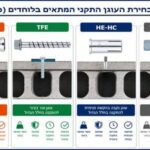
EASY, HC or TFF: The Best Anchor for Hollow-Core (Spancrete) Slabs?
12 בJuly 2026
Rosett Anchor or BA-NY Plug? Choosing a Drywall Fixing
12 בJuly 2026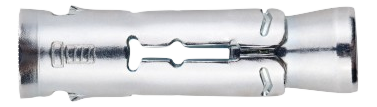
female anchor for hollow concrete block HC
Which Anchor for Hollow-Core (Spancrete) Slabs — Standard and Efficient?
A professional guide comparing four ADIT anchoring solutions for prestressed hollow-core (Spancrete) slabs — organised by anchor type, and based only on the Spancrete data from the European Technical Assessments (ETA).
In short
Four ADIT solutions cover hollow-core slabs: a projecting male screw (TFE) and three female anchors (TFF, HC, HE-HC). The comparison is on C40/50 concrete — the standard grade Spancrete is manufactured to — so all four are compared on the situation you actually meet on a Spancrete project. (For the exceptional case of old Spancrete or special precast in C30/37, only the TFE and TFF are approved.) The TFE is the standout for any job needing a male thread; the TFF is its female twin — same body, same fast install; the HC and HE-HC deliver higher pull-out in thicker shells at the cost of a slower, wider-drilled installation.
Design resistance (FRd) by wall thickness — all products
The governing parameter is the thickness of the lower Spancrete shell. The tables give FRd [kN] by product, size and wall thickness. The TFF values equal the TFE (same anchor body, female head).
Male anchor TFE — direct concrete screw
| Wall thickness | Size 5 · Nrd tension | Size 5 · Vrd shear | Size 6 · Nrd tension | Size 6 · Vrd shear |
|---|---|---|---|---|
| 25 mm | 3.5 | 4.1 | 3.5 | 4.1 |
| 30 mm | 4.0 | 4.8 | 4.0 | 4.8 |
| ≥ 40 mm | 5.3 | 5.5 | 5.1 | 6.1 |
Values in kN. Nrd = tension, Vrd = shear — two separate values; interaction must be calculated per EN 1992-4. Concrete C30/37–C50/60.
Female anchors TFF / HC / HE-HC
| Wall | TFF s5 Nrd | TFF s5 Vrd | TFF s6 Nrd | TFF s6 Vrd | HC M6 F°Rd | HC M8 F°Rd | HC M10 F°Rd | HE-HC M8 FRd | HE-HC M10 FRd | HE-HC M12 FRd |
|---|---|---|---|---|---|---|---|---|---|---|
| 25 mm | ≈3.5 | ≈4.1 | ≈3.5 | ≈4.1 | 1.9 | 3.3 | 4.4 | Not approved — min. 35 mm | ||
| 30 mm | ≈4.0 | ≈4.8 | ≈4.0 | ≈4.8 | 3.9 | 6.7 | 5.6 | Not approved — min. 35 mm | ||
| ≥ 40 mm | ≈5.3 | ≈5.5 | ≈5.1 | ≈6.1 | 4.7 | 7.7 | 7.8 | 3.9 | 4.3 | 5.4 |
Base C40/50 for all. TFF ≈ TFE (identical body, ETA 20/0494). HC: F°Rd equal in all directions; γM M6 1.8, M8 1.5, M10 1.8. HE-HC: fixed values valid from a shell ≥ 35 mm (in the 35–40 mm band the values equal the ≥40 mm row).
Male anchor TFE — the standout screw for Spancrete
The TFE is a concrete screw that threads directly into the drilled hole and cuts a mechanical thread in the body of the concrete. It is the standout solution for any Spancrete project that needs a male screw (an external, projecting thread) — nuts, plates, and any fixture that mounts on ordinary bolts. The TFF version (below) offers the same performance where a female thread is needed.
Installation — 3 steps, no special tool
- 1 · Drill — Ø5–6 mm, a narrow hole.
- 2 · Clean the hole — compressed air or a brush.
- 3 · Drive it straight in — an ordinary impact wrench.
A unique advantage: the screw is removable and re-usable — it can be undone and refitted several times without harming the anchoring strength. The anchor body (the thread in the concrete) stays put; the screw itself is swapped as needed. That is a distinctive feature for hanging work that changes over time and for formwork.
Advantages
- Only 3 steps — the fastest and simplest of all the solutions
- No special tools — an ordinary impact wrench is enough
- Ø5–6 mm drilling — minimal risk to the prestressing strands
- Removable, re-usable screw
- Suits C30/37 and up (including all Spancrete)
- Seismic C1 and C2 approvals
- Approved for fire-suppression systems (CSIC)
- No expansion pressure — safe in a thin shell
Disadvantages
- Two separate resistance values (N and V) — an interaction calculation is required
- For Spancrete: size 5 and size 6 only (no standard M6 or M8)
- Tension Nrd is lower than the HC at M8/M10 in a shell ≥ 30 mm
- A projecting male anchor — not always suitable aesthetically or functionally
Female anchors TFF / HC / HE-HC — fixed anchors for services
All three female anchors are installed in the structure and receive a male screw (M8, M10, etc.) attached to the fixture. What separates them is the locking principle and the complexity of the field installation.
TFF — the female twin of the TFE
The TFF is the female version of the TFE — the same anchor body, the same installation method, but instead of a projecting male screw it has an internal threaded hole that receives a separate male screw (M6–M12 as needed). It suits a flush head with the soffit, or a fixture screwed directly from below. Installation is identical to the TFE — 3 steps, Ø5–6 mm drilling, no special tools. Against the HC and HE-HC, which need 4–5 steps and a wider hole, the TFF is faster and safer to install; where the required resistance fits the TFE loads, the TFF is the natural female choice.
Advantages
- 3 steps — the fastest of the female anchors for Spancrete
- Narrow Ø5–6 mm drilling — minimal strand risk
- No special tools
- C30/37 and up, seismic approval, fire-suppression
- Head flush with the soffit
- The receiving screw is removable and replaceable
Disadvantages
- Nrd lower than the HC at M8/M10 in a thick shell
- Sizes 5 and 6 only (fewer sizes than the HC and HE-HC)
- Two separate N and V values — interaction must be calculated
The locking principle — a thread that deploys wings
The HC and HE-HC lock by form: as they are set, they deploy “wings” that open inside the void and bear against the inner face of the shell. This gives the highest pull-out resistances — the HC reaching 7.7–7.8 kN at M8/M10 in a shell ≥ 40 mm — at the cost of a slower, wider installation than the direct-threading TFE/TFF. The HE-HC is a hammer-set variant, valid only from a shell thickness of 35 mm.
Sources
- ETA 20/0494 — ADIT TFE / TFF concrete screw (hollow-core).
- ETA 15/0912 — ADIT HC hollow-core female anchor.
- ETA 14/0068 — ADIT HE-HC hammer-set female anchor.
- ADIT HE-HC technical data; EN 1992-4:2018 design principles.