


When should I make pull-out test to anchors?
12 בJuly 2026
How to interpret seismic approval for anchors
12 בJuly 2026When should I make pull-out test to anchors?
12 בJuly 2026How to interpret seismic approval for anchors
12 בJuly 2026Where Are the Cracks in the Definition of “Cracked Concrete”?
Classifying concrete as cracked or uncracked is one of the most expensive decisions in an anchor design — yet the industry treats almost all concrete as cracked by default. This article asks whether that default is actually justified.
Imagine two insurance companies that control 65% of the global market in their field, where every legislator and expert either works for them or eventually will. Now imagine there is a relatively rare disease that could justify doubling the price of the insurance and tripling the profits. The experts funded by those companies rule that every patient “at risk of contracting the disease” must buy the insurance — without ever defining clearly who is actually at risk.
Does the disease exist? Yes. If you want to be certain you are covered, is it better to buy the insurance? Yes. But is there any statistical basis for compelling all of humanity to buy it, when actual cases of the disease are isolated? This article deals with exactly that question — in the context of cracked concrete.
Deciding at the design stage whether the concrete is cracked or uncracked is a design decision that has a major effect on the design, and an even greater effect on the cost of the anchoring.
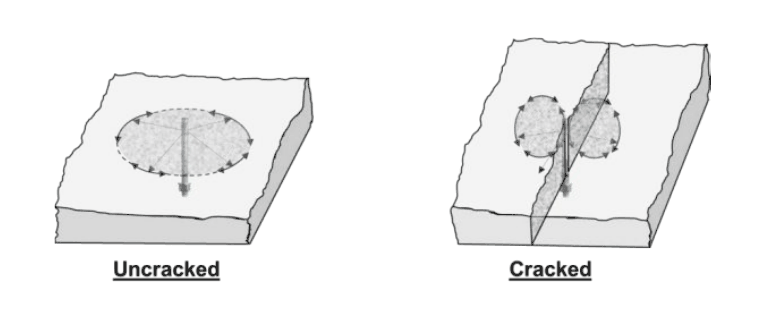
There is no doubt about the underlying phenomenon. It has been studied at length worldwide; a wide crack does reduce the load capacity of an anchor, and the international standards define this clearly. The question is not what the load capacity of an anchor installed in a crack is — it is what the probability is that an anchor in a normal application will end up installed in a crack of the kind the standards describe.
Most, if not all, of the research on the subject is funded by anchor suppliers — the same suppliers who earn up to four times more when the concrete is classified as cracked. It is hardly surprising that they are keen to convince designers that concrete is cracked at all times. Let us examine what the standards actually say, review the various studies, and look at the factors that create or widen a crack at the point where the anchor is installed.
Full academic paper (PDF)
de Lathouwer, Y. (2026). Where Are the Cracks in the Definition of “Cracked Concrete”? A critical review of the normative basis for the cracked-concrete default in post-installed anchor design — 19 pages, with the EN 1992-4 crack-width and pry-out analysis in full.
What the European standards say
The first definition rests on a mathematical condition:
- σRs — stress in the concrete from restrained deformation (0 N/mm² in a compression zone, 3 N/mm² if unknown)
- σLs — stress in the concrete from the applied forces, including the action of the anchorage itself
Because those stresses are usually not known to the fastening designer, the British guidance added help for exactly this situation.
Hold on — how much load does it take to open a 0.3 mm crack?
The standard talks about a crack 0.3 mm wide. But nobody asks the obvious question: what has to happen to a slab before a crack like that opens at all?
You can simply calculate it. We took an entirely ordinary slab — 200 mm, C30/37, Ø12 at 150 mm in the tension face, 25 mm cover — and ran the code’s own crack-width formula:
- To reach 0.3 mm you need a steel stress of 348 N/mm² — about 80 % of the design yield strength.
- That is a moment of roughly 41 kNm/m, around 80 % of the section’s bending capacity.
- A slab working at ordinary service level, at a steel stress of 250 N/mm², cracks to 0.185 mm.
The British standard’s guidance (BBA Guidance no. 39)
The British guidance is more nuanced, and frames the whole question in terms of probability. Anchor capacity is not affected by cracks present at the time of installation, but by the subsequent movement of those cracks. Only loading applied after the anchors are installed is relevant.
…in a building in use, i.e. where decanting does not take place, anchors can be installed in any location provided it is unlikely that a significant increase in loading will occur after the installation of anchors.
This explicitly includes anchors approved only for uncracked concrete.
Imposed loads applied to floors vary with time and space, and thus any realistic consideration of loading will be in terms of probability.
Cracks in concrete occur at a fairly regular spacing, so whether an anchor lands exactly on a crack is itself a matter of probability. The more anchors there are in a connection, the lower the probability that any given one sits in a crack.
The load carried by anchors is generally independent of the imposed loading applied to the structure, and thus there is joint probability involved.
The larger the load on the anchor, the more it tends to affect the concrete. On the other hand, larger loads usually mean deeper anchors — and the deeper into the concrete you go, the lower the likelihood that an existing crack containing the anchor will widen over the years.
The bottom line: the classification of concrete as cracked or uncracked is probabilistic, driven by identifiable factors. Let us work through those factors — starting with the ones unrelated to the anchor itself, and relating instead to the region of concrete in which the anchor is installed.
The classic example: a beam on two supports
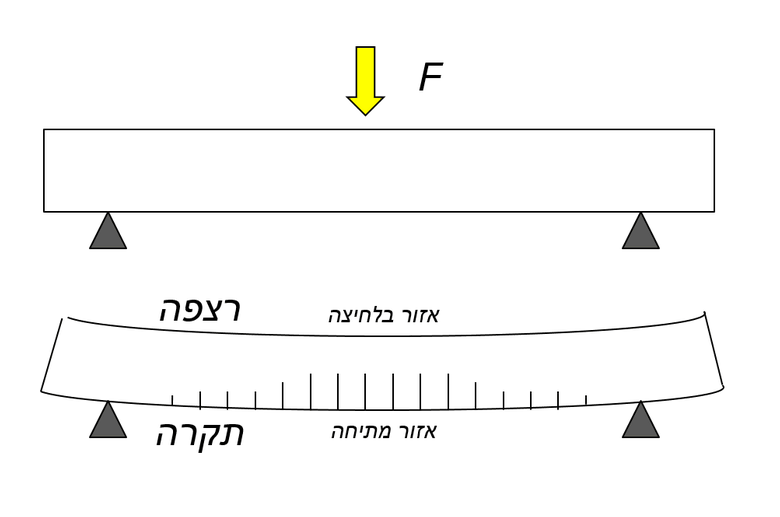
The best-known example in the anchoring field is a concrete beam on two supports: the upper part in compression, the lower part in tension. This gives rise to the simplistic view that concrete in the ceiling is in tension and must be classified as cracked, while concrete in the floor is in compression and is therefore uncracked.
Is that always true?
- It is certainly not true in prestressed slabs.
- Tension and compression in the region of the supports are far lower, and above a support the sign can even reverse — in which case it is the concrete in the “floor” that is locally in tension. And if the supports are not at the ends of the beam, the distribution changes again.
- Tension and compression are also much greater in the outer layers of the concrete, and at a greater distance from the supports.
- The European standard considers an anchor installed in concrete in which a 0.3 mm crack appears through the full thickness of the section after installation. In reality, cracks do not behave that way.
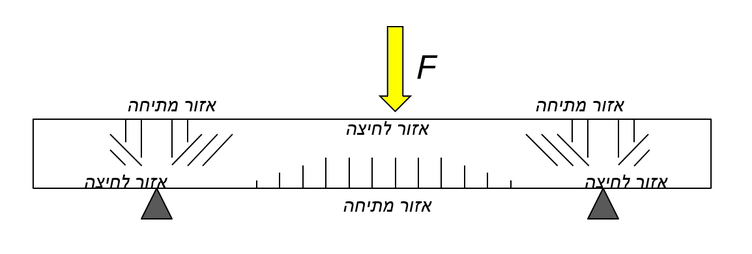
Even if we imagine a beam 400 mm thick, assume the top 200 mm is in tension and the bottom 200 mm in compression, and install an anchor 300 mm long — then installing from the floor side, I will actually reach the concrete region that is in tension, and vice versa. All of the research and all of the standards are built around the simplistic picture, when the reality on site is far more varied.

The crack is a wedge, not a slot
This is probably the simplest point in the whole article, and the most surprising.
When you look at a crack in a slab soffit you see a width at the surface — say 0.3 mm. But a flexural crack does not keep that width as it goes deeper. It narrows, until it closes completely.
And your anchor is not sitting at the surface. It is sitting 60, 80 or 120 mm in. By then the crack is far narrower.
| Embedment | Mean width along the anchor at the reference condition (0.3 mm at the surface) | Mean width along the anchor in a slab at ordinary service |
|---|---|---|
| 60 mm | 0.245 mm | 0.151 mm |
| 80 mm | 0.227 mm | 0.140 mm |
| 120 mm | 0.191 mm | 0.118 mm |
And how is the anchor tested in the laboratory? The test specimen is cracked right through its thickness, and the crack is held at a uniform width along the whole anchorage. The anchor is assessed under a condition more severe than the one it will actually meet in a slab.
There is also a simple contradiction here. If the crack really were 0.3 mm at the depth of the anchor, it would be wider than 0.3 mm at the surface — and the slab would already have breached the very limit that defines “cracked concrete” in the first place.
Pull-out and concrete cone failure: when does the crack actually matter?
The reduction in anchor capacity in cracked concrete for pull-out failure comes from expansion processes that cause movement and release of mechanical anchors, or debonding of the adhesive from the concrete in a chemical anchor. Where the region containing the connection cannot open up — because the concrete there is in compression — that simply cannot happen.
For concrete cone failure, the presence of a crack certainly can produce the reduction that the cracked-concrete definitions describe, because the crack can split the concrete cone, just as it would in concrete that is entirely in tension.
A number of recent studies — for example by Akanshu Sharma — set out to examine a different question, the contribution of supplementary reinforcement, but their result is directly relevant here: they show that the ETA anchoring standard substantially understates the contribution of the reinforcement in the concrete cone calculation. This is fairly logical: the European anchoring rules do not account for reinforcement in concrete cone failure, even though the reinforcement’s job is precisely to absorb tension in the concrete. In a further study, Rasoul Nilforoush shows that the reinforcement’s contribution is proportionally greater the thinner the member is.
This means that if the concrete member is thick, there is a strong likelihood of heavy or closely spaced reinforcement that will significantly improve the concrete cone failure capacity. And if the member is thin — even though the reinforcement contributes proportionally more — a crack is correspondingly less likely to run deep enough to matter.
How different anchor types affect crack formation
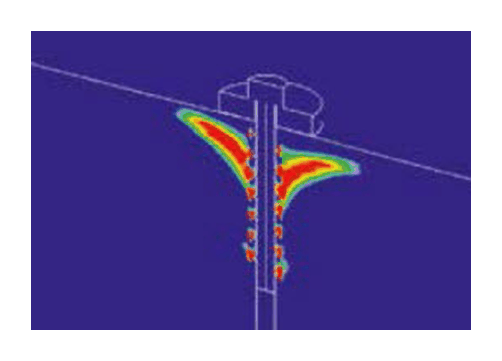
It is known that the tension field the anchor itself creates can cause a crack to appear at the anchor position. But is there a difference between anchor types in that process?
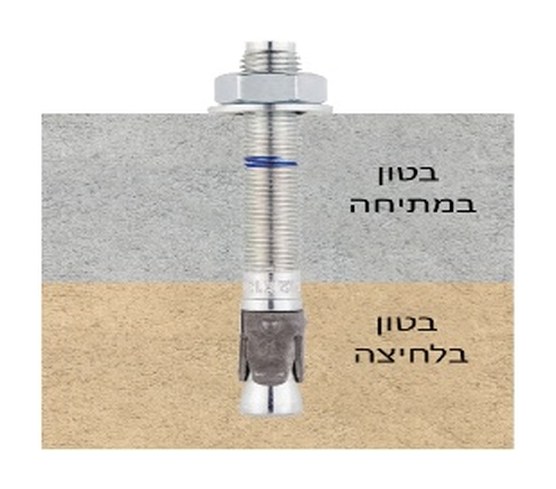
Image source: “Turning the screw on stud anchors”, Engineers Journal, 05-05-15
Wedge anchors and heavy-duty (dynamic) anchors
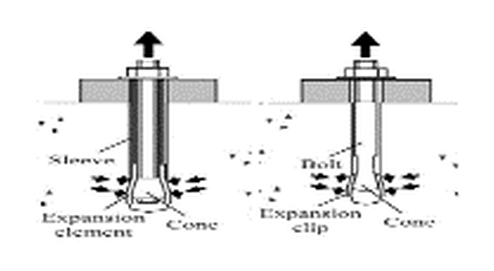
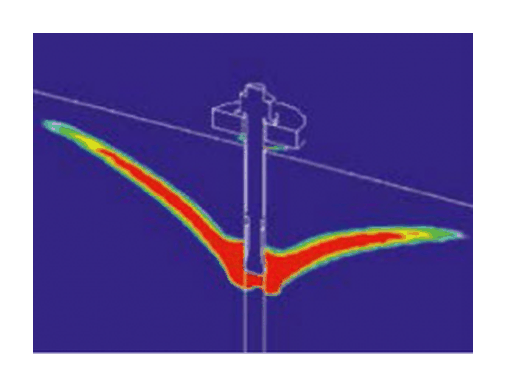
The zone of influence of a wedge anchor within the concrete is very wide. Tension is applied during installation, in order to open the clips, and it persists even without any external load (decaying over time to about 60% of the initial value). This is why installing a wedge anchor close to a concrete edge can sometimes break the concrete before the full load is even applied to the anchor.
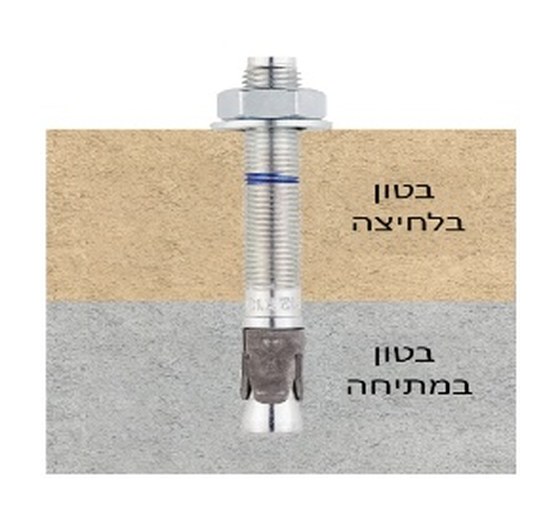
Image source: “Turning the screw on stud anchors”, Engineers Journal, 05-05-15
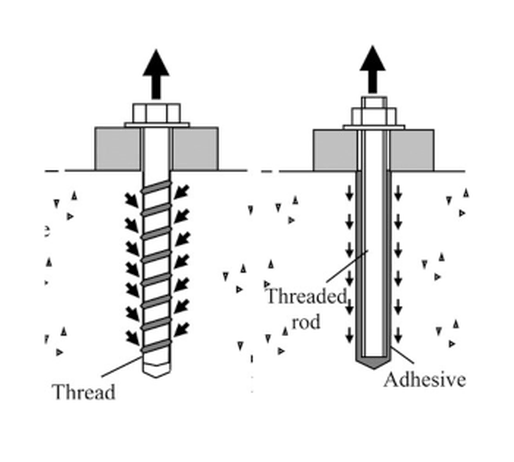
Directly threaded concrete screws and chemical anchors distribute the stresses along the bond or the thread, and apply no tension unless external tension is applied to the anchor. Their influence on the concrete is much less widespread.
Although I have not found research that confirms this directly, I believe that the permanent tension induced by a wedge anchor or a heavy-duty anchor, combined with their wide zone of influence, are contributing factors in crack formation at the anchor location. Even when concrete screws or chemical anchors are under tension, that tension peaks at about one third of the anchor’s load capacity.
And what if the anchor only works in shear?
Plenty of real connections — a section fixed to a wall, a rail, a supporting bracket — load the anchor in shear only, with no tension at all. In that case it is worth stopping to ask what the “cracked” classification actually changes.
When an anchor works in pure shear, three checks can govern:
- Steel failure — a property of the anchor’s steel. It does not change between cracked and uncracked concrete.
- Concrete edge failure — depends on the edge distance, the anchor diameter, the load-transfer length and the concrete strength. The difference between cracked and uncracked is a factor of the standard (1.7 against 2.4), not a value measured on the product.
- Pry-out — depends on the anchor’s stiffness and displacement behaviour, which is the same in both conditions.
And what the cracked-concrete approval actually tests — whether the anchor holds its expansion force as a crack opens and closes under tension — is never exercised here.
More images from the study
Conclusion
On the face of it, the European standards that define cracked concrete are consistent between the concrete standard and the anchor standard, both defining it by the possible appearance of a crack 0.3 mm wide. But while a crack of very shallow depth is enough to have the concrete classified as cracked — because no reference is made to crack depth at all — its effect on an anchor installed in that same crack will be minor if the depth is shallow. The standards do not distinguish between surface cracks and deep cracks.
This also explains why in ordinary testing you will never feel the effect of “cracked concrete”: if it exists at all, it is a phenomenon that develops over time, with a probability tied to the type of design and to where the anchors are installed.
In my opinion, in most cases the concrete is uncracked — or the design can be arranged so that it qualifies as uncracked.
The rule we propose — and it is the reverse of the current one
Put it all together: the crack the standard takes as its reference belongs to a slab working close to its limit; in width, where the anchor actually sits, it is less than half of that; and the uniform full-thickness crack belongs to a particular kind of structure — walls cast into restraint, ground-bearing slabs, water-retaining structures — not to the slabs and soffits where most anchoring is done.
This is a proposal, not a description of the legal position: the standard sets the default the other way. But a default is only a question of who has to prove what — and it belongs on the less common case. A framework that requires the exception to be disproved every time, using information the anchor designer does not have, will return “cracked” every time.
And where the doubt is real, the answer does not change: design for cracked concrete. The penalty is a known cost and the alternative is an unknown risk. You can compare the two classifications for your own connection in a couple of minutes with AAS, our free EN 1992-4 anchor design tool.
Practical design guidance
Seismic design: the concrete is treated as cracked, in every case.
For anchors installed in concrete regions that are under tension, the classification depends on the details of the connection.
Treat as uncracked when…
- the load is distributed across a large number of anchors — preferably concrete screws or chemical anchors;
- a mechanical anchor is used that engages in a compression zone (i.e. deeper in the section);
- in the anchor zone there is no likelihood of a crack forming to a depth close to the embedment depth;
- no significant change in loading on the concrete or the anchor is expected after installation.
Treat as cracked when…
- the connection uses few, short anchors in a tension zone;
- significant load changes on the concrete or the anchor are expected after installation (producing tension and cracking);
- the anchorage sits where the design specifically anticipates a wide crack — a plastic hinge zone, a designed crack location, or a member designed for through-thickness restraint cracking. Ordinary cracked-section design does not count: every reinforced member is designed in the cracked state, so that alone decides nothing.
For anchors installed in concrete regions that are under compression, the concrete is uncracked.
Sources
- BBA Guidance no. 39 — Anchor Bolts for Use in Concrete, British Board of Agrément, Issue 4, 2015.
- Akanshu Sharma — “Comprehensive Experimental Investigations on Anchorages with Supplementary Reinforcement”, Sharma, Eligehausen & Asmus, Institute of Construction Materials, Stuttgart, 2017.
- Rasoul Nilforoush — “Experimental Evaluation of Influence of Member Thickness, Anchor-Head Size, and Orthogonal Surface Reinforcement on the Tensile Capacity of Headed Anchors in Uncracked Concrete”, Nilforoush, Nilsson & Elfgren, Journal of Structural Engineering 144(4), 2018.