

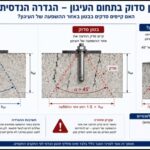
Where are the cracks in the definition of “cracked concrete”?
12 בJuly 2026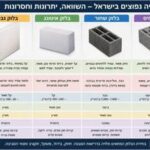
Which blocks are better for anchoring stone cladding?
12 בJuly 2026Where are the cracks in the definition of “cracked concrete”?
12 בJuly 2026Which blocks are better for anchoring stone cladding?
12 בJuly 2026Seismic Approval for Anchors: How to Read It
Demand for seismic approval of anchors keeps growing — but an approval only tells you that an anchor was tested for seismic action, not that it is well suited to it. Reading one correctly is what keeps a design safe.
In recent years the demand for seismic approval of anchors has grown across a wide range of projects. But what exactly is this approval? What does it actually mean, and how should it be used correctly?
What the approval is — and what it is not
A seismic approval for a given anchor certifies that the manufacturer paid an accredited laboratory to test that anchor according to the procedure set out in the European standard ETAG Annex E for seismic design. It does not mean the anchor is “good” for seismic use — only that the anchor was tested.
Naturally, a manufacturer will rarely spend money testing an anchor that performs poorly in this respect. But the approval itself is no guarantee that the anchor will perform effectively under seismic action, relative to its performance under normal loads.
A worked example
The two European categories: C1 and C2
In the European standard — the basis for anchor design in most Israeli design offices — there are two seismic approval categories:
| Category | Intended for |
|---|---|
| C1 | Non-structural elements |
| C2 | Structural elements |
In most building projects, seismic design concerns structural elements, so C1 is not relevant in the majority of cases. In Israel, however, many designers are unaware of this distinction and approve mechanical or chemical anchors for structural elements on the basis of a C1 approval alone.
The American standard
In the American standard, each application type is denoted by a different letter, and the more letters an anchor is approved for, the wider the range of conditions it suits. That said, approvals under the American standard do not state a clear load capacity for each case; instead they refer the designer to clauses that reduce the anchor’s load capacity according to the conditions. In practice, few Israeli designers use the American standard for seismic design.
Common mistakes in design
In most seismic anchor designs in Israel, the calculation is carried out for cracked concrete under static or quasi-static loads, and the designer simply requires that the anchor hold a seismic approval — C1 or C2 — without examining the anchor’s actual seismic performance. That is a double error.
The two mistakes
- If this is structural seismic design, a C2 approval is mandatory — C1 will not do.
- The design must use the load capacity given by the C2 approval in the anchor’s European Technical Assessment (ETA) — not the ordinary static load capacity.
A designer who approves an anchor on the basis of C1 for a structural element, or who never checks the specific load capacity under the C2 approval, is behaving like a hiring manager who takes on a candidate simply because they enrolled in an engineering degree — without ever asking whether they finished it. It is neither safe nor professional.
Chemical rebar connections under seismic action
So what is the answer? EAD 330087-01-0601
The correct solution is to use EAD 330087-01-0601, a document written specifically for the design of post-installed chemical rebar connections. It works on a different basis from the standard anchor route, and it permits full, standards-compliant seismic design of chemical rebar connections — outside the C1/C2 framework entirely. Unfortunately, most Israeli designers are not familiar with it. The result is either incorrect design, or an inability to approve otherwise standard rebar-connection solutions on seismic projects.

In conclusion: principles of sound design
Principles for sound design
- A seismic approval tells you that a test was carried out — not that the anchor is optimally suited to the application.
- For structural design with threaded rods, require a C2 approval, and base the calculation on the C2 values in the European Technical Assessment — not on the static load capacity.
- For structural design with chemical rebar connections, require a seismic approval under EAD 330087-01-0601, and design the connection to that document.
- Compare anchors on their actual seismic performance — not on the mere existence of an approval.