

Which plug is best for plasterboard walls?
12 בJuly 2026
Which type of anchoring points are better?
12 בJuly 2026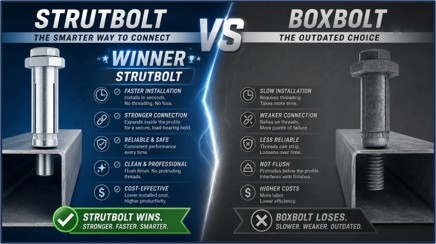
StrutBolt — The Improved Version of Boxbolt
Two trade names for the same engineering family of expanding blind-fastening anchors — but the official ETA figures show StrutBolt taking the lead in most sizes. A side-by-side comparison built entirely from the approval data: loads, design life, corrosion, and safety factor.
In short
Strutbolt and Boxbolt are parallel products from the same engineering family, certified under the same European approval (EAD 330001-00-0602), so they are conceptually interchangeable. But the official ETA figures draw a clear picture: in 4 of the 6 sizes (M6, M8, M10, M16) Strutbolt shows consistently higher pull-out and shear — sometimes by more than 25% — even against Boxbolt’s metallurgically stronger stainless version. Strutbolt is also approved for a 50-year design life (double Boxbolt’s 25) and carries a lower safety factor (γM 1.25 vs 1.33). Boxbolt remains the right choice for very heavy M20 connections that need maximum pull-out, or where a fully stainless version is essential.
What is Boxbolt / Strutbolt, and why is it essential to your project?
In modern construction and steelwork, one of the biggest challenges is making strong, safe connections in hollow steel sections (SHS), or in places where only one side of the structure is accessible. This is where the “Boxbolt” and Strutbolt come in — advanced expanding anchors that have transformed the field of blind steel fastening.
Boxbolt and Strutbolt are trade names for two parallel products from the same engineering family — “Expanding structural bolting assemblies for blind fastening” — both certified under the same European standard, EAD 330001-00-0602. Both are designed to connect steel elements with no need for welding or for threading from the far side of the section, which makes them ideal for hollow profiles where standard bolts, or hand access to the inner face, are simply not possible.
The key advantages of this type of expanding anchor
- Fast, simple installation: no complex equipment and no skilled welders required. All you need is a pre-drilled hole and standard hand tools, working from the accessible side only.
- Safety and durability: the anchor offers a particularly high load capacity and resists vibration and dynamic stresses.
- Design flexibility: the bolts are available in a range of finishes (zinc-plated, hot-dip galvanised, stainless and more) to suit corrosive environments or demanding outdoor conditions.
- Cost saving: by cutting installation time and removing the need for expensive weld inspection, the anchor significantly reduces the total project cost.
Common industry applications
- Steel structures: connecting columns and beams in industrial buildings.
- Railings and barriers: installing safety railings onto existing steelwork.
- Energy facilities: connecting infrastructure in power stations and solar farms.
- Refurbishment and strengthening: adding new elements to existing steel structures without harming the original structural capacity.
Load comparison: ADIT Strutbolt vs Boxbolt BQ_S (stainless)
The table below is based on the characteristic values (NRk / VRk) published in the official European approvals: ETA 25/0373 for Strutbolt and ETA-20/1174 for the stainless BQ_S version of Boxbolt. The percentage is the difference in Strutbolt’s favour (a positive figure means Strutbolt is stronger).
| Size | Pull-out, Boxbolt BQ_S (kN) | Pull-out, Strutbolt (kN) | Pull-out diff. | Shear, Boxbolt BQ_S (kN) | Shear, Strutbolt (kN) | Shear diff. |
|---|---|---|---|---|---|---|
| M6 | 12.7 | 16.1 | +26.8% | 17.6 | 20.4 | +15.9% |
| M8 | 23.1 | 28.9 | +25.1% | 31.6 | 36.4 | +15.2% |
| M10 | 36.5 | 44.7 | +22.5% | 57.1 | 59.2 | +3.7% |
| M12 | 53.1 | 51.4 | −3.2% | 72.4 | 80.3 | +10.9% |
| M16 | 98.9 | 101.5 | +2.6% | 131.6 | 145.6 | +10.6% |
| M20 | 154.4 | 132.7 | −14.1% | 220.2 | 229.1 | +4.0% |
Source: ETA 25/0373, Annex C2 (Strutbolt) and ETA-20/1174, Annex 4 (Boxbolt BQ_S), dated 21/04/2025 and 15/12/2020 respectively.
Load comparison: ADIT Strutbolt vs Boxbolt BQ_Z / BQ_G (galvanised steel)
Because Strutbolt has no stainless version, the fairest comparison in metallurgical terms is against Boxbolt’s galvanised steel version (BQ_Z – zinc-plated, or BQ_G – hot-dip galvanised), where the rated sleeve strength is identical — about 430 N/mm² in both products.
| Size | Pull-out, Boxbolt BQ_Z/G (kN) | Pull-out, Strutbolt (kN) | Pull-out diff. | Shear, Boxbolt BQ_Z/G (kN) | Shear, Strutbolt (kN) | Shear diff. |
|---|---|---|---|---|---|---|
| M6 | 13.7 | 16.1 | +17.5% | 18.8 | 20.4 | +8.5% |
| M8 | 23.6 | 28.9 | +22.5% | 33.3 | 36.4 | +9.3% |
| M10 | 41.8 | 44.7 | +6.9% | 58.5 | 59.2 | +1.2% |
| M12 | 53.7 | 51.4 | −4.3% | 76.3 | 80.3 | +5.2% |
| M16 | 96.0 | 101.5 | +5.7% | 139.3 | 145.6 | +4.5% |
| M20 | 168.0 | 132.7 | −21.0% | 229.9 | 229.1 | −0.3% |
Source: ETA 25/0373, Annex C2 and ETA-20/1174, Annex 4, Table 4.1 (sleeve strength 430 N/mm² in both products).
General engineering comparison
| Parameter | Strutbolt | Boxbolt |
|---|---|---|
| Standard & approval | ETA 25/0373 (21/04/2025, IETcc) | ETA-20/1174 (15/12/2020, Element) |
| Base standard (EAD) | EAD 330001-00-0602 — identical for both products | |
| Design working life | 50 years | 25 years |
| AVCP system | 2+ — identical for both products | |
| Bolt type (strength) | Steel Class 8.8, ISO 898-1 | Steel Class 8.8 (BQ_Z/G) or stainless A4-70 (BQ_S) |
| Available finishes | Zinc-plated (SBZ) / hot-dip galvanised (SBG) — 2 options | Hot-dip galvanised, zinc-coated (indoor use) or full stainless — 3 options |
| Durability at corrosion class C3 | 3 years (SBZ) / 47 years (SBG) | Over 20 years (both galvanised and stainless) |
| Installation torque (Nm), M6–M20 | 13 / 23 / 45 / 80 / 190 / 300 | 13 / 25 / 45 / 80 / 190 / 300 |
| Safety factor (γM) | 1.25 | 1.33 (absent national regulation) |
| Available sizes | M6, M8, M10, M12, M16, M20 — identical | |
| Number of parts | 3 (bolt, sleeve, cone / cone nut) — same working principle | |
Summary: which anchor is better — Strutbolt or Boxbolt?
Both products belong to the same engineering family and are approved under the same European EAD, so they are conceptually interchangeable. That said, the official ETA data draws a clear picture:
- Loads: in 4 of the 6 sizes (M6, M8, M10, M16), Strutbolt shows consistently higher pull-out and shear — sometimes by more than 25% — even against Boxbolt’s metallurgically stronger stainless version.
- The main exception — M20: in the largest size, Boxbolt shows higher pull-out (a gap of 14–21%, depending on version), so for very heavy M20 connections that demand maximum pull-out, Boxbolt is preferable.
- Design life: Strutbolt is approved for 50 years of service, double the 25 years approved for Boxbolt — a clear advantage for projects with a long design-life requirement (ceilings, public buildings, infrastructure).
- Durability in extreme corrosion (C3): here Boxbolt proves preferable when only a galvanised version may be used (Strutbolt SBZ holds just 3 years at C3, versus over 20 years for Boxbolt) — but if you choose the Strutbolt SBG (hot-dip galvanised) version, the picture flips in Strutbolt’s favour (47 years).
- Installation torque and safety factor: very similar between the products, with no practical difference in the field.
The bottom line
For most projects in Israel — standard structural connections in sizes M6–M16, with a long design-life requirement and a hot-dip galvanised finish — ADIT Strutbolt is the recommended choice, thanks to its higher loads and double the approved design life. Boxbolt remains the right choice when M20 with maximum pull-out is required, or when a full stainless version is clearly needed for an especially harsh corrosive environment without switching to a hot-dip galvanised finish.
How to choose the right anchor
To ensure the connection holds up, several parameters matter at the point of purchase:
- Required load: check the manufacturer’s load tables (shear and tension) and compare against the tables above.
- Material thickness: confirm that the bolt’s clamping range (tfix) suits the thickness of the profiles you are joining.
- Type of finish: choose a zinc coating for internal structures, or hot-dip galvanising / stainless for outdoor and corrosive conditions.
- Required service life: for projects with a 50-year design requirement, Strutbolt meets it directly from within the ETA.
If you are looking for an efficient, safe and economical solution for “blind” steel connections, Strutbolt is a professional, market-leading answer — it saves valuable time on site and gives peace of mind with a strong connection that meets the strictest standards. In the specific cases noted above (M20 at maximum pull-out load, or full stainless), Boxbolt is the correct alternative.
Sources
- ETA 25/0373 (21/04/2025, IETcc) — ADIT Strutbolt, Annex C2.
- ETA-20/1174 (15/12/2020, Element) — Boxbolt (BQ_S / BQ_Z / BQ_G), Annex 4.
- EAD 330001-00-0602 — Expanding structural bolting assemblies for blind fastening (base assessment document, common to both).