
StrutBolt — The Improved Version of Boxbolt
12 בJuly 2026
The most common questions on the Web about anchoring to work at height
12 בJuly 2026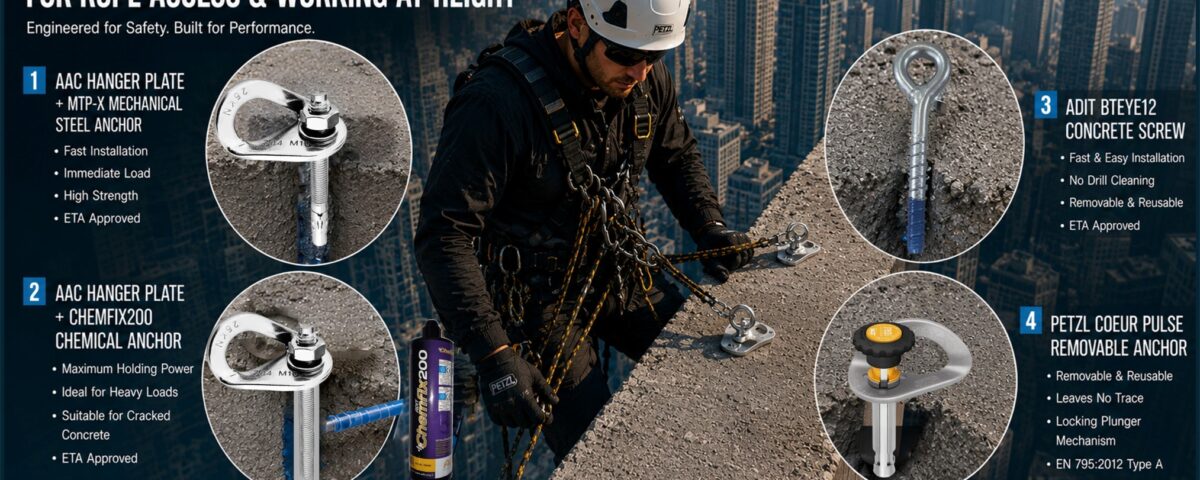
Which Type of Anchor Point Is Better? — The 4 Categories of Concrete Work-at-Height Anchors
Anchor points for work at height on concrete divide by how they are installed and used: mechanical, chemical, and portable/temporary. The right choice depends on the concrete (cracked, old or hollow) and the required load. A practical guide to four categories — with a hard look at the risks of the removable Petzl Coeur Pulse.
In short
Under the standard, a single-person anchor point must withstand a minimum static load of 12 kN (about 1.2 tonnes). All four solutions below meet that when installed correctly. The permanent options — a plate plus a mechanical anchor, a plate plus a chemical anchor, or the all-in-one BTeye2 eye bolt — carry a huge safety margin (25–100 kN). The removable Petzl Coeur Pulse is convenient but works with a narrow safety margin: it deforms permanently at just 6 kN (12 mm version) or 2 kN (8 mm), can be released by a single accidental press, and must always be used in pairs and only from below the anchor.
Minimum standard requirement
Per the standard, a single-person anchor point must withstand a minimum static load of 12 kN (about 1.2 tonnes). Every solution presented here meets this requirement under correct installation conditions.
Category 1 — anchor plate with a mechanical anchor
Adit AAC + Adit MTH or MTP-X or TFE. A combination of an EN 795-rated tab (anchor plate) with a mechanical wedge anchor or concrete screw carrying European ETA approval. Considered a reliable, simple-to-install solution for walls and ceilings in sound, uncracked concrete.
- Tab: Adit AAC — carries European standard EN 795 Type A & B.
- Anchor: Adit MTH — a wedge anchor for fast installation in sound concrete.
- Suited to solid, uncracked concrete, walls and ceilings.
- Simple, one-time installation with consistent performance.
- Breaking load: 25 kN (about 2.5 tonnes) — several times the standard requirement.
- Anchor: Adit MTP-X — a wedge anchor for fast installation, also suitable for cracked concrete.
- Suited to solid and cracked concrete, walls and ceilings.
- Simple, one-time installation with consistent performance.
- Breaking load: 25 kN (about 2.5 tonnes) — several times the standard requirement.
- Anchor: Adit TFE — a wedge-type concrete screw for fast installation, approved for cracked concrete.
- Suited to solid and cracked concrete, walls and ceilings.
- Simple, one-time installation with consistent performance.
- Breaking load: 25 kN (about 2.5 tonnes) — several times the standard requirement.
Strength-to-requirement ratio
- Minimum standard requirement: 12 kN.
- MTH anchor in quality concrete: 25–40 kN depending on size — a large safety margin.
- Field verification option: a pull test up to 6 kN on an engineer’s advice.
Category 2 — anchor plate with a chemical anchor
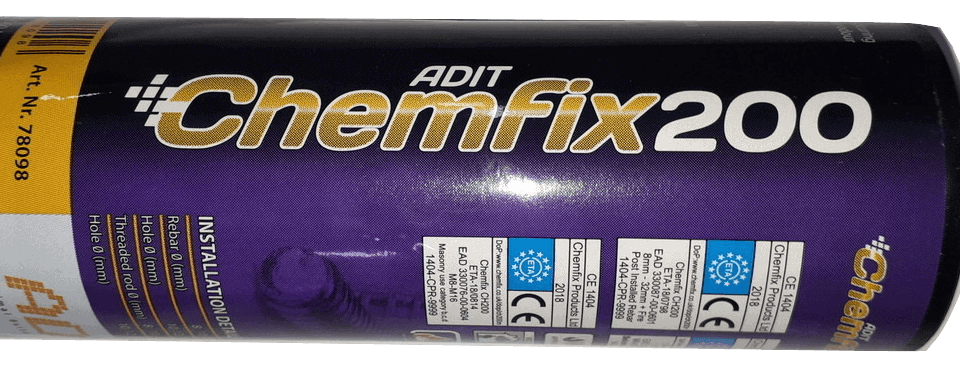
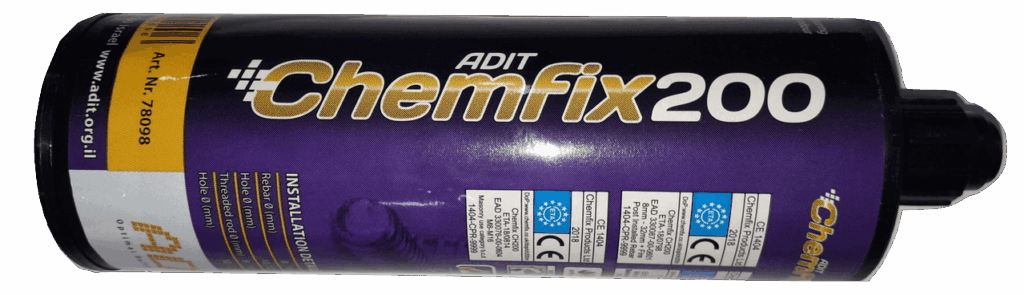
Adit AAC + Adit Chemfix200. A combination of a tab (anchor plate) with a hybrid-based chemical anchor. This is the strongest solution, recommended for loads above 3 tonnes, for cracked concrete, for concrete edges, or anywhere a mechanical anchor could cause local spalling of the concrete.
- Tab: Adit AAC — carries European standard EN 795 Type A & B.
- Chemical anchor: Adit Chemfix200 — a chemical system for cracked concrete and demanding requirements.
- Spreads load evenly along the full depth of the connection — no expansion pressure on the concrete.
- Suited to old, cracked and hollow concrete, and to edges (limited edge distance).
- Typical breaking load: 30–50 kN depending on diameter and drill depth.
When to choose a chemical anchor over a mechanical one?
Cracked concrete, old concrete (over 30 years), drilling close to an edge (less than 100 mm), loads above 30 kN, or anywhere there is a risk of local concrete spalling under the expansion load of a mechanical anchor.
Category 3 — the BTeye2 all-in-one concrete eye bolt
Adit BTeye2 — EN 795 Type B. A compact, fast solution: a concrete bolt with a built-in eye, needing no separate tab. The leading choice thanks to its installation speed, its strength of connection to the concrete, and its European approval. It offers a safety margin far beyond the requirement.
- All-in-one solution: bolt + anchor point in a single body.
- Fast, simple installation — drill directly into the concrete, clean the hole, screw in.
- Suited to both sound and cracked concrete, walls and ceilings; minimum concrete thickness per the manufacturer’s specification.
Strength-to-requirement ratio — BTeye2
- Minimum standard requirement: 12 kN.
- Actual strength: 50–100 kN depending on size and drill depth (about 5–10 tonnes).
- The safety margin is incomparably larger than required — very hard to compromise in a normal installation.
Category 4 — removable / temporary anchor
Petzl Coeur Pulse (⌀12 mm) / Pulse (⌀8 mm). A portable, temporary solution for situations where a permanent anchor cannot be installed. The Coeur Pulse is a fast removable anchor: it is inserted into an existing hole in the concrete, locked by pressing a piston, and removed after the work with no damage to the structure.
- Models: Coeur Pulse ⌀12 mm and Pulse ⌀8 mm (Petzl).
- Inserted into a hole in the concrete, locked by releasing a piston.
- Declared strength: 25 kN (12 mm) / 15 kN (8 mm) in 50 MPa concrete.
- Load before permanent deformation: just 6 kN (12 mm) / just 2 kN (8 mm).
- Intended for use only when the user is below the anchor point.
- Mandatory: at least two anchors used in parallel (the redundancy principle).
- Standard: EN 795 Type B, EN 959:2018.
The specific dangers of the Coeur Pulse — an ordered risk list
The Coeur Pulse is a sophisticated anchor that demands a deep understanding of its limits. Unlike a high-capacity concrete eye bolt such as the BTeye2, which holds tens of tonnes with a very large safety margin, the Coeur Pulse works with a narrow safety margin, and errors in installation or use can end catastrophically.
Danger 1 — a narrow safety margin compared with a permanent bolt
- Coeur Pulse 12 mm: breaks at 25 kN (about 2.5 tonnes in quality concrete).
- Adit BTeye2 (permanent eye bolt): breaks at 50–100 kN (about 5–10 tonnes).
- In other words, the BTeye2 is 2 to 4 times stronger than the Coeur Pulse.
- So any small deviation from the Coeur Pulse’s installation parameters dramatically affects the real strength, whereas with the BTeye2 the safety margin is enormous and covers minor errors.
Danger 2 — a critical dependence on the quality of the press and installation
The Coeur Pulse’s locking mechanism relies on a precise manual press of the piston and its release into the locked position. If the contractor did not press fully, did not release properly, or did not verify the piston locked, the anchor may be completely unsecured.
- There is no reliable visual indicator that the anchor is properly locked in all circumstances — pressing the piston is no guarantee of installation quality.
- If the hole is too wide (an excess of just 1–2 mm), the piston touches the tab when locking — a sign the hole is too big and the grip may be near zero.
- In soft concrete, stone, plaster, or any material that is not solid concrete, the anchor may not hold at all.
- Any deviation from the drilling settings (depth, diameter, cleaning) reduces the strength in a non-linear way.
Danger 3 — unintended release from external pressure
This is one of the most severe risks in field use, and what sets it apart from any other permanent anchor:
- Any press on the piston — even accidental — releases the locking mechanism.
- Equipment on the piston (a rope, carabiner, sleeve, clothing) can push it and release the anchor mid-work.
- If the user climbed above the anchor point (against the fundamental rule), the attached equipment may reach the height of the piston and press on it.
- Accumulated rain, mud, construction debris and dust can make the piston appear stuck, only to release under a sudden load.
- Conclusion: an anchor that can be released with a single press is inherently more dangerous in an active work environment.
Danger 4 — permanent deformation at a low load (6 kN / 2 kN only)
The Coeur Pulse is not designed to absorb high loads at all, even without breaking:
- The anchor deforms permanently and irreversibly at just 6 kN (about 600 kg) for the 12 mm version.
- The 8 mm version deforms at just 2 kN — equivalent to a person dangling in panic without a deceleration device.
- Deforming the piston renders the anchor unusable and very hard to remove from the hole — which can lead to a total failure.
- In a working method using a fall arrester, the arrest force can reach 6 kN and above — right at the “danger threshold” of the larger version.
Danger 5 — a critical dependence on the type and quality of the concrete
The Coeur Pulse is tested and approved under controlled lab conditions. In the field the picture is different:
- The breaking figures (25 kN / 15 kN) were measured in 50 MPa concrete — military/industrial-grade concrete, rare in ordinary construction.
- In 25 MPa concrete (common in Israel) the strength drops significantly — sometimes to 40–50% of the rated figure.
- In cracked concrete, old concrete, soft rock, or near an edge, the strength may be near zero.
- There is no way to check the exact concrete quality in the field before installation without special equipment.
Danger 6 — relying on a single anchor is forbidden, yet common in the field
- The standard (EN 795) and the manufacturer (Petzl) require at least two parallel anchors at all times.
- On fast projects, contractors install just one anchor — an explicit breach of the standard that endangers lives.
- Even with two anchors: if both are installed close together in the same weak concrete section, the failure of one may drag the other down.
Danger 7 — misunderstanding the “below the anchor” rule
The Coeur Pulse was designed solely for use when the user is below the anchor point:
- Working above the anchor point is completely forbidden per the manufacturer’s instructions.
- Equipment (carabiner, rope, sleeves) may reach the height of the piston and release it.
- Rotating the hanger while working above the anchor can shift the equipment’s position and cause a release.
- This rule breaks the geometry of the equipment mounting and dramatically increases the risk of twisting the piston.
Coeur Pulse warning summary — what to check before every use
- Hole check: diameter, depth and cleaning per spec (12 mm at 65 mm depth for the 12 mm version; 8 mm at 50 mm depth for the 8 mm version).
- Lock check: after releasing the piston, verify it is not in contact with the tab (a sign the hole is too wide).
- Piston check: not bent, not scratched, the locking mechanism moves freely.
- Tab check: no deformation, no cracks, free rotation.
- Redundancy: always two active anchors at once.
- Deceleration: when used as part of an arrest system, verify the arrest force does not exceed 6 kN.
- Environment: check there are no objects that could press on the piston during work.
- Age: replace the anchor after any fall event, significant impact, or any suspicion of deformation.
Comparison table — the 4 categories of concrete anchor points
| Category / product | Type | Breaking strength | Load before permanent deformation | Suits cracked concrete | Removable | Standard |
|---|---|---|---|---|---|---|
| Adit AAC + MTH/MTP-X/TFE | Permanent / mechanical | 25–40 kN | – | Yes (MTP-X/TFE) | Yes (AAC) | EN 795 + ETA |
| Adit AAC + Chemfix200 | Permanent / chemical | 30–50 kN | – | Yes | No | EN 795 + ETA |
| Adit BTeye2 | Removable | 50–100 kN | – | Yes | Yes | EN 795 Type A + B |
| Petzl Coeur Pulse 12 mm | Temporary / removable | 25 kN* | 6 kN only | No | Yes | EN 795 + EN 959 |
| Petzl Pulse 8 mm | Temporary / removable | 15 kN* | 2 kN only | No | Yes | EN 795 Type B |
* Coeur Pulse breaking figures are based on testing in 50 MPa concrete (very high quality). In 25 MPa concrete (common) the strength drops significantly.
Key points for choice and installation
- Standards: verify the anchor point meets EN 795 — Type A for permanent, Type B for portable/temporary.
- Concrete type: in cracked, old, hollow or edge-near concrete, use a chemical anchor only.
- Engineer approval: installing permanent anchor points requires the approval of a certified inspector or a registered civil/mechanical engineer.
- Periodic inspection: a detailed inspection by a competent person at least once every 12 months — and after any abnormal event (a fall, an abnormal load, storage in extreme conditions).
- Coeur Pulse — heightened caution: this anchor requires specific training, a check before every use, and full, uncompromising compliance with the manufacturer’s instructions. It must not be used as an “easy and fast” solution without proper training.
Sources
- EN 795:2012 — Personal fall-protection equipment: anchor devices.
- ADIT AAC, BTeye2, MTH, MTP-X, TFE and Chemfix200 technical data.
- Petzl Coeur Pulse and Pulse technical notices (EN 795 Type B, EN 959:2018).