

The history of the self-drilling screw – and why Israel calls it a “borg isqurit”
12 בJuly 2026
StrutBolt — The Improved Version of Boxbolt
12 בJuly 2026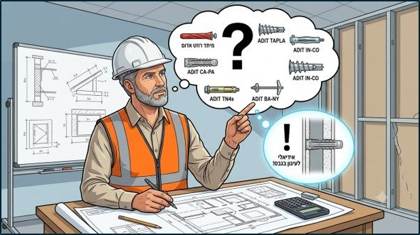
Which Plug Is Best for Plasterboard Walls?
Plasterboard has a weak, crumbly core — so the anchor’s mechanism matters more than its size. A comparison of the BA-NY toggle plug against the market’s leading plasterboard anchors, by recommended service load.
In short
The structural weakness of a plasterboard wall is the tendency of its core to crumble under a concentrated point load, so the best anchors spread the load over a wide area behind the board. The BA-NY toggle plug is the strongest and most convenient wall solution that needs no special tool — up to 90 kg in tension in a double board. For extreme shear there is the metal IN-CO; for ceiling hangs (a heavy chandelier) the spring-toggle CA-PA; and for light-to-medium loads and the fastest install, the TN4S with its 8 mm hole.
The BA-NY plasterboard plug — the engineering advantage
The BA-NY (a “toggle anchor”) is one of the most reliable board-fixing solutions on the market, thanks to its distinctive locking mechanism. Where many classic solutions rely on simple friction or a shallow thread inside the weak gypsum core, the BA-NY takes a different engineering approach that makes the most of the board’s own strength and spreads the load optimally.
1. A wide bearing surface and optimal load spread
The core structural weakness of plasterboard is its tendency to crumble under a concentrated, point pressure. As the screw is driven, the BA-NY’s special nylon arms deploy behind the board and form a wide, flat “fan” that locks against the back of the board. Unlike spiral screw-in (“snail”) plugs that concentrate on one small point and wound the board, the BA-NY creates an engineering lever that spreads the shear and pull-out forces over a very large surface.
The mechanical advantage of the BA-NY
As the screw is driven in, the plug’s nylon arms spread out behind the plasterboard and form a wide, flat fan that locks against the back of the board. Unlike self-drilling spiral plugs — the “snail” type — which concentrate on a single small point and wound the board, the BA-NY creates an engineering lever that distributes both shear and pull-out forces over an unusually large bearing area.
2. Medium-to-heavy loads at two thicknesses
In plasterboard plugs there is a clear load hierarchy, driven directly by the thickness of the board and the number of layers.
- Single board (15 mm): here the plug is an excellent answer for medium to high loads. On the manufacturer’s official capacity data the BA-NY offers an unprecedented level of safety in a single layer, with a recommended service load of 49 kg in tension and 92 kg in shear.
- Double board (30 mm): thanks to the rear deployment mechanism the plug makes the most of the extra thickness. In a double plasterboard wall, two layers of 15 mm, it delivers an exceptional recommended service load of about 90 kg in tension and 127 kg in shear — among the highest in the category, ideal for TVs, heavy shelves and kitchen cabinets.
3. Material durability, no wall damage
Metal plugs with sharp teeth can cut the gypsum’s protective paper and weaken it over time. The BA-NY is made of a quality, flexible nylon and sits flat against the board without wounding the substrate — a fixing that does not loosen over the years.
4. Full installation reliability (no spinning in the hole)
One of the best-known and most frustrating problems with cheap plugs is that they start to spin inside the hole while you drive the screw, reaming it out into a wide, damaged opening.
The locking mechanism: the BA-NY carries small wings at its head that stop the plug rotating in the borehole. As soon as the screw engages, the rear mechanism locks hard against the inner face of the board, so the installer knows the plug is seated and the arms have deployed behind the plasterboard rather than spinning in place.
5. Removable and re-installable
The mechanism allows the screw to be fully removed and refitted without harming the connection — so the hung item can be swapped without limit.
Extended comparison — recommended service load only
| Anchor (& supplier) | Rec. load, single 15 mm board | Rec. load, double 30 mm board | Drill Ø | Material / mechanism | Special tool |
|---|---|---|---|---|---|
| BA-NY | Tension 49 · Shear 92 kg | Tension 90 · Shear 127 kg | 13 mm | Zinc-plated steel + nylon arms | No (driver) |
| Rosett Red (Expandet) | Tension 38.7 · Shear 51 kg | Tension 71.4 · Shear 86.7 kg | 10 mm | Nylon, 30% glass-fibre reinforced | No (driving) |
| IN-CO (M6) | Tension 80 · Shear 100 kg | Tension 80 · Shear 180 kg | 12 mm | Solid metal (folding toggle) | Yes (dedicated setting gun) |
| CA-PA (M6) | Tension 36 · Shear* | Tension 50 · vertical-load* | 18 mm | Solid metal (spring “umbrella” toggle) | No (self-closing spring wings) |
| TN4S (M8) | Tension 24 · Shear 50 kg | Tension 55 · Shear 84 kg | 8 mm | Quality nylon (4-way tie anchor) | No (driving) |
* CA-PA is a spring toggle intended mainly for vertical (ceiling) loads, not primarily for in-plane wall shear. All figures are recommended service loads (Nrec) from the manufacturers’ data sheets — compare service-to-service, never against a characteristic failure load.
An important engineering note about load types
Every figure in this article refers to the recommended service load (Nrec / Vrec) alone, which already contains the manufacturers’ strict safety factors — usually a factor of three or four below the ultimate failure load.
Do not compare one product’s “failure load” or “characteristic load” against another product’s recommended load. That comparison is misleading and puts the stability of the installation at risk. Be aware, too, that some figures published in the Israeli market are failure loads, which is why it is worth relying on the official table above.
Field conclusions and recommendations
- The strongest, most convenient wall anchor with no special tool — the BA-NY. It combines extreme load values (especially 90 kg tension in a double 30 mm board) with simple driver installation, no setting gun, and unlimited removal and refitting of the hung element.
- For extreme shear in metal — the IN-CO. It offers the highest shear capacity (180 kg in a double board), but note that it requires a professional setting gun to fold the anchor behind the wall.
- For plasterboard ceilings and horizontal voids — the CA-PA spring toggle. It is the natural choice for vertical ceiling hangs (such as heavy chandeliers): its massive metal wings open by spring inside the void and give a wide, safe bearing against the direct pull of gravity.
- For light-to-medium loads and a fast install — the TN4S. It has the smallest drill hole (just 8 mm) and a very fast installation, needs no deep cavity behind the board, and gives a far more stable, tidy result than ordinary snail plugs.
Common questions
What is the BA-NY’s recommended service load in a double 30 mm board?
About 90 kg in tension and 127 kg in shear — one of the strongest in the category.
When should I use the metal IN-CO anchor, and when the BA-NY?
The IN-CO is solid metal and excels at very high shear, but its installation requires a dedicated setting gun. The BA-NY gives similar — and, in a double board, even higher — tension loads, needs no special tool, and lets the screw be removed easily to swap the hung item without harming the plug.
Is the TN4S plug suitable for plasterboard walls?
Yes. The TN4S is a universal square nylon anchor for cavity fixings; as the screw is driven it folds and forms a wide knot behind the board. It suits medium loads (up to 55 kg tension in a double 30 mm board), and its big advantage is a small 8 mm drill hole.
Which anchor is best for hanging a heavy chandelier from a plasterboard ceiling?
For vertical ceiling hangs, use a spring-toggle anchor such as the CA-PA — its metal wings open in the void and bear directly against the pull of gravity.
Why is the BA-NY stronger than the red Rosett on plasterboard?
At both thicknesses the BA-NY’s recommended service loads are higher — 49 vs 38.7 kg in tension in a single board, and 90 vs 71.4 kg in a double board.
Sources
- ADIT BA-NY, IN-CO, CA-PA and TN4S technical data.
- Expandet Rosett — Technical Sheet No. 101 (red Rosett).