
Which Block Plug Is Better — ADIT GX-L or Fischer DUOpower?
12 בJuly 2026
Signage Required Under EN 365 for an EN 795 Work-at-Height Anchor Point
12 בJuly 2026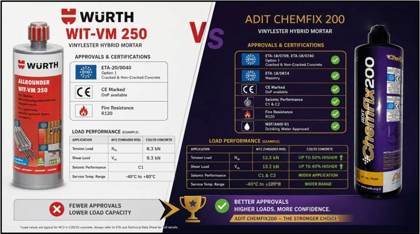
Which Adhesive Is Better — ADIT Chemfix200 or Würth WIT-VM 250?
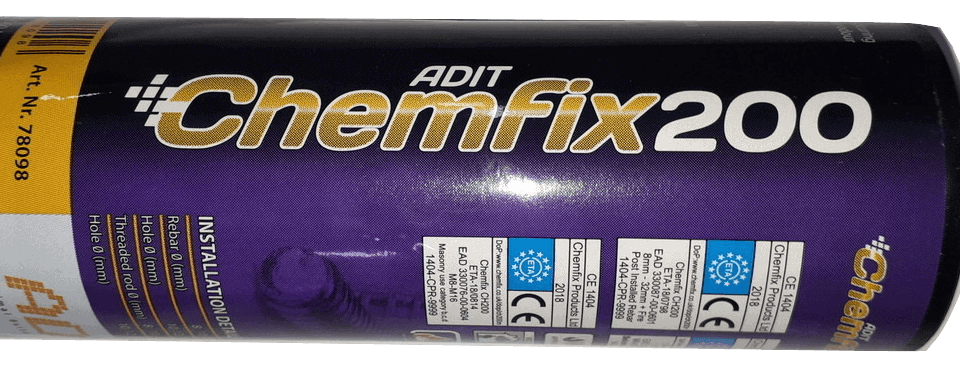
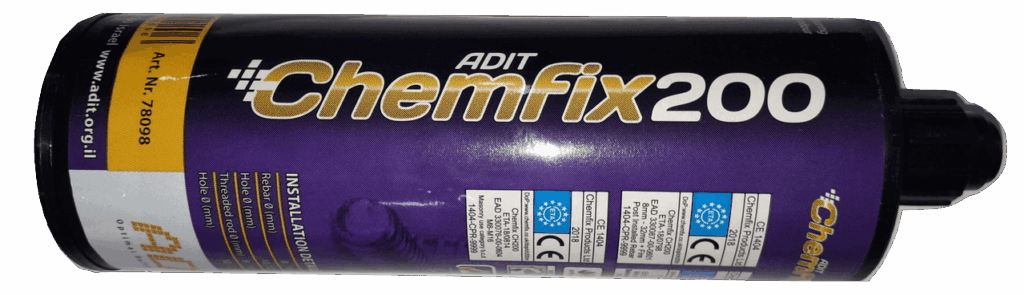
Choosing a chemical adhesive for structural projects means relying on proven laboratory data from the ETA (European Technical Assessment) approvals. This comparison examines two advanced injection systems on the basis of recommended service loads (Nrec in tension and Vrec in shear) in C20/25 concrete, as well as the certification envelope that accompanies each product.
In short
From a dry analysis of the ETA data, the Chemfix 200 wins almost every key engineering parameter. In tension it shows a dramatic superiority (between 23% and 78% more capacity) in both threaded rods and rebar dowels, in cracked and uncracked concrete alike. It also carries the C1/C2 seismic approval and R120 fire resistance that the Würth document lacks. The one place Würth shows higher table values is shear in cracked concrete — but in most pure structural designs the critical failure mode checked for chemical adhesives is tension.
1. Licensing, standards and approvals
The certification envelope is the adhesive’s identity card. While both adhesives hold a CE approval and environmental-quality standards (VOC / LEED), the Chemfix200 shows a crushing advantage in the strictest structural requirements:
- Seismic (C1 and C2): the Chemfix 200 is officially approved for seismic loads in categories C1 and C2 — a critical figure for design in Israel. This figure is completely absent from the Würth document.
- Fire resistance: the Chemfix 200 carries an R120 fire-resistance rating (up to 120 minutes).
- Additional international approvals: the Chemfix 200 holds the American ICC-ES approval (ESR 4366) and is approved for contact with potable water.
2. Capacity in threaded rods (grade 8.8) — tension and shear
The tables below give the recommended service load in kilonewtons (1 kN is roughly 100 kg). The percentage differences in favour of the winner in each category are highlighted.
Non-cracked concrete
| Diameter (M) | Embedment (hef) | Chemfix 200 (tension) | Würth WIT-VM 250 (tension) | Tension difference | Shear: Chemfix vs Würth |
|---|---|---|---|---|---|
| M8 | 80 mm | 13.2 kN | 9.6 kN | +37.5% for Chemfix | Equal (8.6 kN) |
| M10 | 90 mm | 16.6 kN | 13.5 kN | +23.0% for Chemfix | Equal (13.1 kN) |
| M12 | 110 mm | 24.3 kN | 19.7 kN | +23.3% for Chemfix | Equal (19.4 kN) |
| M16 | 125 mm | 36.9 kN | 27.3 kN | +35.1% for Chemfix | Equal (36.0 kN) |
| M20 | 170 mm | 62.7 kN | 43.3 kN | +44.8% for Chemfix | Equal (56.0 kN) |
Cracked concrete
| Diameter (M) | Chemfix 200 (tension) | Würth WIT-VM 250 (tension) | Tension difference | Shear note (Vrec) |
|---|---|---|---|---|
| M10 | 8.6 kN | 5.6 kN | +53.5% for Chemfix | Advantage to Würth (11.2 vs 5.1) |
| M12 | 13.8 kN | 9.1 kN | +51.6% for Chemfix | Advantage to Würth (18.1 vs 8.6) |
| M16 | 20.0 kN | 13.7 kN | +46.0% for Chemfix | Advantage to Würth (27.4 vs 12.0) |
| M20 | 36.9 kN | 23.3 kN | +58.3% for Chemfix | Advantage to Würth (46.6 vs 22.3) |
3. Capacity in rebar dowels (Rebar B500) — tension
Post-installed rebar dowels are one of the most critical applications of chemical adhesives, for continuing concrete pours or strengthening structures.
| Dowel diameter | Concrete state | Chemfix 200 | Würth WIT-VM 250 | Difference in favour of Chemfix |
|---|---|---|---|---|
| Ø10 | Non-cracked | 20.7 kN | 13.5 kN | +53.3% |
| Ø12 | Non-cracked | 34.7 kN | 19.7 kN | +76.1% |
| Ø16 | Non-cracked | 42.2 kN | 27.3 kN | +54.5% |
| Ø10 | Cracked | 10.0 kN | 5.6 kN | +78.5% |
| Ø12 | Cracked | 14.5 kN | 9.1 kN | +59.3% |
| Ø16 | Cracked | 21.7 kN | 13.7 kN | +58.3% |
Professional summary: which adhesive is better?
From a dry analysis of the ETA data, the Chemfix 200 wins almost every key engineering parameter.
- In tension: the Chemfix 200 shows a dramatic superiority (between 23% and 78% more capacity) in both threaded rods and rebar dowels, in cracked and uncracked concrete alike. This gap gives the engineer enormous design flexibility and a significant saving in material.
- In standards and certifications: the presence of a C1/C2 seismic standard and R120 fire resistance in the Chemfix 200 makes it the suitable product for public infrastructure projects, whereas the Würth (per the given document) lacks these critical approvals.
- Shear note in cracked concrete: the only place the Würth WIT-VM 250 shows higher values in the tables is in shear loads in cracked concrete. However, in most pure structural designs, the critical failure mode checked for chemical adhesives is tension (pull-out).
The final conclusion: for a designer or contractor seeking the strongest, safest and best-backed adhesive in terms of structural and seismic certification for concrete infrastructure — the Chemfix 200 is the clearly preferable choice.
Sources
- ADIT Chemfix 200 ETA and ICC-ES (ESR 4366) approval data; seismic C1/C2 and R120 fire ratings.
- Würth WIT-VM 250 ETA data sheet (threaded rods and rebar, C20/25 concrete).