
How to identify your wall and choose the right plug
12 בJuly 2026
Which Adhesive Is Better — ADIT Chemfix200 or Würth WIT-VM 250?
12 בJuly 2026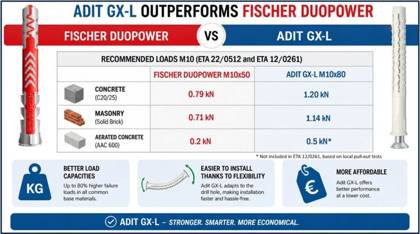
Which Block Plug Is Better — ADIT GX-L or Fischer DUOpower?
In the anchoring world, fixing to light, hollow substrates — such as black block, pumice block, Ytong or gypsum block — is the greatest engineering challenge. Solid concrete forgives mistakes, but hollow blocks demand precise anchoring technology. This comparison, based solely on official recommended service loads, pits the structural ADIT GX-L against the universal Fischer DUOpower.
In short
On problematic substrates — black block and pumice block — the ADIT GX-L shows a clear advantage, with a service load of about 60 kg, 50% higher than Fischer’s long version and nearly 4 times the short version. In solid gypsum block the gap is large too (about 90 kg vs 35–40 kg). In dense Ytong (PB4) the long DUOpower edges slightly ahead (about 110 kg vs 100 kg), but in light Ytong (PB2) the GX-L leads again. For the mixed, fragile walls common in Israel, the GX-L is the safer, more structural choice.
Different engineering approaches to anchoring in blocks
ADIT GX-L: a frame anchor for great depths (frame fixing)
The ADIT GX-L was designed from the outset as a heavy frame-fixing anchor to handle challenging walls. Its main advantage in blocks comes from combining the required drilling length (70 mm minimum) with a very long expansion zone. When it is inserted into a hollow block (black or pumice), the long expansion zone opens and creates friction simultaneously across several internal partitions of the block, spreading the load and preventing a point collapse of the material.
Fischer DUOpower: a smart universal plug (2K)
The DUOpower is built of two types of plastic, and its mechanism is designed to recognise the wall type and respond accordingly. In hollow blocks, it “understands” that it has no wall to press against and forms a “knot” or folding (knotting) behind the first partition. This mechanism is excellent for light and medium applications, but struggles to transfer significant structural loads into a fragile substrate, especially in its shorter versions.
Summary comparison table — recommended pull-out service loads (Nrec) for 10 mm diameter
This comparison focuses on the M10 versions, the most common for hanging significant weights (such as kitchen cabinets, air-conditioners or TV mounts).
| Substrate (block type) | ADIT GX-L (M10x80) | Fischer DUOpower (10×80, long) | Fischer DUOpower (10×50, short) |
|---|---|---|---|
| Black block (hollow split concrete) | ~60 kg (0.6 kN) | ~40 kg (0.4 kN) | ~25 kg (0.25 kN) |
| Pumice block (hollow partitions) | ~60 kg (0.6 kN) | Not relevant for the long version | ~15 kg (0.15 kN) |
| Ytong for anchoring (PB4 / high density) | ~100 kg (1.0 kN) | ~110 kg (1.1 kN) | ~60 kg (0.6 kN) |
| Regular Ytong (PB2 / light aerated) | ~50 kg (0.5 kN) | ~30 kg (0.3 kN) | ~20 kg (0.2 kN) |
| Solid gypsum block | ~90 kg (0.9 kN) | ~40 kg (0.4 kN) | ~35 kg (0.35 kN) |
Summary and engineering analysis of the performance
The superiority of the ADIT GX-L in hollow blocks (black and pumice)
The data shows that in problematic substrates such as black block and pumice block, the ADIT GX-L presents a significant advantage. Its service load, standing at about 60 kg, is 50% higher than Fischer’s long version, and almost 4 times higher than Fischer’s short version in pumice block. The reason lies in the GX-L’s ability to anchor deep beyond the weak plaster layer and grip several partitions at once.
Competitive performance in Ytong (aerated cellular concrete)
In Ytong blocks the picture is more balanced and varies with the block’s density. In light Ytong (PB2), the GX-L keeps a clear advantage (50 kg versus 30 kg). In Ytong for anchoring (PB4), the denser grade, the extended DUOpower manages to produce excellent resistance (about 110 kg) that slightly exceeds the GX-L’s 100 kg. That said, ADIT’s local advantage is in the matching and official testing to the exact Israeli specification.
Dominance in gypsum block (boards and solid blocks)
In solid gypsum block, a large gap is evident in the ADIT GX-L’s favour. While the DUOpower manages only 35–40 kg, the massive structure of the GX-L lets it reach a load of about 90 kg (0.9 kN), making it the perfect solution for heavy loads on partitions of this type.
Final field conclusion
If you know for certain the wall is Ytong (especially at a high density grade), both anchors will provide an excellent answer. But in the Israeli reality, where an installer often encounters mixed walls, hollow black blocks, pumice blocks with delicate partitions or gypsum blocks — the ADIT GX-L (as a long frame anchor) is clearly the safer, more structural and stronger solution.
You are welcome to visit the ADIT GX-L product page, where a large collection of filmed pull-out tests on a range of substrates shows these engineering figures at work in the field.
Sources
- ADIT GX-L frame anchor recommended service-load data (pull-out tests on various block substrates).
- Fischer DUOpower (10×50 and 10×80) recommended service-load data sheets.