
Making Sense of Fixings: The Real Difference Between a Plug, a Toggle, an Anchor and a Jumbo
12 בJuly 2026
The silent guard: Why is EPDM critical in connection with different metals?
12 בJuly 2026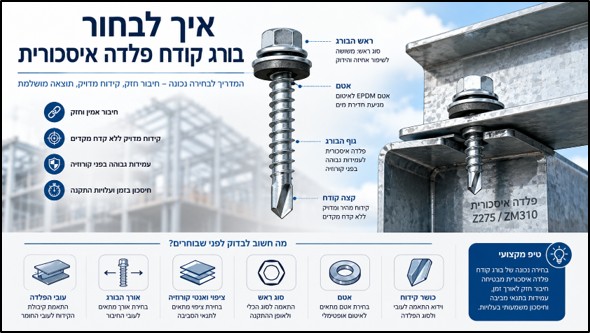
Engineering Guide: Self-Drilling Screws for Steel and Cladding — Correct Selection and Design Data
Connecting corrugated cladding sheets, sheet-metal panels and structural profiles calls for a fast, reliable fixing with proven structural durability. Self-drilling screws are the technology front line here, because they perform three actions in one: drilling the hole in the structural substrate, cutting the thread (tapping), and clamping the fastened element.
In short
Many field failures stem from choosing the wrong screw type, ignoring the maximum drilling thickness of the drill flute, or a poor match of corrosion protection. Two iron rules govern the mechanical match: the drill-flute length must exceed the total steel thickness, and the screw diameter sets the drilling capacity. For steel construction, plain stainless cannot drill — the answer is a bi-metal screw (a hardened carbon-steel tip laser-welded to a stainless body). And the EPDM washer is as critical as the screw itself: it seals against water and separates dissimilar metals to prevent galvanic corrosion.
Two iron rules for the mechanical match of a self-drilling screw
- The drill-flute length (Z) must be greater than the total steel thickness: the screw’s thread must not begin to enter the steel before the drill flute has fully passed through it. If the thread grips the material while the flute is still drilling, the screw will shear or its head will tear off due to the difference in advance rates.
- The screw diameter sets the drilling capacity: thin screws (such as ST3.5 or ST4.8) are for thin sheets and light profiles. Working against heavy, thick-walled profiles (up to 12 mm of steel) requires larger-diameter screws (such as ST5.5 or ST6.3) with a dedicated extended drill flute.
Load tables for engineering design (single screw in steel)
The following data is based on laboratory tests and the official design instructions for ADIT’s leading screw series. The values are given in kilonewtons (kN) for different steel base-plate thicknesses (background thickness e).
1. ADIT ABE / BIE series (for light and medium profiles)
These screws are for fast, efficient drilling in thin profiles and sheet metal (cladding) up to defined thicknesses.
| ABE 5.5 / BIE 5.5 (carbon steel / bi-metal stainless) | e = 0.8 mm | e = 1.5 mm | e = 2.0 mm+ |
|---|---|---|---|
| Pull-out — characteristic failure load (NRk) | 1.9 kN | 3.0 kN | 3.8 kN |
| Shear — characteristic failure load (VRk) | 1.9 kN | 1.9 kN | 1.9 kN |
| Pull-out — recommended design load (Nrec) | 0.6 kN | 0.9 kN | 1.1 kN |
| Shear — recommended design load (Vrec) | 0.6 kN | 1.0 kN | 1.0 kN |
2. ADIT AUTO / BAUTO series (for especially heavy profiles — up to 12 mm)
The flagship series for demanding work against thick-walled profiles, with an extended drill flute that allows direct penetration without pre-drilling into structural steel.
| AUTO 5.5 / BAUTO 5.5 (heavy profiles — drilling up to 12 mm) | e = 2.0 mm | e = 3.5 mm | e = 5.0 mm+ |
|---|---|---|---|
| Pull-out — characteristic failure load (NRk) | 5.4 kN | 8.7 kN | 9.6 kN (AUTO) / 12.5 kN (bi-metal) |
| Shear — characteristic failure load (VRk) | 4.8 kN | 4.8 kN | 4.8 kN (AUTO) / 5.8 kN (bi-metal) |
| Pull-out — recommended design load (Nrec) | 1.8 kN | 2.9 kN | 3.4 kN (AUTO) / 4.2 kN (bi-metal) |
| Shear — recommended design load (Vrec) | 2.6 kN | 2.6 kN | 2.6 kN (AUTO) / 2.8 kN (bi-metal) |
Engineering note: the shear capacity shown in the tables does not account for the peripheral tear-out of the fastened profile (cladding or aluminium sheet). The designing engineer must verify the thin sheet’s own resistance to local tear-out.
Corrosion and metallurgical protection: which screw to choose, and when?
Choosing the metal type and coating of the self-drilling screw is critical to the structure’s service life. The wrong choice causes rapid galvanic corrosion (from contact between dissimilar metals) or corrosive rust that weakens the connection.
The protection ladder and selection principles
- Electro-galvanising (cold galvanising): provides a basic protection of 5–8 microns of zinc. Suitable only for indoor applications, in dry environments not exposed to moisture, water or air pollution.
- Advanced coatings (such as Atlantis C3 / C4): special multi-layer coatings designed to withstand hundreds of hours of salt-spray testing. Highly recommended for outdoor installations of cladding sheets on steel structures, giving excellent resistance to local weather conditions.
- Full stainless steel (A2 / A4): the most corrosion-resistant material. A must for marine environments (coastline), wastewater treatment plants, chemical industries, or connecting aluminium sheets (to prevent destructive galvanic corrosion between carbon steel and aluminium).
Scientific explanation: why plain stainless screws cannot drill steel
Many designers and installers wonder why you cannot make a self-drilling screw entirely of stainless steel (A2 or A4) so it drills directly into a steel structure. The answer lies in metallurgy: austenitic stainless is a tough, highly corrosion-resistant metal, but it is relatively soft in terms of structural hardness.
When you try to drill with a stainless screw tip into structural building steel (made of hard carbon steel), the friction heat causes the stainless flute to lose its shape immediately, “smear” and burn, without penetrating at all.
The engineering solution: bi-metal screws
Bi-metal screws (such as the ADIT BIE and ADIT BAUTO series) combine the best of both worlds through advanced laser-welding technology:
- The screw tip (the drill flute and first threads): made of hardened carbon steel that undergoes careful heat treatment. This tip can drill and cut a thread in thick steel structures easily and quickly.
- The screw body and head: made of quality stainless (A2 or A4). Once the screw finishes drilling and tapping, the part left exposed to the open air and the corrosive environment is fully resistant stainless.
The importance of the EPDM seal (washer): sealing and preventing galvanic corrosion
A component no less critical than the screw itself is the EPDM seal (washer) fitted under the screw head. The EPDM has two key engineering roles in cladding and roofing:
- Complete sealing against water and moisture: during tightening, the EPDM rubber is compressed and conforms precisely to the shape of the sheet or cladding. It creates a perfect, long-lasting seal that prevents rain and moisture reaching the drilled hole — a situation that could lead to leaks into the structure and internal rusting of the framework.
- Separating materials (preventing galvanic / chemical corrosion): when dissimilar metals are joined (for example, a steel or stainless screw to an aluminium sheet, or to cladding), differences in electrical potential and acidity (pH) arise that can accelerate chemical processes in a wet environment. The EPDM washer acts as a physical barrier and electrical insulator that prevents direct contact between the screw metal and the sheet metal, halting the development of galvanic corrosion.
Common questions (FAQ) — self-drilling screws for cladding and steel
How do you match the drill-flute length to the profile thickness?
Consult the manufacturer’s data defining the effective drilling range. For example, the AUTO and BAUTO series come with an extended drill flute (about 16 mm long, with a 5.1 mm flute diameter), which lets them safely drill especially thick steel profiles in the range of 1.75 mm up to 12.0 mm wall thickness.
What happens if you use a self-drilling screw that is too long or too short?
If the screw is too short, the drill flute will not fully pass the substrate and the thread will not lock. If the screw is longer than needed, there is no engineering harm to the connection strength, but it is an economic waste and can interfere visually or functionally on the other side of the profile. The correct rule is: thickness of the mounted sheet + thickness of the structural profile + drill-flute length + 3 mm reserve.
Are self-drilling screws available with a painted head?
Yes, absolutely. ADIT’s leading screws are available today with an oven-baked painted head per the standard RAL catalogue. Oven painting is not only aesthetic (allowing a full match to the cladding sheet’s shade, such as white, cream, grey or green) but also gives an extra polymer protection layer to the screw head, which is directly exposed to the weather.
Which tool is recommended for installing self-drilling screws in the field?
Use a fast screwdriver with a dedicated clutch that allows stopping the moment the washer seats against the sheet. An impact driver may be used only if the installer is skilled and stops the driving action immediately as the screw seats; over-tightening (“stripping”) with an impact driver can strip the thread cut in the steel, destroy the EPDM seal and severely harm both the seal and the load capacity of the connection.
How many self-drilling screws are needed per square metre of cladding?
As a rule of thumb, allow about 4 to 6 screws per square metre of cladding or corrugated sheet in standard roofing. The exact quantity can rise to 8–10 screws depending on site conditions, in areas exposed to high wind loads (in the mountains or near the sea, for example), and is of course subject to the engineering specification of the sheet manufacturer.
What rotation speed (rpm) is recommended when drilling into steel?
The speed must be matched to the substrate thickness. On thin sheet, work at a high speed of about 1,800–2,500 rpm. Against thick structural steel (over 4–5 mm), the speed must be dropped to around 1,000–1,500 rpm, with moderate, constant pressure. Drilling too fast in thick steel generates a great deal of heat, which burns the drill flute and destroys it completely.
Can a self-drilling screw be reused?
This is not recommended at all from an engineering standpoint. First, the drill flute loses its sharpness after the first installation. Second, and no less important, the EPDM seal takes a plastic (“crushed”) shape and sets during tightening. On reuse, the seal will no longer be fully elastic, which will very likely lead to a loss of seal and potential leaks.
Sources
- ADIT ABE / BIE and AUTO / BAUTO self-drilling screw series design data and laboratory tests.
- ADIT coating specifications (electro-galvanised, Atlantis C3 / C4, stainless A2 / A4) and EPDM washer data.