
How to choose a self-drilling screw
12 בJuly 2026
What is a self-drilling screw?
12 בJuly 2026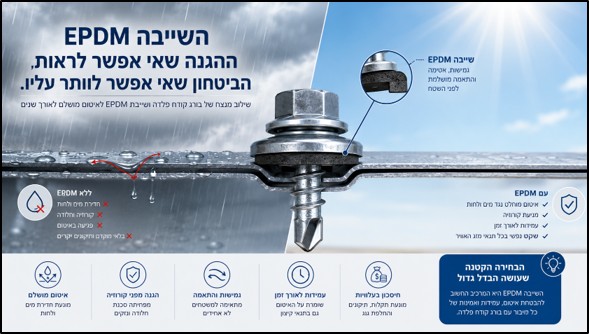
The Silent Guard: Why the EPDM Washer Is Critical When Connecting Dissimilar Metals
In construction and installation, the smallest details are sometimes what decide whether a structure lasts decades or crumbles within a few years. One of the unsung heroes here is the EPDM washer (ethylene propylene diene monomer) — the metallurgical and chemical line of defence at every point where two dissimilar metals meet.
In short
When you use a self-drilling screw of one material (say, galvanised steel) to connect a profile of another (such as aluminium or cladding sheet), a reactive contact is created between the two metals with different chemical and electrical properties. The EPDM washer is not “just rubber” — it seals hermetically against water, breaks the electrical circuit that drives galvanic corrosion, separates materials of differing pH, compensates for thermal expansion, and absorbs shock. Skipping it is a “saving” that costs dearly.
The critical engineering roles of the EPDM washer
The EPDM washer is not “just rubber”. It is an advanced synthetic polymer designed to perform several tasks at once to ensure the integrity of the structure:
- Hermetic sealing against water and moisture: EPDM is a highly elastic material. During tightening, the washer is compressed, expands and conforms precisely to the shape of the hole the screw drilled in the profile or sheet. It creates a fully sealed valve that prevents rainwater and moisture reaching the connection, thereby preventing leaks into the structure and hidden corrosion.
- Preventing galvanic (electrochemical) corrosion: when two dissimilar metals (for example stainless and aluminium) touch each other in the presence of moisture, a tiny “battery” is formed. An electric current passes between them and causes the “weaker” metal to oxidise and crumble at an accelerated rate. The EPDM washer acts as an electrical insulator that physically separates the screw head from the profile, breaks the electrical circuit and prevents the metal from decaying.
- Separating materials of different pH: industrial environments, acid rain, or even reactions between different building materials create varying levels of acidity or alkalinity (pH). Contact between materials of opposing pH accelerates chemical corrosion. EPDM rubber is especially resistant to a wide range of extreme pH levels (both acids and bases) and forms a neutral barrier that prevents a destructive chemical reaction between the screw and the substrate it is installed on.
- Compensating for thermal expansion: different metals expand and contract at different rates under heat and cold (for example, between day and night). A fully rigid fixing of the screw can cause deformation, elongation of holes or cracks in the profile. The elasticity of the EPDM allows a minimal “play” (stress absorption) that keeps the connection intact without harming the seal.
- Shock absorption: in structures exposed to strong winds, machine vibration or movement, the washer absorbs the vibrations and prevents the screw from working loose over time.
The bottom line, from engineers
Skipping the EPDM washer in a connection between dissimilar metals, or in outdoor roofing, is a “saving” that will cost dearly. It is not merely a seal against water, but the central metallurgical and chemical line of defence that prevents the steel or aluminium structure from being destroyed from within.
Common questions (FAQ) — EPDM washers and screws
What is EPDM, and how is it different from ordinary rubber?
EPDM stands for Ethylene Propylene Diene Monomer. It is a high-density synthetic rubber specifically designed to withstand extreme outdoor conditions. Unlike ordinary rubber (neoprene or simple plastic), which dries out, cracks and crumbles under solar (UV) radiation and heat, EPDM retains its elasticity for decades even when exposed to ozone, heavy heat and severe cold.
Does the EPDM washer come separately or pre-assembled on the screw?
In the construction and roofing industry, EPDM washers usually come pre-assembled on the screw as a “bonded washer”. They are assembled together with a small metal cap (such as aluminium or stainless) that presses the EPDM evenly downward and stops the rubber “escaping” sideways during tightening.
How often should EPDM washers on a cladding roof be replaced?
Quality EPDM washers are designed to last at least 15 to 20 years and more (their life often matches the life of the sheet itself). However, if a screw is removed for any reason (for example to repair the substrate), the screw and washer must be replaced with new ones. The EPDM takes a plastic (“crushed”) shape on the first fixing, and on reuse it will no longer provide a reliable seal.
What happens if you tighten the screw too hard (over-tightening)?
Over-tightening is one of the most common installation mistakes. If the screw is over-tightened, the metal cap crushes the EPDM beyond its flexibility. The rubber is pushed out past the edges of the metal, tears and loses its sealing ability. The screw should be tightened just enough for the rubber to expand slightly and touch the edges of the metal, but not spill out.
Is EPDM resistant to chemicals and oils?
EPDM excels in resistance to water, steam, weather elements, weak acids and bases (pH differences). However, it is not resistant to mineral oils, fuels or petroleum-based lubricants (these cause it to swell and be destroyed). In specific environments with constant contact with fuels or industrial oils, alternative sealing materials such as Viton or nitrile (NBR) should be used.
Sources
- ADIT self-drilling screw and bonded EPDM washer technical data.
- General engineering guidance on galvanic corrosion, sealing washers and material compatibility (EPDM vs Viton / NBR).