
What is the difference and what is better? Chemical anchor or Mechanic?
12 בJuly 2026
How to choose a self-drilling screw
12 בJuly 2026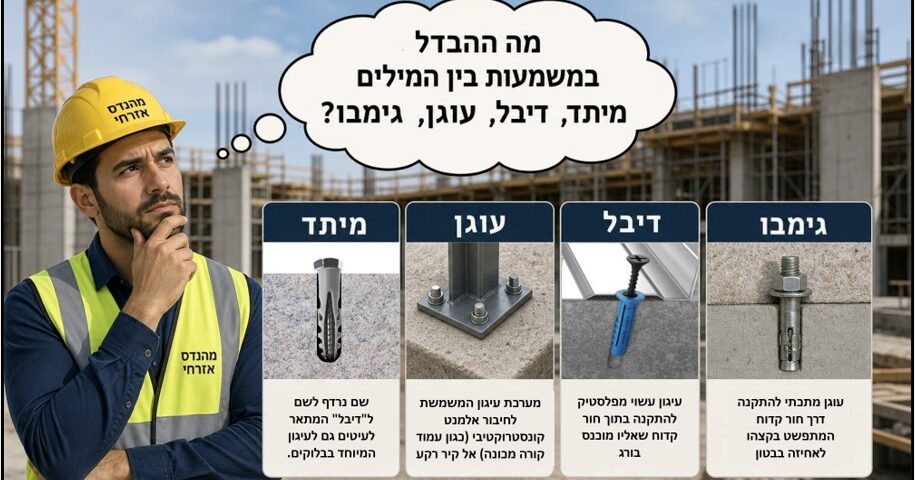
Making Sense of Fixings: The Real Difference Between a Plug, a Toggle, an Anchor and a Jumbo
Professionals — and certainly amateurs — often use the words plug, toggle, anchor and “Jumbo” as if they were synonyms. Engineering-wise and in practice, these are completely different elements that directly affect load capacity, structural safety and the type of base material. This guide from ADIT Ltd sets the terms straight and gives you the tools to choose correctly.
In short
Choosing the wrong fixing — for example, hanging a heavy load on a hollow substrate with an element meant for solid concrete — can lead to serious mechanical failure, from property damage to a risk to life. In brief: nylon plugs for light-to-medium items in block and concrete; dedicated toggles (such as BA-NY and IN-CO) for drywall; and approval-controlled engineering anchors (mechanical or chemical) for heavy, structural loads in concrete. Minimise the use of old sleeve anchors (“Jumbo”) and move to modern, safer solutions.
The three golden rules for choosing a fixing element
- Base material: is it concrete (cracked / uncracked), hollow block, Ytong (AAC) block, or a plasterboard sheet?
- Load capacity: is the applied load light (a few kilograms), medium (tens of kilograms) or heavy and structural (hundreds of kilograms and up)?
- Direction and type of stress: is it a shear stress (a load vertical to the wall, like a TV) or a pull-out/tension stress (a load pulling the anchor out, like a ceiling hang)?
1. Plug (Dibel) — the classic solution for light loads
The plug is the most familiar and common element in light domestic and industrial use. Engineering-wise, it is a sleeve (a plastic housing) inserted into a pre-drilled cylindrical hole. When a metal screw is driven into it, the screw forces the plug’s walls outward, creating pressure and mechanical expansion that presses on the walls of the hole (friction).
Correcting a common field mistake: many people buy cheap plugs made of polyethylene (simple plastic). These tend to dry out, deform, lose flexibility over the years and shear easily. Professionals work exclusively with plugs made of quality nylon (Polyamide PA6), such as ADIT’s TN4S universal plug range. Nylon retains its mechanical properties for decades, does not dry out, and withstands extreme temperatures.
- Suitable substrates: blocks, concrete, solid bricks, and in dedicated models plasterboard too.
- Load range: light to medium (usually between 10 kg and 80 kg, depending on the plug diameter and block type).
- Common uses: hanging pictures, light shelves, bathroom accessories, small light fittings and frames.
2. Toggle (Meitad) — the official term and its practical use
There is a big misunderstanding in the field rooted in linguistic confusion. Officially (per the Academy of the Hebrew Language and the Standards Institution of Israel), the word meitad is the general Hebrew name for all types of plugs and mechanical anchors (including plastic plugs). But in professional language and among contractors in Israel, the term “toggle” has come to be identified mainly with two specific product types:
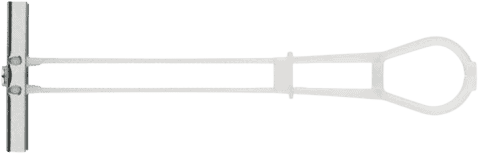
- Toggles for plasterboard and cavities: mechanical fixing solutions more complex than an ordinary plug, based on collapsing, spreading or opening “wings” behind the plasterboard to spread the load over a wide area (because the gypsum itself is brittle and cannot hold a local expansion pressure). Notable examples are the IN-CO steel toggle and the BA-NY collapsing nylon toggle.
- Frame anchors: extra-long plugs that come with an integral screw (for installation through the connected element), used to fix door frames, wide timber structures or profiles to block walls.
- Suitable substrates: plasterboard sheets, cement-board sheets, hollow blocks and lath-and-plaster ceilings.
- Load range: medium (up to about 90 kg in double plasterboard using a structural BA-NY toggle).
- Common uses: hanging TV arms on plasterboard walls, kitchen cabinets, door frames and plasterboard structures.
3. Anchor (Ogen) — heavy-duty anchors for heavy structural loads
When you move into civil engineering, frameworks and structural work, plastic plugs leave the picture and give way to anchors. An anchor is an element made entirely of metal (galvanised steel, hot-dip galvanised steel or stainless) or based on a chemical injection system (structural resin / adhesive), designed to carry enormous loads — from hundreds of kilograms to tens of tonnes per single anchor.
Anchors divide into two main families:
- Mechanical anchors (such as the wedge anchor / concrete screw): work on a principle of extreme friction or direct threading. A leading example is the MTP-X wedge anchor, which expands inside the hole via a controlled tightening torque, or the thread-cutting concrete screws of the TFE series.
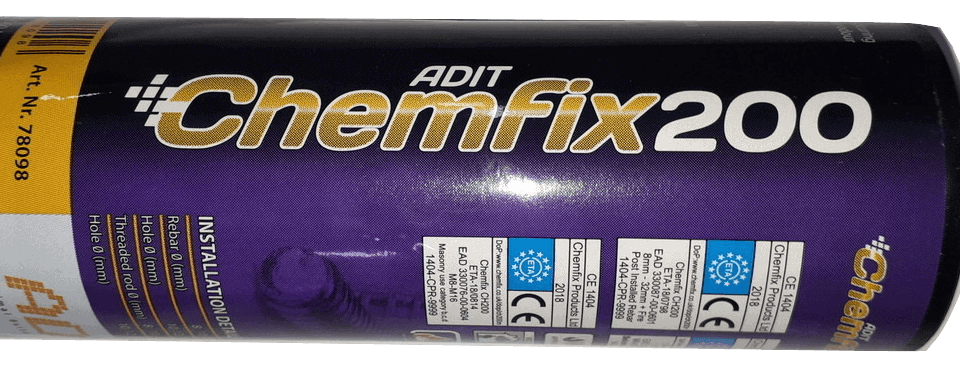
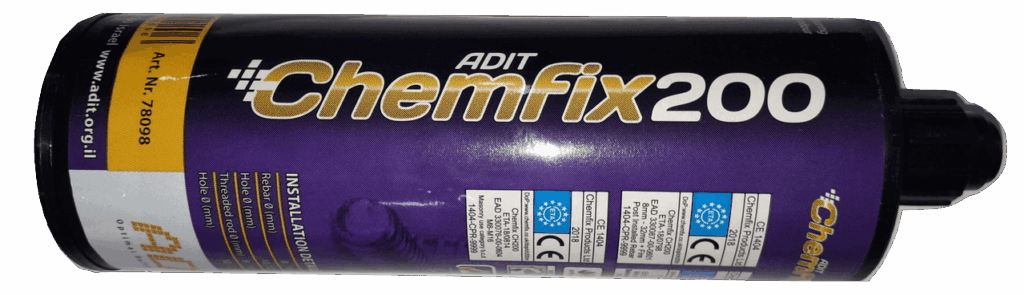
- Chemical anchors: based on injecting a two-part adhesive (such as Chemfix 200) into the hole and inserting a threaded rod. The adhesive cures and creates a perfect bond between the rod and the concrete with no internal splaying stresses, giving it an engineering advantage when working close to edges.
- Suitable substrates: cast concrete (cracked and uncracked), hard natural stone, and in some cases solid blocks.
- Load range: very heavy (hundreds of kilograms up to tens of tonnes).
- Common uses: anchoring steel structures, industrial machinery, lighting columns, safety railings, lifting cranes and frame connections.
4. Jumbo (Sleeve Anchor) — the familiar slang and the engineering truth
Correcting a common engineering mistake: there is no real engineering product called a “Jumbo anchor”. The word “Jumbo” is old Israeli commercial slang that took root in the field for a sleeve anchor. This anchor consists of a metal bolt, a cone sharpened at its tip, and a thin metal sleeve wrapping the bolt. As the bolt is tightened, the cone is drawn inward and forces the metal sleeve to expand and open inside the hole.
A serious engineering warning about the “Jumbo anchor”
Because of their low price, Jumbo anchors are very popular, but they carry two critical limitations that many installers dangerously ignore:
- Forbidden in hollow blocks: a Jumbo anchor creates a concentrated, enormous splaying pressure. Installed in a hollow block (a common Block 8 or Block 20), the sleeve simply bursts the inner wall of the block. The anchor will feel temporarily “gripped”, but under a light load it will pull out together with fragments of the block!
- Unsuitable for cracked concrete or dynamic loads: simple Jumbo anchors have no European approval (ETA) for cracked concrete. In an earthquake, the development of a micro-crack in the concrete, or a dynamic load, the anchor immediately loses its grip.
The modern alternative: advanced construction engineering has completely replaced the outdated Jumbo anchors with far more advanced, safe products, such as direct-thread concrete screws (TFE) or structural wedge anchors (MTP-X) approved for cracked substrates and earthquakes.
Summary comparison table — understand it in a second
| Comparison parameter | Plug | Toggle (drywall / cavities) | Structural anchor | Sleeve anchor (“Jumbo”) |
|---|---|---|---|---|
| Structural material | Quality nylon (PA6) or plastic | Collapsing metal or expanding nylon | Reinforced steel or chemical resin | Galvanised steel (bolt + thin sleeve) |
| Primary substrate | Blocks, bricks, solid concrete | Plasterboard, hollow blocks | Cracked and uncracked concrete, stone | Uncracked concrete only! |
| Gripping mechanism | Expansion and friction in the hole | Collapse or wing-spread behind | Controlled friction, threading or bonding | Metal-sleeve expansion by a cone |
| Load class | Light to medium (10–80 kg) | Medium (20–90 kg) | Very heavy (hundreds of kg to tonnes) | Medium to heavy (solid concrete only) |
| Removable? | Yes (the screw comes out, the plug stays) | Depends on model (IN-CO stays fixed) | Concrete screws yes, wedge anchors no | Partial and very awkward |
Common questions (FAQ) — practical anchoring engineering
Q: I want to hang an adjustable arm for a 65-inch TV on a hollow block wall. What is the most correct thing to use?
A: By no means a Jumbo anchor! An adjustable arm creates a strong pull-out stress (moment) on the wall every time you move the screen. The most correct solution for a hollow block is a quality universal nylon plug such as the TN4S in 10 mm or 12 mm diameter with a matching screw of suitable length, or moving to chemical anchoring with a mesh sleeve dedicated to hollow blocks, which creates an especially strong internal adhesive mass.
Q: What is the difference between a simple coloured plastic plug and a nylon plug?
A: The difference is in service life and safety. Cheap plastic (polyethylene) quickly loses its flexibility, dries out from temperature changes and shears inside the wall under a shear stress. A nylon plug (Polyamide PA6) is a material with exceptional mechanical memory — flexible enough to expand or collapse perfectly, rigid enough not to shear, and durable for decades without drying out.
Q: Is it permitted to use a wedge anchor (“cone anchor”) inside a block wall?
A: Absolutely not. A wedge anchor (such as the MTH or MTP-X) is designed to work only in cast, solid concrete. Its mechanism requires a high tightening torque that causes the small steel clip at its tip to climb a cone and apply an enormous point pressure. In a hollow block or Ytong, the anchor will simply crush the substrate around it and never reach tightening, or will pull the inside of the block out.
Q: Why are modern concrete screws now replacing sleeve anchors (Jumbo)?
A: Concrete screws (such as ADIT’s TFE series) offer three critical engineering advantages: first, they create no splaying and expansion stresses inside the concrete, so they allow installation very close to the edge of the element or between adjacent bolts. Second, their installation speed is several times faster (drill and drive directly with an impact wrench). Third, they can be fully and cleanly removed, unlike the Jumbo, which always leaves rusty metal remnants stuck in the wall.
Q: When must I switch to chemical anchoring (structural adhesive) instead of a mechanical metal anchor?
A: Switching to chemical anchoring (such as Chemfix 200) is needed in three main situations: 1. When the edge distances are very small (for example, anchoring close to the edge of a concrete pour or a roof beam, where a mechanical anchor would burst the concrete corner). 2. When the load is dynamic, unusual and very extreme. 3. When “rebar post-installation” is required — that is, connecting a new steel reinforcement element to existing concrete as a continuous extension of the structure’s frame.
Summary and engineering recommendation
Matching the fixing element to the substrate is not a recommendation — it is an unequivocal safety and engineering requirement. Remember the simple rule: nylon plugs for light and medium items in blocks and concrete; dedicated toggles (such as BA-NY and IN-CO) for plasterboard walls; and approval-controlled engineering anchors (mechanical or chemical) for heavy, structural loads in concrete. Minimise the use of outdated sleeve anchors (“Jumbo”) as far as possible and move to modern, safer solutions.
Planning a complex anchoring system, or unsure about anchor capacity on your project? The engineers and specialists at Adit Ltd are available to match the most precise, compliant and safe solution to your engineering requirements.
Sources
- ADIT TN4S plug, BA-NY and IN-CO toggle, MTH / MTP-X wedge anchor, TFE concrete screw and Chemfix 200 technical data.
- General engineering guidance on fixing selection by base material, load and stress direction.