

Why You Must Not Install a Chemical Anchor in Young Concrete
12 בJuly 2026
ADIT SLPT vs Hilti HSL4: Which Dynamic Anchor Is Better?
12 בJuly 2026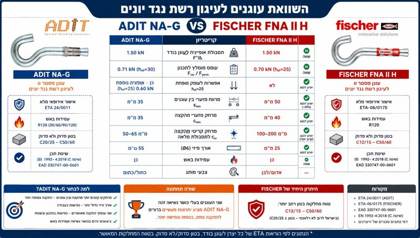
Anchoring for Anti-Pigeon Netting: ADIT NA-G or Fischer FNA II H?
Two nail-in anchors, one European approval standard. A direct, data-based comparison of the ADIT NA-G and the Fischer FNA II 6×25 H for fixing netting and other non-structural systems to concrete.
In short
The ADIT NA-G and the Fischer FNA II 6×25 H (part no. 44126) are galvanised steel nail anchors with a hook-shaped head, for non-structural (redundant) fixings in cracked and uncracked concrete. They work on the same principle — controlled expansion by a clip that opens as the nail is driven — both are push-through installations set with a hammer, no torque wrench required. Both are approved under the same EAD, so the comparison is direct and fair. On load and fire performance they are effectively identical; the practical differences favour the NA-G.
The two anchors
Both are pre-positioned (push-through) fasteners: you drill, push the anchor through the fixture into the hole, and drive the nail home with a hammer. The nail forces a clip to expand and grip the concrete. Neither needs a torque wrench. To decide which is better we compare them on two tracks — which approval covers them and under what conditions, and what characteristic performance each one declares. Because both sit under the same EAD, the comparison is like-for-like.
Approvals side by side
Both anchors were approved under the same underlying assessment document: EAD 330747-00-0601, “Fasteners for use in concrete for redundant non-structural systems”. That is the correct document for multiple non-structural fixings, not for primary structural applications — so the two products are genuinely in the same class and can be compared directly.
| Parameter | ADIT NA-G | Fischer FNA II 6×25 H |
|---|---|---|
| ETA number | ETA 24/0011 | ETA-06/0175 |
| Issuing body (TAB) | IETcc, Spain | DIBt, Germany |
| Date of issue | 06/05/2025 | 02/03/2021 |
| Underlying EAD | 330747-00-0601 — identical for both | |
| Design method, EN 1992-4:2018 | Method C — ETA 24/0011, cl. 2.2.10, Annex C | Method C — ETA-06/0175, Annex B1 |
| Cracked / uncracked concrete | yes / yes | yes / yes |
| Approved concrete classes | C20/25 – C50/60 | C12/15 – C50/60 |
| Fire resistance | R120 (30/60/90/120 min), Annex C3 | R120 |
| Reaction to fire | A1 to EN 13501-1 | A1 to EN 13501-1 |
| Material and coating | carbon steel, Zn ≥ 5 μm (ISO 4042); sherardised clamp ≥ 40 μm (EN 13811), Annex A1 | galvanised steel (gvz) |
| Installation method | pre-positioned, hammer-set, no torque | pre-positioned, hammer-set, no torque |
| Approved environmental conditions | dry interior, −40°C to +80°C, Annex B1 | dry interior (with hef ≥ 25 mm), ETA-06/0175 Annex B1 |
| Intended working life | 50 years | 50 years |
What the approvals comparison shows. Both anchors were approved under the same EAD, both are intended for redundant non-structural systems in concrete, both are designed to EN 1992-4:2018 Method C, and both are rated R120 for fire resistance and A1 for reaction to fire. The only difference in the approval envelope is that Fischer also covers C12/15 concrete, while Adit is limited to C20/25 and above. On Israeli projects, where the concrete is normally C25/30 or better, that difference has no practical effect. On standards, the two are fully equivalent.
Installation parameters
The comparison is made for the Ø6 hook anchor at the minimum effective depth the two manufacturers have in common — hef = 25 mm — so that resistance is measured at the same embedment. For the Adit anchor the standard depth of 30 mm is also shown.
| Parameter | ADIT NA-G hef = 25 | ADIT NA-G hef = 30 | Fischer FNA II hef = 25 |
|---|---|---|---|
| Nominal drill diameter d0 | 6 mm | 6 mm | 6 mm |
| Drilling depth h1 | 35 mm | 40 mm | 31 mm |
| Overall embedment hnom | 30 mm | 35 mm | ≈ 26 mm |
| Minimum member thickness hmin | 80 mm | 80 mm | 80 mm |
| Minimum spacing smin | 35 mm (c ≥ 50) | 35 mm (c ≥ 50) | 50 mm |
| Minimum edge distance cmin | 35 mm (s ≥ 80) | 35 mm (s ≥ 80) | 40 mm |
| Critical edge distance ccr for full resistance | 50 mm | 65 mm | 100–200 mm (load dependent) |
The real difference is in the spacings. The Adit ETA permits smin = 35 mm and cmin = 35 mm — some 30% less than the Fischer ETA allows (50 mm and 40 mm). In practice that means NA-G anchors can be set closer to a concrete edge and closer to each other, which on narrow ledges and parapets is often what decides whether a netting layout is buildable at all.
A point the Fischer datasheet does not make clear
Before the numbers, one thing worth stating plainly. In ETA-06/0175 (Table C1.1, “Characteristic resistance of a fixing point”) there are columns for FNA II 6×25/…, FNA II 6×25 M6/M8, FNA II 6×25 OE, FNA II 6×30 OE, FNA II 6×30/… and FNA II 6×30 M6/M8.
The FNA II 6×25 H (part number 44126) does not appear as a column of its own. The H and the OE (eyelet) are two bent heads installed by the same pre-positioned method, and Fischer’s own website groups them on a single product page, “Nail anchor FNA II-H / FNA II-OE”. The H resistance values are therefore taken from the OE column of the ETA.
Characteristic resistance — single anchor, all load directions
| Size / model | hef | F0Rk [kN] C20/25 – C50/60 | Source |
|---|---|---|---|
| ADIT NA-G Ø6×55 (reduced depth) | 25 mm | 1.50 | ETA 24/0011, Table C2 |
| ADIT NA-G Ø6×55 (standard depth) | 30 mm | 1.50 | ETA 24/0011, Table C2 |
| Fischer FNA II 6×25 H (= OE) | 25 mm | 1.50 | ETA-06/0175, Table C1.1 |
The characteristic resistance is identical. Both anchors give F0Rk = 1.50 kN under exactly the same conditions — single anchor, concrete C20/25 to C50/60, at the critical edge distance. The difference between a hook head (H/G) and an eyelet head (OE/R) does not change that value for either manufacturer.
1. Load — recommended (permissible) load Frec
Both manufacturers publish a “maximum recommended load” that already embeds the safety factors required by EN 1992-4:2018 — the material factor γM and a load factor γL = 1.4.
A note on comparing fairly. The Fischer FNA II 6×25 H is made in one effective depth only, hef = 25 mm. The Adit NA-G Ø6×55 is longer and is approved for two setting depths: 30 mm (standard) and 25 mm (reduced, as an option where the concrete thickness does not allow more). A fair comparison is therefore made at each product’s own standard setting depth.
Compared at each product’s own standard installation depth:
| Anchor / condition | Frec [kN] | Reference |
|---|---|---|
| ADIT NA-G — standard (hef = 30) | 0.71 | ADIT datasheet §5.3 |
| ADIT NA-G — reduced (hef = 25, optional) | 0.60 | ADIT datasheet |
| Fischer FNA II (hef = 25, single model) | 0.70 | Fischer datasheet |
At each product’s standard depth, ADIT gives 0.71 kN against Fischer’s 0.70 kN — a 0.01 kN difference, within the rounding of the safety factor and not meaningful. The characteristic resistance F0Rk is 1.50 kN for both.
2. Fire performance — F0Rk,fi
The ADIT ETA states characteristic fire resistance for four exposure times. Fischer’s ETA presents it as a resistance level, but both anchors are rated R120.
| Fire exposure | ADIT NA-G — F0Rk,fi [kN] |
|---|---|
| 30 minutes | 0.27 |
| 60 minutes | 0.24 |
| 90 minutes | 0.19 |
| 120 minutes | 0.14 |
Source: ETA 24/0011, Appendix C3. For Fischer, see ETA-06/0175, Appendix C2.
3. Which anchor is better?
| Criterion | ADIT NA-G | Fischer FNA II 6×25 H | Advantage |
|---|---|---|---|
| Approval (EAD, EN 1992-4 method, cracked concrete, R120, A1) | Yes | Yes | Equal |
| Concrete class | C20/25 and up | from C12/15 | Fischer (not relevant in Israel) |
| Characteristic resistance F0Rk | 1.50 kN | 1.50 kN | Equal |
| Recommended load Frec (standard depth) | 0.71 kN | 0.70 kN | ADIT (marginal) |
| Edge & spacing (smin, cmin, ccr) | ~30% smaller; ccr 2–4× smaller | Larger | ADIT |
| Reduced-depth option (hef = 25 mm) | available — 0.60 kN | not applicable (no longer model) | ADIT (flexibility) |
| Overall length / fixture thickness | 55 mm | 25 mm | ADIT |
Bottom line
In raw load capacity the two anchors are effectively equal — the same F0Rk of 1.50 kN, the same recommended design load (0.71 vs 0.70 kN, within the safety-factor limits), the same EAD, the same EN 1992-4:2018 method, and the same R120 fire rating. If a Fischer FNA II is called out in a specification, it can be substituted by the ADIT NA-G with no loss of load capacity. The NA-G’s practical advantages then make it the preferred choice:
- Smaller edge and spacing distances — smin and cmin about 30% smaller and ccr 2–4× smaller. This matters a great deal in crowded layouts, close to edges, and around reinforcement.
- Greater physical length (55 mm vs 25 mm) — allows a thicker fixture and easier push-through installation, and leaves room to work when the concrete or render thickness is not known exactly in advance.
- Two approved setting depths — the NA-G is approved at a standard depth of 30 mm with Frec = 0.71 kN, and also at a reduced depth of 25 mm with Frec = 0.60 kN as an alternative. The Fischer FNA II 6×25 H is locked to 25 mm, which leaves less flexibility on site.
Fischer’s only edge — approval down to C12/15 concrete — does not come into play on Israeli projects, where concrete is C25/30 or higher. In practice the ADIT NA-G is the better choice: identical in approved load capacity, more flexible in installation parameters and setting depths, and with no compromise on fire performance or on full European approval.
Sources
- ETA 24/0011 — Instituto de Ciencias de la Construcción Eduardo Torroja (IETcc), 06/05/2025 — NA Nail Anchor (ADIT / Index)
- ETA-06/0175 — Deutsches Institut für Bautechnik (DIBt), 02/03/2021 — Fischer Nail Anchor FNA II
- EAD 330747-00-0601 — “Fasteners for use in concrete for redundant non-structural systems”, 5/2018
- EN 1992-4:2018 — Design of fastenings for use in concrete
- ADIT NA technical datasheet (FT NA-es, Rev 0, 15/01/24)
- Fischer FNA II loads (LT_FNA-II_EN_T1, 05/2021)