

ADIT NA-G vs Fischer FNA II H — Nail Anchor Comparison
12 בJuly 2026
Is the Hilti Dynamic Set Engineering-Justified — or Just Marketing?
12 בJuly 2026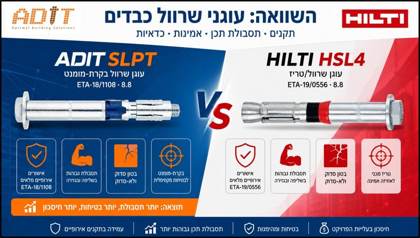
ADIT SLPT vs Hilti HSL4 — Heavy Sleeve Anchors: Standards and Design Resistance
A full comparison of two heavy torque-controlled sleeve anchors: their standards and approvals, and their design resistance in tension and shear — in both cracked and uncracked concrete — with the percentage differences and the economic conclusion.
In short
The two anchors belong to exactly the same family — heavy torque-controlled sleeve/wedge expansion anchors in galvanised grade-8.8 steel, force-expanded (with the ability to re-expand under load) and approved for cracked concrete under ETA Option 1. This comparison is built on the manufacturers’ own official design-resistance values (NRd, VRd), at the same concrete grade (C20/25, the Israeli B30) and the same embedment depths.
- Tension, uncracked concrete — near-complete technical equivalence (≈0% across most diameters).
- Tension, cracked concrete — the SLPT has a real edge at the small diameters: M8 +33%, M10 +26%, M12 +10%; equivalent at M16–M20.
- Shear — equivalent: SLPT slightly higher at the small diameters, HSL4 higher at M20.
- Approvals — identical core (cracked concrete, seismic C1/C2, fire, shock). The HSL4 carries a wider approval envelope for special uses (fatigue, nuclear, ICC-ES, variable depth).
- Price — the SLPT is roughly 30% cheaper.
1. Standards and approvals
Both anchors are torque-controlled expansion anchors approved to the same core envelope. The difference is in the range of special approvals, where the HSL4 goes further, and in the diameter range, where the SLPT starts one size smaller.
| Characteristic | ADIT SLPT | Hilti HSL4 |
|---|---|---|
| Anchor type | Torque-controlled expansion sleeve | Torque-controlled expansion sleeve/wedge |
| ETA | ETA-18/1108 | ETA-19/0556 |
| EAD | 330232-02-0601 | 330232-00/02-0601 |
| Diameter range | M6–M20 | M8–M24 |
| Uncracked / cracked (Option 1) | ✓ / ✓ | ✓ / ✓ |
| Concrete grades | C20/25–C50/60 | C20/25–C50/60 |
| Seismic | C1 / C2 | C1 / C2 |
| Fire resistance | ✓ R120 | ✓ |
| Shock loads | ✓ | ✓ |
| Fatigue | — | ✓ (ETA-19/0858) |
| Nuclear (ACI 349) | — | ✓ |
| ICC-ES (ESR) | — | ✓ ESR-4386 |
| VdS (sprinklers) | ✓ M8–M20 | ✓ |
| Variable embedment depth | — (fixed depth per diameter) | ✓ (3 settings) |
| Dry / wet / flooded drilling | ✓ / ✓ / ✓ | ✓ (also diamond / hollow) |
| Steel / galvanising | 8.8 · Zn 5–8 µm | 8.8 · Zn ≥5 µm |
| Design service life | 50 years | 50 years |
Both anchors cover the core engineering envelope needed for structural anchoring: cracked concrete, seismic C1/C2, fire and shock. The HSL4 adds a broader set of special approvals — dynamic fatigue, nuclear qualification (ACI 349), the American ICC-ES listing, and variable embedment depth. The SLPT, in turn, offers a diameter range that starts at M6 (the HSL4 starts at M8).
2. Tension design resistance — uncracked concrete
NRd [kN] · C20/25 · single anchor, no edge/spacing effects · steel 8.8 · difference relative to HSL4
| Diameter | hef SLPT / HSL4 [mm] | ADIT SLPT | Hilti HSL4 | Difference |
|---|---|---|---|---|
| M8 | 60 / 60 | 13.3 | 15.2 | −12% |
| M10 | 70 / 70 | 19.2 | 19.2 | ≈0% |
| M12 | 85 / 80 | 25.7 | 23.5 | +9% |
| M16 | 100 / 100 | 32.8 | 32.8 | 0% |
| M20 | 125 / 125 | 45.8 | 45.8 | ≈0% |
In uncracked concrete the two anchors are almost perfectly equivalent — the concrete cone governs both at the same embedment depths. The small gap at M8 (favouring the HSL4) and at M12 (favouring the SLPT) comes from minor differences in pull-out capacity and embedment depth.
3. Tension design resistance — cracked concrete
NRd [kN] · C20/25 · single anchor · steel 8.8 · difference relative to HSL4
| Diameter | hef SLPT / HSL4 [mm] | ADIT SLPT | Hilti HSL4 | Difference |
|---|---|---|---|---|
| M8 | 60 / 60 | 10.7 | 8.0 | +33% |
| M10 | 70 / 70 | 13.5 | 10.7 | +26% |
| M12 | 85 / 80 | 18.0 | 16.4 | +10% |
| M16 | 100 / 100 | 23.0 | 23.0 | 0% |
| M20 | 125 / 125 | 32.1 | 32.1 | ≈0% |
Here the SLPT’s advantage at the small diameters stands out: from M8 to M12 its tension design resistance is 10–33% higher. The engineering reason is the governing failure mode — in cracked concrete the SLPT is limited by the concrete cone (the higher value), whereas the HSL4 is limited by pull-out failure (NRk,pull) at a lower value. At the large diameters (M16–M20) both anchors are cone-governed and therefore identical.
4. Shear design resistance
VRd [kN] · C20/25 · single anchor · steel 8.8 (adequate fixture thickness) · difference relative to HSL4
| Diameter | ADIT SLPT | Hilti HSL4 | Difference |
|---|---|---|---|
| M8 | 26.4 | 24.9 | +6% |
| M10 | 49.8 | 48.4 | +3% |
| M12 | 60.1 | 63.4 | −5% |
| M16 | 89.0 | 91.8 | −3% |
| M20 | 113.4 | 126.8 | −11% |
In shear the picture is balanced: the SLPT is slightly higher at the small diameters, and the HSL4 — with its high-strength shear sleeves — is the stronger of the two at M20 (+11%). For most applications the difference is negligible.
Reference case — M10, tension
Uncracked concrete: NRd 19.2 kN for both anchors (equal).
Cracked concrete: NRd 13.5 kN for the ADIT SLPT versus 10.7 kN for the Hilti HSL4 — a +26% advantage for the SLPT.
Note on embedment depth: the HSL4 can be set at a variable embedment depth (3 settings). The comparison here is made at the minimum depth (hef,1), which matches the SLPT’s fixed installation depth. At the deeper settings the HSL4 can reach a higher resistance, but at the cost of a deeper hole. At an equal installation depth the picture is the one shown in the tables above.
Conclusion
Engineering-wise, the ADIT SLPT and the Hilti HSL4 are equivalent — and in cracked concrete the SLPT even holds an advantage. In tension in uncracked concrete and in shear the values are almost identical; in tension in cracked concrete the SLPT’s resistance is 10–33% higher across the M8–M12 range. Both anchors carry the same core approvals: ETA Option 1 for cracked concrete, seismic C1/C2, fire and shock.
- For the overwhelming majority of structural anchoring applications (cracked concrete, seismic C1/C2, fire) the SLPT is the right choice: equivalent-or-better performance at roughly a 30% saving.
- Reserve the HSL4 for projects that specifically require dynamic-fatigue approval, nuclear qualification (ACI 349), an ICC-ES listing, or the flexibility of a variable embedment depth.
- At the small diameters in cracked concrete (M8–M12) the SLPT is not only cheaper but also stronger in tension.
Sources
- ETA-18/1108 — ADIT SLPT torque-controlled sleeve anchor.
- ETA-19/0556 — Hilti HSL4 torque-controlled expansion anchor (with ETA-19/0858 for fatigue; ICC-ES ESR-4386).
- EAD 330232-00/02-0601 — Metal anchors for use in concrete (torque-controlled expansion anchors).
- EN 1992-4:2018 — Design of fastenings for use in concrete.
Data sources and basis of comparison: ADIT / Index SLPT — technical datasheet FT SL-en Rev.5 and ETA-18/1108 (EAD 330232-02-0601), design resistances in C20/25. Hilti HSL4 — HSL4 technical datasheet and ETA-19/0556 (fatigue: ETA-19/0858), design resistances in C20/25 at depth hef,1. All values are design resistances (NRd / VRd) for a single anchor without edge or spacing effects, grade-8.8 steel, at the same concrete grade (C20/25 = Israeli B30) and at matching embedment depths. The price figure (~30%) is an ADIT Ltd estimate and may change. The figures are given for engineering illustration and comparison only; for a binding design, carry out a project-specific calculation to the current ETA under the responsibility of a qualified engineer. Trade names belong to their respective owners.