

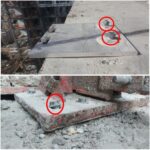
Crooked anchors: common questions about incorrectly installed anchors
12 בJuly 2026
A rock anchor to fix DYWIDAG bars? Think again
12 בJuly 2026Crooked anchors: common questions about incorrectly installed anchors
12 בJuly 2026A rock anchor to fix DYWIDAG bars? Think again
12 בJuly 2026Cracked Concrete and Anchoring — Frequently Asked Questions
The full guide: anchoring and cracked concrete, in a question-and-answer format. What actually counts as “cracked concrete”, when it matters, and how to choose the right anchor for it.
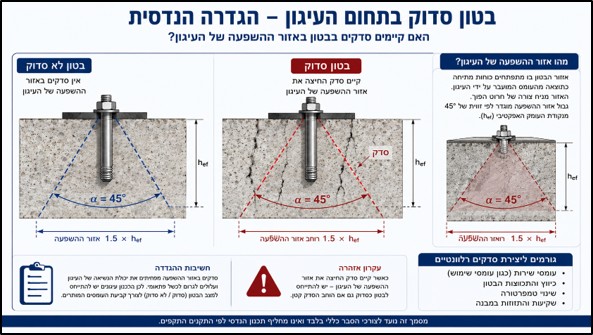
Deciding whether the concrete counts as cracked is the first question in any anchor calculation.
In short
“Cracked concrete” does not mean concrete with visible cracks, old damage, or young concrete — it means concrete in a tension-stress zone where a new crack may appear, or an old one widen, at the anchor location. Most ceilings, suspended floors and areas subject to dynamic and seismic loads are defined as cracked concrete. Without an explicit instruction from the structural engineer, the safe choice is a cracked-concrete-rated wedge anchor such as the ADIT MTP-X, which carries the strict European ETA seismic approval in categories C1 and C2 — and in Israel every structural design requires C2.
The full guide — anchoring and cracked concrete (FAQ)
Is concrete in tension cracked concrete?
Not necessarily. Tension raises the chance of a crack appearing, but defining concrete as cracked depends on the probability of a significant crack appearing at the anchor location after the anchor is installed.
Is old, damaged concrete cracked concrete?
No. Old, damaged concrete is not covered by the European standards, and although it can definitely cause a significant drop in the capacity of an anchor connected to it, it has nothing to do with concrete defined as cracked.
Is cracked concrete concrete with cracks?
No. Concrete with cracks visible to the eye is not “non-standard” concrete, and the anchor’s function within it is not covered by the European standards — pull-out tests are recommended to assess an anchor’s capacity in it. But concrete with very fine cracks can be a factor that raises the chance of the concrete being cracked, because cracked concrete is concrete in which a new crack appears, or an old crack widens, at the anchor location.
Is concrete in a ceiling cracked?
Not necessarily. Concrete in a ceiling, far from any support, is in tension — a factor that raises the risk of the concrete being cracked. But in an area of a ceiling near a support point, it may not be — there the concrete is usually in compression. It should be added that the length of the anchor relative to the thickness of the concrete also has an effect: concrete that is in tension on one face is usually in compression on the opposite face, so the zone in which the connection sits, and the type of anchor, both matter.
Is concrete in a floor cracked?
Not necessarily. See the answer about the ceiling — a floor can also be in tension.
Is young concrete (under 28 days) cracked concrete?
No, there is no connection. Concrete before 28 days is not an approved substrate for anchor installation under the European standard.
Is Spancrete (prestressed concrete) cracked concrete?
No. Spancrete is uncracked concrete, but it is better to use anchoring designed for Spancrete within it.
Is an anchor rated for cracked concrete good for cracked concrete?
Not necessarily. A rated anchor is one that was tested for cracked concrete. That is no evidence of the bolt’s quality for cracked concrete — only that its capacity for cracked concrete was measured.
Is concrete in compression uncracked?
Yes, with an exception, because concrete in compression generally does not allow the existence of a deep crack that could affect the anchor’s function.
Can the definition of concrete as cracked change according to the anchor type?
Yes, in theory. After a wedge anchor (cone anchor) is installed, its wings create a tension zone at the anchor tip. This means that even when no tension is applied to the anchor, the area where it is installed is in tension. By contrast, a concrete screw (such as the ADIT TFE) or a chemical anchor (such as Adit Chemfix100) apply tension in the concrete only when tension is applied to them. Although the logic is clear — it is better not to use a wedge anchor in terms of the chance of a crack appearing — we do not make it a rule. Under the European standards, you may not install an uncracked-concrete anchor in cracked concrete. But since the definition of cracked concrete is probabilistic, there are two cases where it seemed right to us to ignore the cracked state: (1) if the load applied to the anchor is only in shear; (2) if the anchor’s uncracked-concrete pull-out capacity is 3 times higher than required — no anchor has a cracked-concrete capacity lower than one-third of its uncracked-concrete capacity.
Can you test an anchor’s cracked-concrete capacity in the field?
You cannot, because the case described in the European standard — an anchor installed in a 0.3 mm crack along its whole length — is an almost impossible situation in a standard building. This also explains why the writer of these lines thinks there are very few real cases of cracked concrete.
Who gains and who loses from defining the concrete as cracked?
If the concrete is not really cracked, the supplier gains because the cost of the item is multiplied by 3, the contractor loses for the same reasons, and the designer loses because it can cause unnecessary complexity in the detail. In the rare cases where the concrete really is cracked, everyone certainly gains.
How do I know if I need a “cracked-concrete wedge anchor” or a regular one?
Cracked concrete does not mean the concrete is “broken” to the naked eye, but that it is in a tension-stress zone that can create micro-cracks around the anchor. Under the European standard and the new Israeli standard (T”I), most ceilings, suspended floors and areas subject to dynamic and seismic loads are defined as cracked concrete. If there is no explicit instruction otherwise from the structural engineer, the safe and correct choice is to always use a cracked-concrete wedge anchor (such as the MTP-X) for a maximum safety factor.
When is it better to use a wedge anchor instead of a chemical anchor?
The huge advantage of a wedge anchor (cone anchor) is work speed: the moment you have drilled the hole and tightened the nut to the correct torque, the anchor is immediately ready to carry a full load! With a chemical anchor you must wait hours for the material to cure. So when it is a dry, clean installation on firm, stable concrete with a tight schedule, the wedge anchor is the most economical and efficient solution.
Is it permitted to install a wedge anchor in a block wall (hollow or Ytong)?
Absolutely not! A cone/wedge anchor creates an enormous expansion pressure on the walls of the drilled hole. Installing it in a hollow block, black block or lightweight concrete (Ytong) will cause the block to burst and break from within, and the anchor will pull out easily. For blocks, use a suitable plastic plug (such as the ADIT GX-L), dedicated block Jumbo anchors, or a chemical anchor (such as Adit Chemfix100) with a mesh sleeve.
Must the drilled hole be cleaned before inserting a wedge anchor?
Yes! Although a mechanical anchor is a little more forgiving of the presence of dust than a chemical anchor, an accumulation of drilling dust at the bottom of the hole will prevent the wedge anchor from reaching the required installation depth. In addition, dust can interfere with the correct opening of the expansion clip against the concrete walls. It is always recommended to vacuum or blow out the dust before inserting the anchor.
Is the MTP-X wedge anchor earthquake-resistant?
Yes. The MTP-X model holds the strictest engineering approvals in Europe (ETA), including a seismic (earthquake) approval in categories C1 and C2. This figure is extremely important for public engineering projects and infrastructure structures across Israel. It is important to remember that in Israel every structural design requires a C2 classification, so there is a clear preference for these solutions over other products, such as anchors based on epoxy-acrylate resins, which are usually intended for light-to-medium loads and often come with a C1 standard only.
Sources
- ADIT MTP-X wedge anchor ETA and seismic (C1/C2) approval data; TFE concrete screw and Chemfix100 data.
- European anchor design standards and the Israeli standard (T”I) on cracked vs uncracked concrete.