

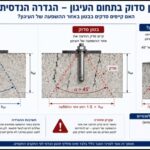
Cracked concrete and anchoring: frequently asked questions
12 בJuly 2026
How to make a steel connection to steel?
12 בJuly 2026Cracked concrete and anchoring: frequently asked questions
12 בJuly 2026How to make a steel connection to steel?
12 בJuly 2026A Rock Anchor to Connect a DYWIDAG Bar? Think Again!
It is common practice to use a rock anchor to connect a DYWIDAG bar to bored piles in situations with single-sided formwork. But is it really the cheapest, most efficient and safest solution?
In short
A rock anchor has no technical specification defining its capacity, and the recommended pull-out test is rarely done in practice. In a real field test, a rock anchor held only 5.4 tonnes, while an ADIT MES held 14 tonnes. The rock anchor’s low sticker price (about 8 ₪) is misleading — once the deep 32 mm drilling, the bit cost and the labour are counted, the real cost reaches about 45.5 ₪ per point. A chemical anchor is stronger (10–18 tonnes), needs only a 20 mm hole, and costs about 15.5–18 ₪ per point.
The problem with the rock anchor
First of all, there is no technical specification defining the capacity of the rock anchor, or the effect of the installation depth and concrete type, as is customary in the anchoring field. It is hard to understand how a connecting component is used without knowing its connection strength. And although some suppliers recommend performing a pull-out test on the rock anchor, the test is almost never carried out in practice.
The idea for this article was born from a pull-out test we carried out for one of the largest contractors in the country, on a rock anchor at a construction site in Rishon LeZion. The anchor held only 5.4 tonnes.
We then also carried out a pull-out test on an ADIT MES anchor — which held a completely different capacity: 14 tonnes.
The customer, who used a rock anchor for a 16 mm DYWIDAG with an allowable pull-out load of 9 tonnes (and a rupture pull-out capacity of about 14 tonnes), expected a far higher capacity than the 5.4 tonnes obtained in the test. It is worth noting that the way the contractor closed the anchor — which, he said, was carried out in accordance with the supplier’s instructions — caused considerable movement of the anchor during the pull, apparently because the anchor had not opened fully during installation. Therefore, first of all, you must choose a rock anchor according to its approved capacity — and not start from the assumption that “every rock anchor is equal”.
The hidden cost of the rock anchor
The perceived advantage of a rock anchor is that its visible cost is low (about 8 ₪ per anchor, excluding VAT), and the DYWIDAG bar can be removed after the pour. Ostensibly, the cost per anchor point comes to 8 ₪. But in practice, the installation requires drilling to a depth of 40 cm (and sometimes more) with a 32 mm diameter bit. Such a bit costs about 500 ₪ and is usually not enough for more than 20 holes. If you add that a worker needs at least 7 minutes to drill each hole — and in a case where the bit gets stuck on rebar, a new bit is needed — and if you add the installation time of the anchor itself, it turns out that a worker installs on average about 4 anchors per hour. At a wage of 400 ₪ per day, that means an added labour cost of about 12.5 ₪ per point. And without taking into account the need for a chipping hammer, the total cost reaches 45.5 ₪ per anchor point.
The chemical solution — more efficient, stronger and cheaper
A possible and more economical alternative is chemical anchoring. This requires drilling with a 20 mm diameter to a depth of only 20 cm. With standard chemical adhesives you get a capacity of about 10 tonnes, and with stronger adhesives you reach about 18 tonnes. In terms of capacity and loads, chemical anchoring is far stronger, more efficient and safer than the rock anchor. And what about cost?
The chemical adhesives that suit this work include Adit CT50Pro, a polyester chemical anchor with a European approval for uncracked concrete (for threaded rods, dowels and blocks), at about 2.5 ₪ per point, and Adit Chemfix200, an advanced vinylester-hybrid chemical anchor for cracked and uncracked concrete and for seismic categories C1–C2, at about 5 ₪ per point.
The rest of the cost follows the same logic as before. A 20 mm bit, 20 cm long, costs about 180 ₪ and lasts for roughly 40 holes — at the smaller diameter and shallower depth the bit wears far more slowly — so the bit works out at about 4.5 ₪ per hole. Drilling takes 3–4 minutes, and injecting the adhesive and setting the bar takes about another 5 minutes, so at the same daily wage the labour comes to roughly 4.5 ₪ per point. To that add about 35 cm of DYWIDAG bar that stays buried in the pour, worth about 4 ₪. The true total is therefore 15–18 ₪ per anchor point — about a third of what the rock anchor costs.
Cost comparison per anchor point
| Cost item | Rock anchor (₪/point) | Chemical — standard (₪/point) | Chemical — strong (₪/point) |
|---|---|---|---|
| Raw material (anchor / adhesive) | 8 | 2.5 | 5 |
| Drill-bit cost per hole | 25 | 4.5 | 4.5 |
| Labour (drilling + installation) | 12.5 | 4.5 | 4.5 |
| DYWIDAG cost left in the pour | — | 4 | 4 |
| Total per anchor point | 45.5 ₪ | 15.5 ₪ | 18 ₪ |
And all this — without taking into account the cost of the pull-out test required by the rock-anchor suppliers’ guidelines (a cost of thousands of shekels), versus the fairly precise knowledge of the chemical anchoring’s capacity, even without a pull-out test.
Summary
It is worth checking whether chemical anchoring is not preferable to the mechanical rock-anchor solution for connecting the DYWIDAG. And if you do choose a rock anchor — it is important to know exactly which anchor you are buying and to verify that its capacity is approved.
Sources
- ADIT MES anchor and pull-out test data (Rishon LeZion site comparison: rock anchor 5.4 t vs ADIT MES 14 t).
- ADIT chemical anchoring product data (polyester for uncracked concrete; vinylester-hybrid for cracked/uncracked and seismic C1–C2).