

Epoxy Adhesive for Rebar Dowels: The Perfect Solution for Anchoring in Professional Construction
12 בJuly 2026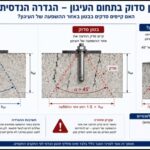
Cracked concrete and anchoring: frequently asked questions
12 בJuly 2026Epoxy Adhesive for Rebar Dowels: The Perfect Solution for Anchoring in Professional Construction
12 בJuly 2026Cracked concrete and anchoring: frequently asked questions
12 בJuly 2026Common Questions About Crookedly Installed Anchors
Installing anchors in a non-standard way is almost the norm in the field. That is perhaps also why the standards apply such large safety factors to them. But how much should these defects worry us? When can you pass quietly, and when must you fix? Can these cases be prevented, or at least reduced? This article focuses on mechanical anchors — a later article will take up chemical anchoring.
In short
Crooked or shallow installation weakens an anchor mainly in tension — a smaller, shallower concrete cone, a weak hole-next-to-hole zone, and the anchor working in bending rather than tension — and a crooked anchor no longer deforms like its straight neighbours, so they do not share the load together. In shear, the effect depends on position relative to the concrete edge: far from any edge, a crooked anchor has almost no effect. The best defence is design — slotted holes, spread-out anchors, spare holes, using only 75% of the capacity, and welding a crooked anchor to the profile.
1. Which defects are we talking about?
1.1 Installing the anchor at a depth different from that specified
Wedge anchors are sometimes cut off because the contractor probably could not install them to the required depth. The tell-tale signs in the field are short anchors left exposed above the face of the profile, or anchors that stand proud of the concrete because they were driven only part of the way in after the drill met rebar.
1.2 Installation at an angle
A partial installation process without closing to the required torque, in anchors that expand in concrete. This fault is a little special, and we will discuss it separately later. On site the defect is easy to identify: the anchor is visibly not square to the concrete surface, because the hole was drilled at an angle to get around rebar.
2. Why does the worker install incorrectly?
The reason for these installations is that the installer, while drilling in the concrete, hits rebar that they cannot drill through.
They then have two options: to drill at an angle, or to install to a shallower depth. Both cause a non-standard installation.
3. What is the capacity difference between correctly and incorrectly installed anchors?
Tension
In tension, the crooked installation causes 3 main weaknesses:
- The concrete cone is much smaller and also less deep.
- The zone where there is a hole next to a hole is an area of great weakness.
- The anchor works not in tension but in bending.
The problem is not only that the capacity in bending is much lower than in pull-out, but that the anchor does not behave the same as the other, correctly installed anchors. The meaning: the resistance and deformation of the crooked anchor will differ from the sound anchor, and the anchors will not work together.
This is, incidentally, the reason it is forbidden to mix anchors of different types, or even of different diameters. In summary, the contribution a single crookedly installed anchor adds to 3 straight anchors is especially small in pull-out.
Shear
In shear, the situation is quite different. The determining factors are the anchor’s position relative to the concrete edge:
| Scenario | Effect of the crooked installation |
|---|---|
| Anchor near the concrete edge, installed toward the edge | A notable drop in the concrete-edge capacity |
| Anchor near the concrete edge, installed in the opposite direction | A small reduction in the calculated installation depth |
| Anchor far from any edge (steel failure governs) | Almost no effect — capacity identical to a straight anchor (sometimes even higher) |
That is, if the anchors work mainly in shear, and if no anchor was installed toward the edge — there is almost no effect if several anchors are not installed straight.
If the main load applied to the anchors is in pull-out, then depending on the installation angle, between 50% and 100% of the capacity of the crookedly installed anchor should be deducted.
4. How do you reduce the chance the contractor installs crookedly?
Correct design is the best protection. Here are the practical ways to reduce the risk:
- Slotted holes — when there is no shear in the direction of the slot, this lets the contractor move the bit rather than angle it. Note that slotted holes require a wide washer.
- Spreading the anchors in the design — avoid concentrating anchors on the same line as far as possible, to reduce the chance that several anchors land on building rebar.
- Extra holes in the profile — leave the contractor additional options if they hit building rebar while drilling.
- Using only 75% of the capacity — a design that uses a maximum of 75% of the anchors’ approved capacity (per connection failure), to allow the remaining anchors to cover for an anchor that is not installed correctly.
- Avoiding large-diameter anchors — when the governing failure is the concrete cone and not steel failure: the larger the anchor, the more likely it is to hit rebar.
5. What do you do when an anchor is not installed correctly?
When an anchor installed crookedly is already discovered, there are several courses of action to improve the situation:
Welding to the profile
You can weld the anchor to the profile, with or without added steel, to prevent the anchor working in bending. This certainly improves the situation and makes the anchor start working together with the others directly, without a bending stage. However, it does not solve the problems of the installation depth and the reduced concrete cone.
Adding anchors
You can add holes in the profile to attach additional anchors, but you must take into account the minimum distances between anchors and check how much a further anchor near the others will add. And this is regardless of the difficulty of drilling in the field in a profile pressed against concrete.
Adding a profile by welding
You can weld an addition to the existing profile in which we add new anchors.
Additional plates — a no-weld solution
If you do not want welding, and if the existing anchors are threaded and protrude more than 1 cm above the existing profile, you can attach additional plates connected to the protruding anchors. The added plate is fixed to the existing profile together with a further welded anchor, which simply increases the number of anchors actually carrying load. In the fuller version of the detail, two plates are attached to the existing profile, one on each side, with additional anchors to enlarge the bearing area.
Replacing with chemical anchors
If they are concrete screws that are easy to remove, you can replace them with chemical anchors in their place, which will be stronger.
Summary
You can and must fight the phenomenon of crooked anchors through correct design, understanding the danger of the phenomenon, understanding the ways to treat such cases, and understanding the danger of not treating them.
Key points to remember
- A crooked anchor in pull-out — a reduction of 50%–100% of the capacity depending on the angle.
- A crooked anchor in shear, far from an edge — minimal effect on performance.
- Anchors that differ in deformation do not work together — do not mix them.
- Designing to 75% of the capacity provides a “safety cushion” for anchors that will be installed crooked.
- Welding the anchor to the profile allows correct load distribution together with the other anchors.
- In the next article — chemical anchors and the effect of non-standard installation on them.
Sources
- ADIT engineering guidance on mechanical anchor installation defects (depth, angle) and their effect on tension and shear capacity.
- General anchor design principles (concrete cone, edge distance, spacing, safety factors).