

The most common questions on the Web about anchoring to work at height
12 בJuly 2026
Making Sense of Fixings: The Real Difference Between a Plug, a Toggle, an Anchor and a Jumbo
12 בJuly 2026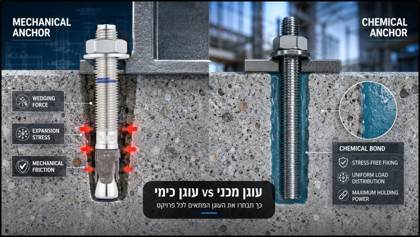
Chemical Anchor or Mechanical? What’s the Difference and Which Is Better?
Construction and renovation sometimes call for especially strong fixings — ones an ordinary bolt and plastic plug simply cannot provide. That is where the two main players come in: the chemical anchor and the mechanical anchor (the one we all know as the “Jumbo”). Here is everything you need to know about the difference, and when each one wins.
In short
A mechanical anchor (the Jumbo) grips by expansion and friction — cheap, available, and loadable the instant it is tightened, but it puts expansion pressure on the substrate. A chemical anchor bonds with a two-part resin — the strongest solution there is, with no internal pressure, better corrosion protection, and the ability to work in hollow block, natural stone and old, crumbling concrete. The mechanical anchor still wins in two clear cases: high temperatures / welding work nearby, and where an immediate load must be applied. For heavy structures, edges, challenging substrates and corrosive outdoor conditions, the chemical anchor is the professional choice.
What is a mechanical anchor (the Jumbo bolt)?
The mechanical anchor works on a principle of expansion and friction. As you drive the bolt in, its metal wings splay out and press against the walls of the hole drilled in the concrete, creating a purely mechanical grip — with no chemical component at all.
- Advantages: available, relatively cheap, and can be loaded immediately once tightening is complete — there is no need to wait for any material to cure.
- Disadvantages: it creates “expansion pressure” on the substrate. Installed too close to the edge of a wall, or in a hollow block, it can crack the concrete or simply fail to grip.
What is a chemical anchor?
A chemical anchor is an advanced fixing method based on a chemical reaction. Instead of relying on physical pressure, a resin (a two-part adhesive) is injected into the drilled hole and the threaded rod is then inserted. The adhesive cures and becomes one unit with the concrete or block.
Why prefer a chemical anchor?
- Unrivalled strength: a chemical anchor is considered the strongest solution available. It can carry far heavier loads than the mechanical anchor, making it the natural choice for peak-load work — steel structures, safety railings, canopies and industrial hangers.
- No internal pressure: because there are no “wings” forced open, a chemical anchor exerts no pressure on the substrate. This allows installation close to the edges of walls or columns without fear of cracking.
- Corrosion protection and a perfect seal: the adhesive fills the entire hole cavity, preventing water and moisture reaching the threaded rod. In effect the resin “wraps” the rod and isolates it from the environment, so the metal itself is protected from corrosion — a significant advantage over a mechanical anchor, where the metal stays exposed inside the hole and, over time, exposed to any moisture that seeps in. For this reason a chemical anchor is the ideal choice for outdoor conditions, salt-laden environments (such as coastal areas) or anywhere corrosion is a real long-term risk.
- Strengthening weak, old or crumbling substrates: while the Jumbo needs firm, uniform concrete for its wings to press against properly, a chemical anchor works excellently in hollow block too (with a mesh sleeve) or in natural stone. A further important advantage: in old, cracked or crumbling concrete, the chemical resin does not just bond to the existing concrete — it also seeps into the existing cracks and actually strengthens and knits the concrete back together around the hole, whereas a mechanical anchor in such a substrate may simply “fail to grip” or keep crumbling the weak concrete around it.
When is a mechanical anchor still the right choice?
For all its advantages, the chemical anchor is not the solution for every situation. There are two areas where the mechanical anchor still clearly wins.
High temperatures and welding work
The chemical resin is fundamentally a polymeric material, and every chemical adhesive has a defined working-temperature range above which it softens and loses strength. A mechanical anchor, by contrast, is metal-only and does not “melt” or weaken in heat — so it is far more suitable for environments exposed to high temperatures. When welding is carried out near the anchor, the sparks and emitted heat can damage the resin of a chemical anchor that has not yet fully cured, or weaken an already-cured resin if the heat is transferred directly to the anchoring zone. In such situations, and generally in any application adjacent to constant heat sources (kilns, furnaces, heat-conducting lines), the mechanical anchor is the safe, preferred choice.
Immediate load availability
- Immediate load: a mechanical anchor carries a full load immediately after tightening. A chemical anchor requires a curing time for the resin — usually minutes to hours, depending on ambient temperature and resin type — before the full load can be applied.
- Simplicity and cost: no thorough cleaning of the hole is needed, no injection gun is required and there is no cost of a resin cartridge — which makes it more economical for simple jobs and large volumes.
Note: cleaning the hole is critical for a chemical anchor
Using a chemical anchor requires thorough cleaning of the hole from dust before injection, to ensure maximum bond between the resin and the concrete. A dusty hole can significantly reduce the bond strength and cause failure even at relatively low loads.
Summary comparison table — chemical anchor vs mechanical anchor
The following table summarises the practical differences between the two solutions, based on the criteria that actually drive anchor choice in the field.
| Criterion | Chemical anchor | Mechanical anchor (Jumbo) |
|---|---|---|
| Maximum loads | Very high — suited to peak loads | Medium-high, but lower than the chemical |
| Load availability | Requires curing time | Immediate, from the end of tightening |
| Proximity to edges / cracking | No internal pressure, suits edge proximity | Creates expansion pressure, risk of cracking |
| Corrosion resistance | Rod isolated and protected from moisture by the resin | Metal more exposed to moisture in the hole |
| Heat / welding resistance | Sensitive to extreme heat and welding sparks | Preferable — metal only, not weakened by heat |
| Weak substrates / old concrete | Strengthens and knits the concrete around the hole | May fail to grip or crumble a weak substrate |
| Installation simplicity and cost | Requires hole cleaning, resin and an injection gun | Available, cheap and simple to install |
The bottom line: which do you choose?
If you are hanging a simple shelf on a solid concrete wall, the Jumbo will do the job. But if you plan to install heavy structures, canopies or safety railings, to work on challenging substrates (such as old, crumbling concrete), or to withstand outdoor conditions with a corrosion risk — the chemical anchor is the most professional and safest choice. Conversely, in environments exposed to high temperatures, near welding work, or where weight must be loaded immediately — the mechanical anchor still holds the advantage.
Remember: using a chemical anchor requires thorough cleaning of the hole from dust before injection, to ensure maximum bonding.
Common questions (FAQ) — chemical anchor vs mechanical anchor
Does a chemical anchor protect against corrosion?
Yes. The resin fills the entire hole cavity and wraps the threaded rod, isolating it from water and moisture ingress. As a result the metal itself is better protected from corrosion over time, compared with a mechanical anchor where the metal stays more exposed inside the hole.
Why is a mechanical anchor preferable for welding work or high temperatures?
A mechanical anchor is metal-only and does not lose strength in heat. A chemical anchor, by contrast, is based on a polymeric resin that can soften or be damaged by exposure to extreme heat or welding sparks, so in such environments a mechanical anchor is preferable.
Which anchor is more suitable for old, crumbling concrete?
The chemical anchor. The resin seeps into the existing cracks in the old concrete and actually strengthens and knits it back together around the hole, whereas a mechanical anchor in such a weak substrate may not grip properly or may keep crumbling the concrete.
Which anchor carries higher loads?
The chemical anchor is considered the strongest solution and can carry heavier loads than a mechanical anchor, which makes it the natural choice for peak-load work.
Can a chemical anchor be loaded immediately?
No. A chemical anchor requires a resin curing time, usually minutes to hours depending on ambient temperature, before the full load can be applied. A mechanical anchor, by contrast, allows immediate loading once tightening is complete.
Is a chemical anchor suitable for installation in a hollow block?
Yes, with a mesh sleeve. While a mechanical anchor needs firm, uniform concrete for its metal wings to press against properly, a chemical anchor works excellently in hollow block and natural stone too.
Sources
- ADIT chemical anchoring systems and mechanical (wedge / Jumbo) anchor technical data.
- General engineering guidance on bonded vs expansion anchors (load, edge distance, curing, temperature).