

Why the Jumbo anchor is the wrong choice in most applications
12 בJuly 2026
Cracked or uncracked concrete? BBA Guidance No. 39
12 בJuly 2026
Several Israeli Standards (SI) define a required safety factor for the design of a chemical anchor or a mechanical anchor. A prominent example is the stone-cladding (curtain-wall) standard, which requires a safety factor of 4 relative to the failure load.
However, because Israel has no dedicated national standards for anchoring, we use the European standard EN 1992-4:2018, which does not work with fixed safety factors but with factors that depend on the failure mode. For example, steel failure in shear requires a far smaller safety factor than pull-out (concrete) failure.
This article explains how to combine the two sets of requirements in a professional and correct way.
Clarifying the terms used in the European standards
The European anchoring standard defines a chain of loads, each one adding a further layer of safety factors:
The Israeli standard works with a single ratio (a factor of 4) between the ultimate failure load and the service load. The European standard splits the safety into several layers according to the failure mode and the load type.
Comparing the capacity of a single anchor with the load applied to it
It is important to stress that the Israeli standard does not enter into the European standard’s calculation method at all — the method that distinguishes between different failure modes and accounts for a 50-year design life, fatigue and other considerations. The Israeli requirement is far simpler: it compares the applied load with the capacity of a single anchor. The required check is therefore direct — take the load applied to the anchor without any safety factor (NSd), take the anchor’s characteristic failure load as a single anchor (FRk) from the technical datasheet, and compare them. If a multiplier of 4 or more is obtained — excellent, and exactly the same in shear. This check stands on its own and is not part of the EN factor system.
The Israeli standard’s requirements relate to the capacity of a single anchor relative to the load applied to it, and not to the design of an anchor group as in the European standards. In practice, compare:
Fu,m (ultimate failure load) — from verified technical data, from standards/approvals, or from a field pull-out test
versus: NSd — the load applied to the anchor without any multipliers
The requirement: Fu,m ≥ 4 × NSd
When only a characteristic failure load appears in the technical data, it can be estimated as follows:
| Load type | Average difference between Fu,m and FRk | Note |
|---|---|---|
| Tension (pull-out) | approx. +20% | Fu,m ≈ 1.20 × FRk |
| Shear | approx. +10% | Fu,m ≈ 1.10 × FRk |
Even if the ratio against the characteristic failure load does not reach exactly 4, remember that the characteristic failure load (FRk) is usually about 20% lower than the ultimate failure load (Fu,m) — i.e. it is conservative to begin with. So even if the ratio is a little below 4 against FRk, the true margin against failure is greater, and field pull-out tests can be used to close the gap and prove the actual capacity.
Calculating the total safety factors under the European standards
The figure given in the approval certificates is always the characteristic failure load (FRk). The safety factor (γM) between FRk and the design load varies according to the failure mode:
| Failure mode | γM factor | Typical average | Note |
|---|---|---|---|
| Anchor / concrete-cone failure | 1.5 – 1.8 | 1.65 | usually pull-out |
| Steel failure | 1.25 – 1.5 | 1.35 | usually shear |
The load factor (γF) between the design load and the service load: 1.4 (2/3 permanent load × 1.35, and 1/3 variable load × 1.5).
Total safety factor from the ultimate load down to the service load:
Comparing the SI factor of 4 with a European safety factor
| Failure mode | EN factor (Fu,m to service) | Israeli requirement | Max utilisation of FRd |
|---|---|---|---|
| Tension (concrete / bond failure) | 2.8 | 4 | 75% |
| Shear (steel failure) | 2.35 | 4 | 59% |
The practical conclusion is that the European standard’s factors should not be compared with the required safety factor (4). Instead, compare the applied load directly with the manufacturer’s data for a single anchor, or with on-site pull-out test results.
For anyone who nevertheless wishes to take the European standard’s safety factors into account — those factors (without the difference between the characteristic and ultimate failure loads) range between 2.3 and 2.9.
The factor of 4 must not be inserted into the EN calculation system. The European standard is already precise and conservative in defining the capacity itself (characteristic load, cracked/uncracked concrete, and material factors by failure mode) — precisely so as not to be overly conservative in the safety factors. Multiplying the forces inside the EN calculation, on top of a capacity that is already conservatively defined, means double-counting the safety and adding artificial over-conservatism. The correct approach: apply the factor of 4 to the capacity of a single anchor (Fu,m/FRk) and compare against it — as a separate, independent check. That is the required check.
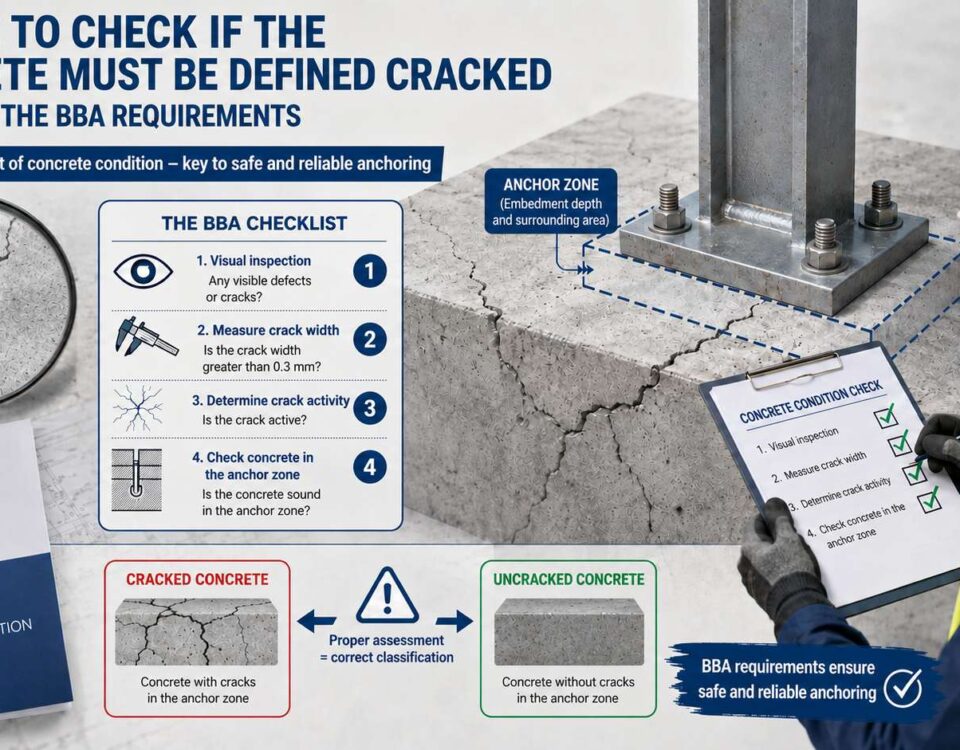
The definition of cracked concrete usually reduces the anchor’s capacity by about 30% relative to uncracked concrete — which is always the actual condition at the moment the anchor is installed. (“Cracked concrete” in anchoring describes a state in which a 0.3 mm crack has developed along the entire length of the anchor — a condition that does not exist in reality at the time of installation.)
So if you take the EN factor in tension — 2.8 (replacing 2.9, since the product is 1.65 × 1.4 × 1.2) — and multiply it by 1.2 (moving up to the ultimate failure load) and by 1.3 (moving up to the capacity in uncracked concrete), you obtain an actual safety factor of about 4.3 — above the required 4.
Why the real factor is above 4
Classifying the concrete as cracked cuts the anchor resistance by roughly 30 percent against uncracked concrete — and uncracked is always the actual state of the concrete at the moment the anchor goes in. “Cracked concrete” in anchor design describes a 0.3 mm crack running the full length of the anchor, a condition that simply does not exist at installation.
Take the European factor in tension, 2.8. Multiply by 1.2 to get from the characteristic load to the ultimate failure load, and by 1.3 to get from cracked to uncracked resistance. The true safety factor comes out at about 4.3 — above the 4 the Israeli standard asks for.
A personal view
Whoever set the factor-of-4 requirement in the Israeli standards probably did not anticipate that designers here would use a conservative European standard for anchor design — and certainly not its assumption that anchors sit in cracked concrete, with the reduced resistance that follows. Designers have a natural tendency to assume cracked concrete for safety, because the boundaries of the definition are unclear, and suppliers push in the same direction, partly for commercial reasons.
What that means in practice is that when the designer declares the concrete cracked, the anchors in most cases hold far more than the design ever asked of them. You can argue about whether that is justified in tension, where poor installation really can cost capacity. Shear is a different matter: the resistance barely depends on the quality of the installation, only on the anchor diameter and the grade of the steel — which is exactly why the European standard asks for a smaller factor there. In that case the demand for a factor of 4 in shear is hard to explain.
Summary
Key points
- Ordinary design under EN 1992-4 yields, in most cases, an actual safety factor greater than 4.
- Compliance with the SI requirement can be verified with a simple check: Fu,m ≥ 4 × NSd.
- In tension — utilising up to 75% of the capacity in the EN calculation is enough to satisfy a factor of 4.
- In steel shear — utilising up to 59% of the capacity in the EN calculation is enough to satisfy a factor of 4.
- Do not embed the factor of 4 inside the EN calculation — check it separately against the capacity of a single anchor, because EN already defines the capacity precisely and conservatively.
Common questions
How do you check compliance with the factor-of-4 requirement without changing the EN calculation?
Compare directly: the ultimate failure load of a single anchor against the load applied to it, with no multipliers on either side. If the ratio is 4 or more you have met the requirement. The check is entirely separate from the EN calculation and does not alter it.
What do you do when the technical data gives only a characteristic failure load?
Estimate the ultimate failure load by adding about 20 percent in tension and about 10 percent in shear. If the result is marginal, an on-site pull-out test is the way to demonstrate the capacity you actually have.
Why not simply multiply the loads by 4 in the design software?
Because that is double counting. The European standard already defines the resistance conservatively: a characteristic rather than a mean load, a reduction for cracked concrete, and material factors by failure mode. Multiplying again on top of that produces artificial conservatism and expensive design with no engineering justification.