

Signage Required Under EN 365 for an EN 795 Work-at-Height Anchor Point
12 בJuly 2026
Hanging a cabinet on a block wall: which plugs, and how
12 בJuly 2026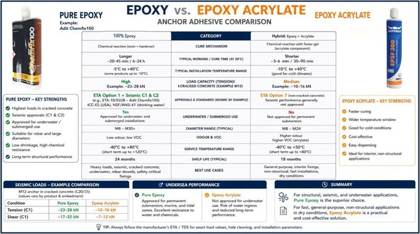
A Dangerous Deception in the Adhesive Market: Selling Epoxy-Acrylate as Epoxy
Epoxy-based adhesives and epoxy-acrylate adhesives are among the most common materials for anchoring dowels (chemical anchors) in concrete. Despite the similarity in use, there are fundamental differences between them — in chemical composition, and in physical and performance properties. Marketing an epoxy-acrylate under the “epoxy” name hides a very real gap in structural capacity.
In short
A pure epoxy (such as ADIT CHEMFIX100) forms a very dense, three-dimensional crosslinked network with strong covalent bonds and near-zero shrinkage — the highest bond strength on the market. An epoxy-acrylate (such as ELRAM V200), despite carrying “epoxy” in its name, cures by free-radical polymerisation, forms a much less dense structure and shrinks more. The official failure-load data is unequivocal: the epoxy-acrylate performs almost identically to (and in large diameters even below) a basic, cheap polyester (ADIT CT50Pro), while the pure epoxy shows double the capacity or more across all diameters.
Structure and chemical composition: epoxy vs epoxy-acrylate
Epoxy adhesive (such as ADIT CHEMFIX100)
Epoxy adhesive is based on epoxy resins, usually bisphenol-A or its derivatives, which react with a hardener, typically amines. During the reaction a very dense three-dimensional polymer network (a crosslinked network) is formed, with strong covalent bonds.
- A long, controlled curing reaction (polyaddition).
- Formation of a very rigid structure with a high, maximal bond density.
- Zero sensitivity to shrinkage during curing, which ensures a full grip in the hole.
Epoxy-acrylate adhesive (such as ELRAM V200)
Epoxy-acrylate adhesive is based on acrylate resins combined with epoxy components. The curing mechanism is completely different and works by free-radical polymerisation with an initiator.
- A very fast curing reaction in the field.
- A significantly less dense polymer structure compared with pure epoxy.
- An inherent tendency to shrink during curing, which affects the capacity values.
Physical properties and their effect on rebar-dowel anchoring in non-cracked concrete
Mechanical strength and bond in non-cracked concrete
Pure epoxy: provides the highest bond strength on the market between concrete and steel. Suited to edge loads, heavy structures and critical engineering anchors.
Epoxy-acrylate: shows only medium strength. Despite its misleading name that includes the word “epoxy”, its performance level is far from pure structural epoxy.
Working and curing time
- Pure epoxy: a long, convenient working time that allows easy, deep insertion of threaded rods and dowels with no fear of premature drying in the nozzle.
- Epoxy-acrylate: cures at high speed — a property that shortens waiting times but demands very fast work in the field.
Shrinkage and thermal resistance
- Pure epoxy: a near-zero shrinkage percentage. This property prevents the formation of micro-cracks between the adhesive and the walls of the non-cracked concrete and ensures the anchor’s integrity is maintained for decades.
- Epoxy-acrylate: has a markedly higher shrinkage percentage, which reduces the static grip capacity and places it closer to the characteristics of the polyester family.
Practical comparison in non-cracked concrete: CHEMFIX100 vs ELRAM V200 vs CT50Pro
To understand the engineering meaning of this data, we compare the load performance of three adhesives representing three different chemical technologies: pure epoxy, epoxy-acrylate, and polyester. Note that ADIT CT50Pro is a pure polyester (PESF) and not an epoxy.
Analysis of the findings: epoxy-acrylate is far closer to polyester than to epoxy
From examining the official technical data for characteristic failure loads (NRk) in non-cracked concrete, one fact is unequivocal: the performance of the epoxy-acrylate (ELRAM V200) is almost identical to — and in some cases even lower than — that of the basic, cheap polyester (ADIT CT50Pro). Against both, the pure epoxy (ADIT CHEMFIX100) shows an absolute superiority with double the capacity values and more across all diameters.
Table 1: characteristic pull-out failure load (NRk) in non-cracked C20/25 concrete (kN)
The values are shown for grade 5.8 steel threaded rods (ATR 5.8) at standard installation depth (STD):
| Rod diameter (ATR 5.8) | ADIT CT50Pro (polyester) | ELRAM V200 (epoxy-acrylate) | ADIT CHEMFIX100 (pure epoxy) |
|---|---|---|---|
| M10 | 23.2 kN | 26.86 kN | 46.4 kN |
| M12 | 33.7 kN | 39.40 kN | 67.4 kN |
| M16 | 62.8 kN | 57.91 kN | 125.6 kN |
| M20 | 98.0 kN | 90.79 kN | 196.0 kN |
| M24 | 141.2 kN | 126.67 kN | 282.5 kN |
A look at the table shows that in the large diameters (M16 and up), the simple polyester (CT50Pro) even overtakes the epoxy-acrylate (ELRAM V200). The distance between them and the CHEMFIX100 proves that the V200 behaves in engineering terms like an improved polyester, not a true epoxy.
Table 2: characteristic shear failure load (VRk) in non-cracked concrete (kN)
For shear loads without the effect of close edge distances in non-cracked concrete, the most common failure mode is defined as steel failure of the rod itself. Since all three adhesives can bring the steel to its full capacity in these conditions, the characteristic shear values are completely identical and derive directly from the steel rod diameter (ATR 5.8):
| Rod diameter (ATR 5.8) | ADIT CT50Pro (polyester) | ELRAM V200 (epoxy-acrylate) | ADIT CHEMFIX100 (pure epoxy) |
|---|---|---|---|
| M10 | 15.0 kN | 15.0 kN | 15.0 kN |
| M12 | 21.0 kN | 21.0 kN | 21.0 kN |
| M16 | 39.0 kN | 39.0 kN | 39.0 kN |
| M20 | 61.0 kN | 61.0 kN | 61.0 kN |
| M24 | 88.0 kN | 88.0 kN | 88.0 kN |
Summary of engineering recommendations for non-cracked concrete
The choice between the three materials in non-cracked concrete should be made from calculated professional and economic considerations:
- ADIT CHEMFIX100 (pure epoxy): for cases requiring a maximum safety margin, especially heavy pull-out loads, or where there are difficult thermal and environmental stresses in the structure. It offers an unrivalled solution.
- ADIT CT50Pro (polyester): the most cost-effective solution for standard applications in non-cracked concrete. As proven in the data, it provides excellent capacities that sometimes even exceed the epoxy-acrylate in large diameters, at a far lower cost.
- ELRAM V200 (epoxy-acrylate): a fast-curing intermediate solution, but in engineering terms of pull-out loads in non-cracked concrete, remember that it is close in performance to polyester and is not a substitute for pure structural epoxy.
Sources
- ADIT CHEMFIX100 (pure epoxy) and CT50Pro (polyester) ETA characteristic-load data.
- ELRAM V200 (epoxy-acrylate) technical data sheet.