

Wedge anchor or concrete screw: which should you use, and when?
12 בJuly 2026
Combining the Israeli safety-factor requirement with European anchor design
12 בJuly 2026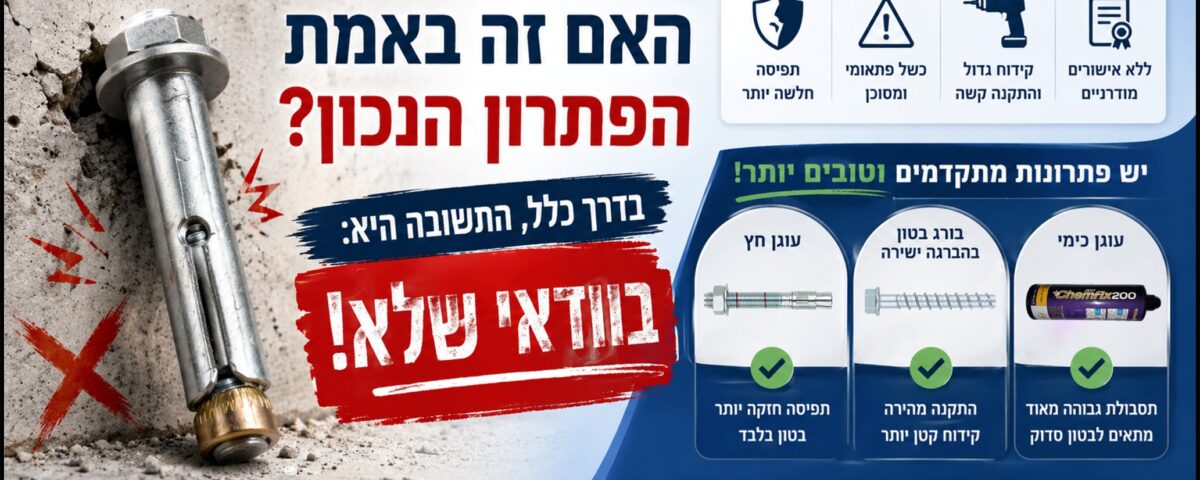
Why the Jumbo Anchor Is the Wrong Choice in Most Applications
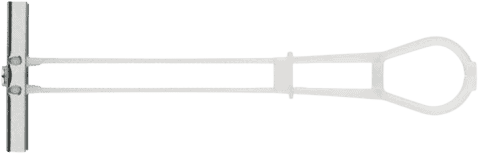
Most small contractors and renovators in Israel reach for the Jumbo (bulky sleeve) anchor by default — out of habit, and out of conservatism. In simple cases it does the basic job. But on almost every engineering and economic measure, better options exist.
Stop for a moment and look at it from an engineering, professional and economic standpoint, and three questions decide the matter. Is the Jumbo the best solution? Is it the cheapest? Is it the easiest to install? On all three the answer is an unequivocal no.
Why the Jumbo fails modern standards
Jumbo anchors rest on an old technology: a thin sheet-metal sleeve that opens inside the hole. They hold no modern engineering approval — no European ETA — they concentrate very high stresses in the base material, and they are prone to sudden, dangerous pull-out failure, particularly in cracked concrete or under dynamic load.
Is the Jumbo the easiest to install? No
The installation is in fact fairly cumbersome. It needs a large hole in the concrete — 12 mm at minimum — a hammer to drive the sleeve in by force, and a long manual tightening of the nut with a spanner. And there is a further drawback that matters on site: if you have put it in the wrong place, it is difficult and sometimes impossible to get it back out of the wall.
A modern concrete screw, by contrast, needs a far smaller hole — 6.5 mm — drives into the concrete in about two seconds of direct screwing with an impact driver, and carries an advantage the Jumbo cannot match: it can be reversed out easily and re-used.
Jumbo versus the modern alternatives
| Anchor type | Hole in concrete | Pull-out capacity | Hollow blocks? | Verdict |
|---|---|---|---|---|
| Jumbo anchor (half-inch, 12.5 mm) | Very large (12 mm) | Low for its size | Unsuitable, even dangerous | Outdated |
| Wedge anchor (8 mm) | Medium (8 mm) | 2-3 times a Jumbo | Concrete only | Recommended for concrete |
| Concrete screw (7.5 mm) | Very small (6.5 mm) | Equal to or higher than a half-inch Jumbo | Depends on the wall | Recommended, fully removable |
| Structural nylon plug | Varies with the plug | Much higher in hollow blocks | Yes | Best for blocks |
What the alternatives give you
On a concrete wall, a quality wedge anchor costs the same and is no harder to install, yet holds two to three times the load. It can be used in a far smaller diameter because its steel is of a higher grade, with significantly higher shear and pull-out values: an 8 mm wedge anchor is equivalent to — and even stronger than — a bulky half-inch (12.5 mm) Jumbo. It is simply hammered in and tightened quickly. A 7.5 mm concrete screw holds exactly the same loads as a half-inch Jumbo, needs a much smaller borehole, and generates no internal splitting stresses in the concrete. And in a block wall the Jumbo is a real danger: it is thoroughly unsuited to blocks — especially hollow block — and holds very low loads, if any, because it simply breaks the internal walls of the block as it expands. A structural nylon plug holds far higher loads there, costs less, is the easiest and simplest of all to install, and is completely safe.
Is the Jumbo the cheapest solution? No
It may look cheap as a single purchase on the shelf, but relative to its load capacity it is the most expensive option of all. Once you add the cost of labour, the long drilling time, the wear on drill bits caused by the large holes it needs, and the fact that a very thick Jumbo is required to match the performance of a thin wedge anchor or concrete screw, the modern alternatives come out cheaper — a 7.5 mm concrete screw drives into concrete in about two seconds with an impact driver, and can be unscrewed and reused.
So why do people keep using it?
In our analysis at Adit, the answer is not a professional one but a psychological one: a lack of technological awareness, old habits, and conservatism in the construction industry — or simply that the Jumbo is the most common product, sitting on the front shelf of the local builders’ merchant.
Installing the modern alternatives correctly
If you move to concrete screws or wedge anchors, follow three golden rules for a safe structural installation:
- Drill accurately. Drill only to the exact diameter specified by the manufacturer (for example, a 6.5 mm hole for a 7.5 mm concrete screw), and keep the hole perpendicular to the wall.
- Clean the hole thoroughly. A critical stage, and one that is often forgotten. Clear the drilling dust with a dedicated pump or blower — dust left in the hole can jam the screw or cause a sudden pull-out failure.
- Tighten to a controlled torque. With a concrete screw, drive with an impact driver until the head is fully seated against the fixture; with a wedge anchor, tighten with a torque wrench to the manufacturer’s figure so the expansion ring opens fully.
Common questions
Can a wedge anchor be used in Ytong or hollow blocks?
Absolutely not. A wedge anchor, like the Jumbo, is a mechanical anchor working on friction and expansion pressure. It is intended for solid concrete only, reinforced or unreinforced. Used in blocks it will break the block apart and fail immediately. Blocks need purpose-made nylon anchors.
Is there any case where the Jumbo still has an advantage?
In current engineering practice, almost none. Concrete screws, wedge anchors and chemical anchors offer better performance, faster installation and considerably greater safety on every parameter.
We hope this gives you engineering and economic food for thought before your next purchase. It is time to move on to a field full of advanced anchoring options and technologies — ones that make the work on site easier, save you time and money, and give you far stronger, safer connections along with peace of mind.