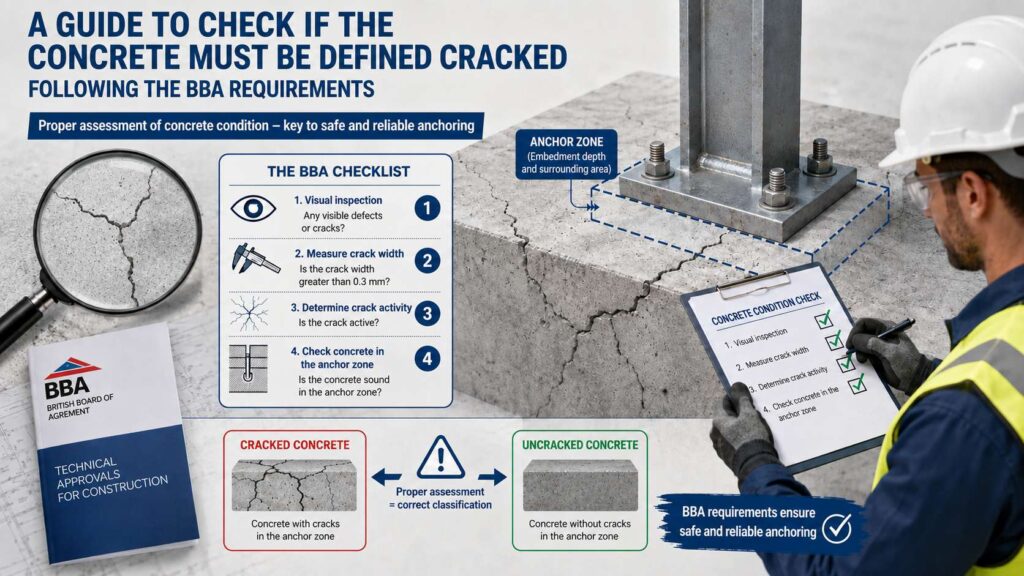


What is a chemical anchor, and what types are there?
12 בJuly 2026
Why the Jumbo anchor is the wrong choice in most applications
12 בJuly 2026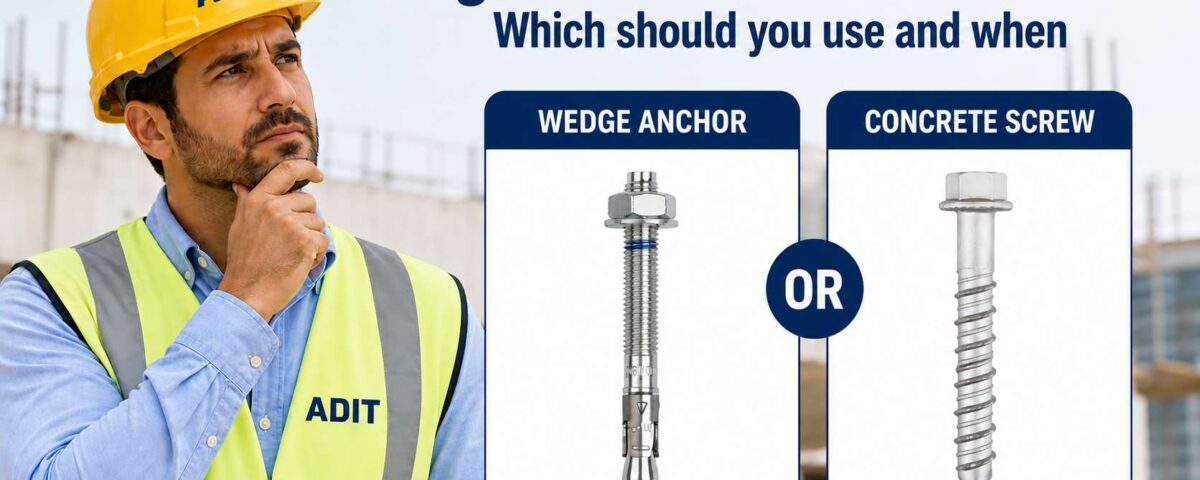
Wedge Anchor or Concrete Screw: Which Should You Use, and When?
Mechanical anchors are a critical component in structural engineering, infrastructure and building safety. This is a comparative engineering look at the two principal solutions: the MTP-X wedge anchor, designed for cracked concrete and seismic loads, and the direct-threaded concrete screw. Understanding how each anchor works, and how it behaves under different loads, is essential to choosing the right fixing for the requirements of the European standard (Eurocode) and for the conditions on site.
How each anchor works
The MTP-X wedge anchor
A wedge anchor grips through expansion clips forced against the wall of the borehole, producing a single, very strong grip point based on concentrated compression and friction. The MTP-X was designed specifically for cracked concrete and is approved for applications demanding high seismic resistance (categories C1 and C2). Its follow-up (secondary) expansion mechanism lets the clips keep expanding as a crack opens, so the anchor maintains its grip and its performance under seismic action.
The direct-threaded concrete screw
A concrete screw is driven directly into a pre-drilled hole whose diameter matches the core of the screw — with no expansion clips and no chemical compound. It is installed with a hand wrench or an impact driver, and the sharp thread cuts a matching thread into the concrete itself. Unlike the wedge anchor, it grips at many points distributed along the whole depth of the thread, so the stresses are spread evenly rather than concentrated at a single point.
Engineering comparison
The engineering and operational parameters, brought together for a direct comparison between the two anchoring methods:
| Parameter | Wedge anchor (MTP-X) | Concrete screw |
|---|---|---|
| Stress distribution | Concentrated at the grip point (high local pressure) | Distributed along the whole thread |
| Installation close to an edge | Limited; the concentrated stress can drive an edge (splitting) failure | Excellent; reduced risk of edge failure, which suits railings and profiles fixed at the edge of an element |
| Speed and ease of installation | More involved — the anchor has to be set with a hammer and then tightened to a controlled, accurate torque | Very fast and easy with an impact driver, which is what site crews prefer |
| Small vibrations and out-of-flat surfaces | Excellent; the clamping force of the nut pulls the element tight against the wall and absorbs movement where the surfaces are not true | Less suited to preventing small movements on surfaces that were never flat to begin with |
| Dynamic / seismic (earthquake) | Category leader; stringent ETA for cracked concrete and seismic | Excellent; pull-out raises friction along the thread and increases dynamic resistance |
| Blast loads | Weak — holds roughly 40% less than under static load | Ideal — an excellent energy absorber, via controlled slip and gradual energy absorption |
| Reuse / temporary removal | Permanent; cannot be removed or reused once expanded | Can be unscrewed, fully withdrawn and reused |
| Relative cost (same diameter) | Significantly more economical | Higher unit cost |
Behaviour under dynamic, seismic and blast loading
Where high-energy vibration, accidental loading, seismic events or unusual blast pressures are involved, it is the character of the anchor’s response that decides whether the system survives.
Under blast loading a concrete screw behaves as an outstanding energy absorber, and is the right solution for these situations. When the pressure wave arrives, the screw’s natural way of dealing with extreme pull-out forces is a gradual, controlled slip along the thread path it has cut into the concrete. That slip absorbs critical energy without leading to rapid structural failure.
A wedge anchor does not perform well under sharp impact loads such as an explosion. Its localised mechanical expansion mechanism tends to reach a sudden, abrupt failure threshold, and the engineering data show it holding roughly 40% less under blast loading than under static loading.
Quality of the concrete substrate
Concrete that is weak but not friable. Standard wedge anchors are inherently difficult to install here: the expansion ring depends on initial friction against the wall of the hole, and weak concrete can crush locally and prevent the wings from opening. A concrete screw, by contrast, cuts its own permanent internal thread, which does not rely on that initial friction.
Concrete that is friable or crumbling. Neither mechanical mechanism — wedge or screw — is safe to use. In these cases you must move to a chemical anchoring solution, an injection resin, to guarantee the integrity of the substrate and continuous load transfer.
When to choose the concrete screw
Choose the concrete screw where splitting is a risk (close to edges or at tight spacing), when working with concrete of weak or unknown quality, for temporary or reusable fixings, and for security or engineering applications that need an ideal energy absorber against blast loads. In weak-but-sound concrete it is often the safer bet, because it does not depend on the initial friction of an expansion ring against the borehole wall.
When to choose the MTP-X wedge anchor
Choose the MTP-X when the application is entirely permanent, installed in sound concrete (cracked or uncracked), and maximum resistance is required under stringent seismic standards — thanks to the follow-up expansion mechanism that compensates for cracks as they open. It is also the preferred solution where a strong clamping force is needed to pull a steel element tight against a wall that is not perfectly flat, and to damp small cyclic vibrations, as in stair structures or machine frames.